CK5
Register an account today to become a member! Once signed in, you'll be able to participate on this site by adding your own topics and posts, as well as connect with other members.

64" rear swap

not at all... you have more composure than i do.. I certainly don't appreciate being spoken to in a condescending way...
 
rdn2blazer what did you use to paint the frame and brackets? Looks really good! :bow:

Sorry for the hijack


Thanks, it looks good but it's crap paint. Krylon hammertone paint. I took it to bare steel, primered with good self etching paint, then sanded and put a good four coats on. Took forever to harden up. Now it chips like glass. Going to pull the body and paint the frame properly.
 
If I come across as being a dick or something I promise it's unintentional, just trying to discuss this :thumb:

Me too :thumb:

I did watch the video. Stress/strain are related to how a material deforms under a load. That would be related to, say, the spring actually breaking. When we're talking about axle wrap, we're talking about moments, or how torque is involved in this.

He specifically notes the length of the spring reducing spring wrap in the video ;)

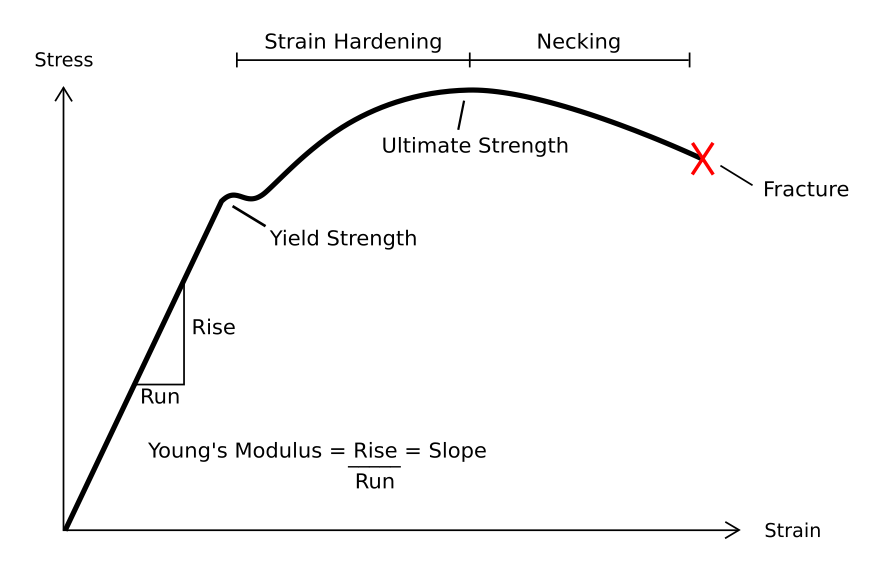
The breaking of the spring would be the tensile point of a stress/strain plot. We are talking about the elastic (temporary) deformation of a material (in this case, a "spring"). A stress/strain plot has a linear portion which is the elastic deformation until you reach the yield point (were elastic ends and plastic begins). This goes back the my explanation of the components of stress.

Spring wrap is deformation of the spring by definition. I know Wikipedia is academically a poor reference, but for the sake of an interweb forum argument, that's all the effort I'm going to put into finding a source :)
In materials science, deformation is a change in the shape or size of an object due to an applied force. This can be a result of tensile (pulling) forces, compressive (pushing) forces, shear, bending or torsion (twisting). Deformation is often described as strain.
515px-Stress-strain1.svg.png

Stress_Strain_Ductile_Material.png

I've got to go to homework and study but those diagrams complement my explanations pretty well. Actually, the paragraph that I read in about 12 seconds on Wiki seems to be pretty useful for this discussion along with this just being good knowledge for us 4x4-modifying-guys.
http://en.wikipedia.org/wiki/Deformation_(engineering)

not at all... you have more composure than i do.. I certainly don't appreciate being spoken to in a condescending way...
I'm sorry if I came across as being disrespectful to you, although I would argue that you started it :P
Taking offense to someone on a forum that you've never met is a little overboard. I'm a pretty go-easy but opinionated guy in person. I understand how you could be offended but come on, there's no way to convey tone here. Let's all try to give each-other the benefit of the doubt and assume that we are all involved in a discussion with some friendly ribbing.
 
The breaking of the spring would be the tensile point of a stress/strain plot. We are talking about the elastic (temporary) deformation of a material (in this case, a "spring"). A stress/strain plot has a linear portion which is the elastic deformation until you reach the yield point (were elastic ends and plastic begins). This goes back the my explanation of the components of stress.

Spring wrap is deformation of the spring by definition. I know Wikipedia is academically a poor reference, but for the sake of an interweb forum argument, that's all the effort I'm going to put into finding a source :)

515px-Stress-strain1.svg.png

Stress_Strain_Ductile_Material.png


You're still missing what I'm saying. Stress/strain stuff is used to model if a component will fail from forces imposed upon it.

Spring wrap is deflection of the spring due to a moment, which is based on a lever arm.

I'm not saying 64's will fail in shear. I'm saying they will deflect more than 52's under torque because the spring is longer and hence the moment is larger. More deflection is exactly what spring wrap is.

There is more to this than just stress/strain and nobody here is saying that the springs will snap because they're too long.
 
seems pretty simple to me.... the axle rotating is trying to create a bend point, between the center pin and spring eye.... all things being equal, other than length, the longer one has a much easier task of making that bend point than the shorter one..
 
Theres a big difference between Knowledge and Wisdom. Just cuz the books say what it "should" do does not mean thats what it will do in real world situations.

I'm not an engineer but I do work with them on a regular basis , nice guys but theres a big difference between the drafting table and what works out in the field .

I did the 64" on my k10 I used K3500 springs WITH all the over loads a stock low mile spring pack. I replaced wore out busted down old 52" springs . My spring wrap went from virtually non-existent to extreme and violent.
 
I put 64's from a new duramax on my burb have the over load still in them have yet to have a problem with axle wrap at all.

Scott put the same springs in his four door with out the overload, had to build a traction bar cuz his pinion was rotating tremendously.
 
Seems to me like the longer, flatter springs would be easier to send into an "S" shape than shorter ones with more arch.
 
It appears to me that the detonation of the atoms would coagulate the neutrons in the spring. Hence the need for bucket seats versus a bench. That is all. :D
 
Stress/strain stuff is used to model if a component will fail from forces imposed upon it.

Stress/Strain functions are used to measure an object/material's deformation due to a force. In this case, we are discussing the linear (elastic; i.e. spring) portion of the plot before the yield point of the material.

Spring wrap is deflection of the spring due to a moment, which is based on a lever arm.
Where stress is a component of that product. Again, stress is force per unit area, and a longer spring is spreading the same force over a larger denominator (area), therefore reducing the value of w in the Euler-Bernoulli equation, therefore reducing the value of u (the deflection of the beam).

More deflection is exactly what spring wrap is.
And deflection is calculated using stress, which is the quotient of force (constant) and cross-sectional area.


There is more to this than just stress/strain and nobody here is saying that the springs will snap because they're too long.
We have not discussed tensile strength at all. We are only discussing up to the yield point (elastic deformation...wrap). Deformation of a beam is very simple to calculate and I have not mentioned anything about tensile strength. This is absolutely a discussion about strain. Strain by definition is what we are talking about.

Theres a big difference between Knowledge and Wisdom. Just cuz the books say what it "should" do does not mean thats what it will do in real world situations.

I'm not an engineer but I do work with them on a regular basis , nice guys but theres a big difference between the drafting table and what works out in the field .

I did the 64" on my k10 I used K3500 springs WITH all the over loads a stock low mile spring pack. I replaced wore out busted down old 52" springs . My spring wrap went from virtually non-existent to extreme and violent.

I have also worked under engineers my entire life. I'm a third generation construction worker in Anchorage. I am getting an engineering degree so that I will get paid more for my real-world experience with construction and mechanics. I started working on, modifying, and driving my own rigs in 1991. I have much more real-world experience with this stuff than I have education from a university.

However, I know of zero testing that has been done to give someone "experience" with this and eliminate other variables that would skew their results. Except, that I bet ya that Ford (along with other manufacturers...paid any attention to the increasing length of leaf springs in modern diesel trucks???) probably has run a lot of these kinds of tests:
http://www.youtube.com/watch?v=VGvwlI4YMQs&feature=player_embedded#

Has anyone actually watched this video? It's lost to me how you can watch this and not be completely clear that as spring length increases, wrap decreases. At 21 seconds in to the video:
For 2008, all Ford pickup truck leaf springs grew 8" longer. Which now we are the longest spring in the segment. Why is that important? The windup stiffness of the leaf spring increases as the square of it's length.
There's still an argument here? Really?

Ok, so you guys don't know me or my real-world experience level. One of you disputes my materials and mechanical engineering capabilities. Are you guys really too stubborn to listen to a major truck manufacturer? Do you think they are totally bogus in their ideas and completely off on a tangent?

Remember to add that the greater the length from the axle centerline to the frame bushing of the leaf, the greater the resistance to spring wrap. It's resistance to "S-ing" increases as its length increases.


EG: 32" half length (F-150 in reverse) wraps less than a 22.5" half length (YJ) given the same leaf thickness.

http://www.pirate4x4.com/forum/showthread.php?t=846526
Refer to post #8. Apparently I am not the only person in the wheeling world making exactly the same argument.
 
Last edited:
My eyes are rolling into the back of my head with this discussing guys!WAY WAY too much thought into this. Bolt it up, run it, if it breaks or don't work like ya want it to fix it, period, DONE :D. See, it's that simple. You guys are trying to make it sould like rocket science. Remember trucks are what red neck hillbillies play with. It's not the Space Shuttle. :haha:I work on stuff that goes into space, trust me, I know.
 
Last edited:
you keep saying it's spreading the force over a larger area... your wrong... it's giving the force an easier chance to bend the leaf due to the length....read that short last post i wrote, and explain how thats wrong.....

don't be offended but you keep talking about how great engineers are and pointing out what McBean said in the video at .21, etc is gospel..... your not swaying me in the least,


pssssst, 1/2 the engineers I've ever met where complete common senseless idiots... I work in the marine biz, and they are the bane of my existence 1/2 the time....
 
ha ha ha ha ha:D:D This went from a "how-to" to a pee-pee measuring contest with an architect's scale, and everybody is trying to use a different side of the scale to measure with.:doah::haha:
 
Say what you want dude its not that big a deal, But I bet that at least 50% of those of us that have done the swap have had some sort of axle wrap issues . So Academics aside, my REAL world actual experience with the subject matter tells me what I need to know . My trucks axle wraps bad under hard acceleration. bad enough that I broke the U-joint and sent my d-shaft into low earth orbit on my test ride. My shackle angle is 40 degress with a 7" shackle .

My truck has a Built 377 small block I'd conservatively rate around 375 HP Running through a NV4500/NV241 back to a SF 14 bolt with 4.56's turning 37" MTR's
 
Say what you want dude its not that big a deal, But I bet that at least 50% of those of us that have done the swap have had some sort of axle wrap issues . So Academics aside, my REAL world actual experience with the subject matter tells me what I need to know . My trucks axle wraps bad under hard acceleration. bad enough that I broke the U-joint and sent my d-shaft into low earth orbit on my test ride. My shackle angle is 40 degress with a 7" shackle .

My truck has a Built 377 small block I'd conservatively rate around 375 HP Running through a NV4500/NV241 back to a SF 14 bolt with 4.56's turning 37" MTR's
 
actually, I'm gonna apologize for mucking up a "How to" thread and bow out....
 
Top Bottom