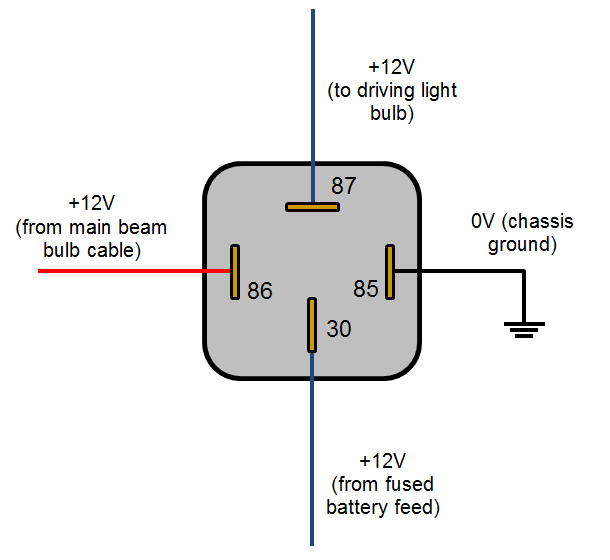
That's a single headlight diagram, we're going for four, right? Three pins are high/low beam. Two pins are high only.
Use the voltmeter as a guide, forget any schematic that says "typical". Generally they are ok, generally doesn't work when you are dealing with an electrical problem. That's why GM didn't put out service and electrical manuals covering "model years 1981-1987".

Sorry, "typical" screams Haynes, and while they may be ok sometimes, they are not when you are knee deep in wiring. Rant over. The only thing you care about is making sure you are working with headlight wiring only (not marker/turn signal) and that you know which wire is high beam and which is low coming off the switch.
Low and high aren't on at the same time...when switched to high beam tan should NOT have voltage, since it's low. The headlights should only be getting power to the proper pin when the headlight dimmer is in the proper position...using that schematic to demonstrate, 12V to tan when in low, 12V to lt green when on high.
All your relays are doing is taking the load off the headlight switch (along with perhaps increasing load capacity of the wiring to the headlights). 12V from battery to the relay, should be 12V out to the headlight when that relay closes. Wire color is irrelevant when modifying factory wiring, the position of the wire on the relay is.
You using a relay somewhat like this?
In your case, again using the "typical" diagram, assuming low beam setting. 86 would be the tan wire as it comes off the headlight switch. 30 probably comes from the battery. 87 goes to the low pin on the headlight. 85 obviously just goes to ground. The GM oval relays if used, have five terminals, but same basic idea. I'm *assuming* the layout of relays is some sort of standard.