CK5
Register an account today to become a member! Once signed in, you'll be able to participate on this site by adding your own topics and posts, as well as connect with other members.

ACR dual battery questions

mrk5

The Sticker Guy
Moderator
Vendor
GMOTM Winner
Author
Joined
Apr 20, 2004
Posts
26,978
Reaction score
27,311
Location
Northern Colorado
I have been running 2 batteries in parallel just straight wired together. I'm planning to move 1 battery to the bed and I don't want to keep them wired straight parallel to save me needing to purchase a long length of large battery cable. I was looking at using a ACR (automatic charging relay) but my concern is winching and the large electrical draw. The ACR is only rated for 120 amps.

If I'm winching, it's going to draw up to 450 amps. With the winch connected to the engine bay battery, would it be pulling more than 120 amps thru the ACR from the rear battery? Or would it only draw on the nearest battery?
 
I haven’t installed my acr relay yet but the 150 amp continuous duty solenoid hasn’t flinched when I’ve winched with mine.

I fully understand a solenoid is probably more robust than a solid state relay so it may not be an apples to apples comparison.

The thing you don’t expect is if the acr relay drops below it’s set voltage it’s going to open the relay anyway and not allow the current to flow from the second battery. I can’t remember what my cyrix acr is set to but memory says it was like 13.1v and it would open and disconnect the two batteries.

I’m ok with that action in my case because the winch leads are connected to my aux battery. Which it is a bigger dee cycle unit that handles the deep discharge rate of the winch and camper loads better than the cranking battery. The only thing I’m not sure of is if the acr could take the initial high amp discharge of the winch before the relay cuts open.

I’d almost get a manual disconnect to put on the cable between the aux battery and the acr if you were concerned about letting the smoke out of it.
 
you'd only be drawing if the combine/parallel trigger is fired...
 
If your main battery falls below 13.5-6 volts while winching or any time the ACR should open and cut off the aux battery from charging system. So if there is no other path to aux from winch your good.

This is like the one I use. I forget whether the 1314 or the 1315 senses only the main battery or both. I think the 1314 only senses the main battery, so I have the 1315.
 
I've done some really heavy pulls with my ACR, and it hasn't tripped during a pull except when my batteries were old and tired. When that happens just combine manually with the switch.

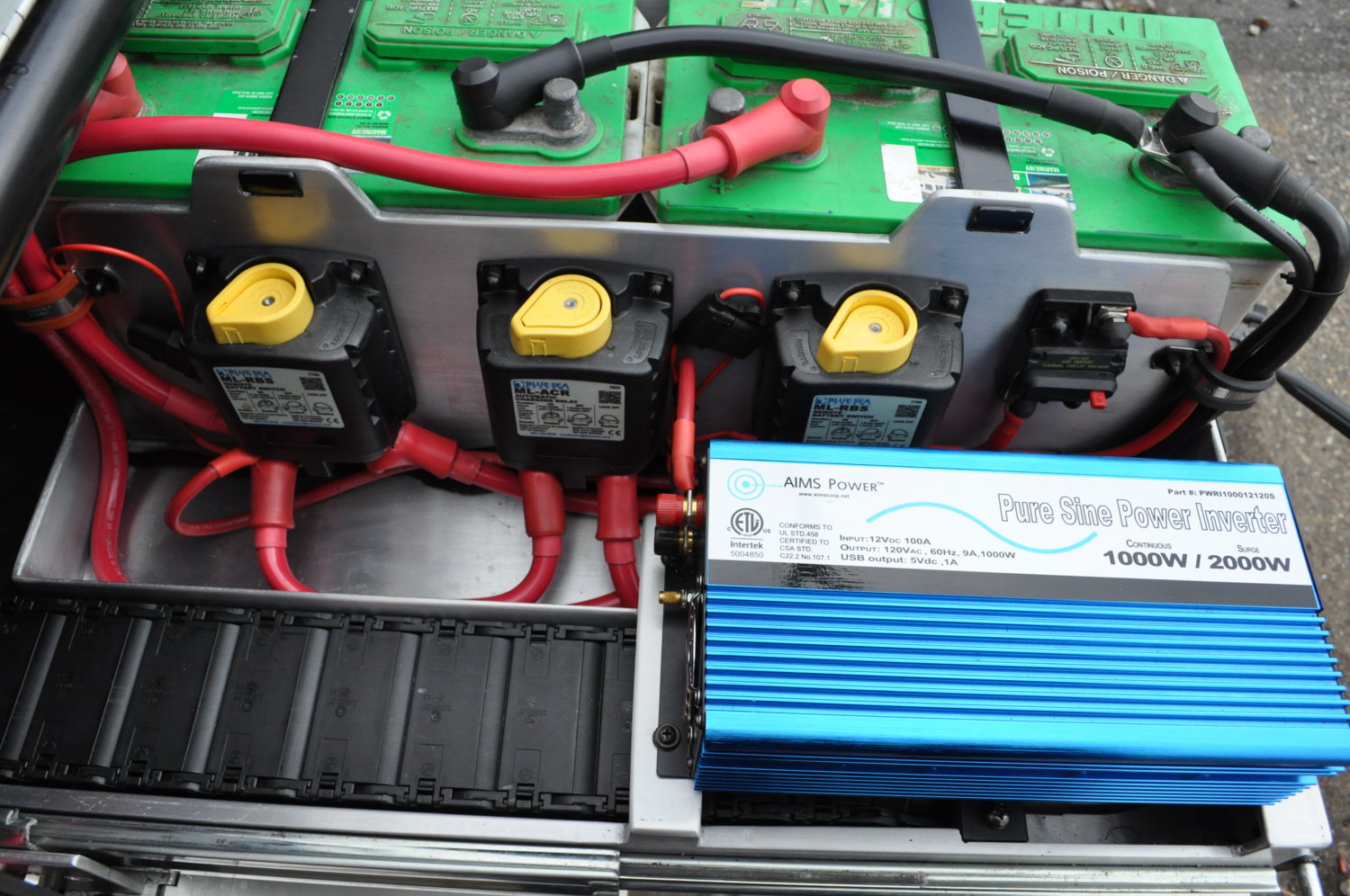
This is the 500amp continuous unit: https://www.bluesea.com/products/category/35/91/Automatic_Charging_Relays/ML-ACRs

This is the one you want. Its a magnetic unit. You can manually control this one too. I can say it's saved my ass overnight from stuff being left on at the campsite. When I find the house or the aux battery dead I've thrown that switch and fired the truck.
 
I’m getting ready to install two batteries as well, in simple terms what’s the acr do? Never heard of one.
 
It senses the voltage on 1 or both batteries. When the battery it monitors is above 13.5 it closes, linking the 2 batteries in parallel, allowing the alternator to charge both. If the monitored battery falls below that voltage it will open and charge only the 1 battery.
 
What's the cost difference between a 120A ACR and a 300-500A one?

I haven't put a voltmeter on the batteries while winching, but it's almost certainly going to turn off an ACR, so you'll be "safe" in that respect (see below). However, instead of worrying about saving the ACR, it's a better plan to try to have both batteries connected for winching. A single battery is typically about 20mOhm, so that loses 2V for every 100A you're drawing. So 300A into the winch, 100A out of the alternator at 12.5V nominal puts you at 8.5V. Now add the second battery and you're at 10.5V, which is 50% more power to the winch. (Yes, these are general numbers just to illustrate the concept.)

Here's another way to look at it. If the combined battery bank is .01Ohm and you draw 120A (in excess of alternator output), you've dropped 1.2V, which should cut the ACR. Actually, the voltage will drop even more than that because the run of wire to the rear battery means the front battery will supply more than half of the current.
 
Or if it monitors both batteries it will connect the two batteries if one is above 13.5. Like having a solar panel feeding the aux battery. The solar could feed both until the demand on the aux battery drops the voltage below the 13.5 value.

Though the idea of running solar on most rigs around here is pretty slim.
 
Or if it monitors both batteries it will connect the two batteries if one is above 13.5. Like having a solar panel feeding the aux battery. The solar could feed both until the demand on the aux battery drops the voltage below the 13.5 value.

Though the idea of running solar on most rigs around here is pretty slim.
My acr monitors both I have 1 of those tiny solar panels you leave on your dash and plug into aux power port. I have the cigar lighter plug main batt, and add 3 port power on aux. After a few days of sun the relay click off and on, I have to unplug the solar panel or switch to other port, few days same result.

I think 120a are smaller relays, contacts. The 200-500a use much bigger solenoid type
 
I run the 500 amp


full
 
What's the cost difference between a 120A ACR and a 300-500A one?

I haven't put a voltmeter on the batteries while winching, but it's almost certainly going to turn off an ACR, so you'll be "safe" in that respect (see below). However, instead of worrying about saving the ACR, it's a better plan to try to have both batteries connected for winching. A single battery is typically about 20mOhm, so that loses 2V for every 100A you're drawing. So 300A into the winch, 100A out of the alternator at 12.5V nominal puts you at 8.5V. Now add the second battery and you're at 10.5V, which is 50% more power to the winch. (Yes, these are general numbers just to illustrate the concept.)

Here's another way to look at it. If the combined battery bank is .01Ohm and you draw 120A (in excess of alternator output), you've dropped 1.2V, which should cut the ACR. Actually, the voltage will drop even more than that because the run of wire to the rear battery means the front battery will supply more than half of the current.
That's one of my big reservations is losing the dual battery power like I've been running.

I was also thinking I have no idea what voltage does with the winch running. I was watching a video this morning with a SXS running a winch and noticed you could see battery voltage. It wasn't pulling super hard, but voltage dropped to around 11v.

Now I'm thinking I should suck it up and buy some 4/0 cable and the bigger ACR so I can run the batteries together.

The spoiler is that I'm doing all of this so I can mount a winch at the back of the truck.
 
Ok, bringing this back up as now the truck is out of storage.

Sorry for my stupidity but I just don't understand how one of these works, I'm sure I'm overthinking it and just cant get it... What is needed to safely charge my 2nd battery and run them together? Bonus points if I can isolate one and use it for "overland" and have a fresh start battery in the morning.
 
Yes what an ACR does.
If you really want to you could do the same thing, but manual. Flip a switch close a relay/solenoid to charge both batteries. Just don't forget to open switch or 2 dead batteries.
 
Yes what an ACR does.
If you really want to you could do the same thing, but manual. Flip a switch close a relay/solenoid to charge both batteries. Just don't forget to open switch or 2 dead batteries.
I would rather have it automatically do it, I bet I would forget.
 
Automatic is the same manual except solid-state controller.
It will monitor the voltage and close or open depending. So when the truck is off it will open. Start truck and main battery charges to 13.5v it closes and charges both batteries. Easy peasy.
Most will a provision to manually connect both batteries together for emergency jump starting. Mine is not wired ATM but I plan on using a momentary push button for that.
 
I would potentially combine for winching too
 
My current setup is a 150 amp continuous duty solenoid. Three way switch. Position one joins both batteries with the ignition on. Middle position kills the solenoid so the batteries can’t be joined. The other position joins the batteries, but the power for the solenoid comes from the aux battery. I’ve typically only used that to self jump the main cranking batter from the aux battery.

The way I have it set up I will typically leave the switch in the first position as it will automatically join the batteries when I turn the key on and separate them when I shut the key off. It’s been that way for a long time and it’s stone cold simple and reliable. Just leave the switch and go. Even if you plan on extended storage let’s say as long as the key is off the batteries are still separated.

The only reason I plan on switching to an acr is for solar. If there is enough power coming in from solar that would be tied directly to the aux battery, the acr would join the batteries to allow the main battery to take charge from the solar. Once the solar input dips below the acr set voltage point the batteries would be separated again.
 
My current setup is a 150 amp continuous duty solenoid. Three way switch. Position one joins both batteries with the ignition on. Middle position kills the solenoid so the batteries can’t be joined. The other position joins the batteries, but the power for the solenoid comes from the aux battery. I’ve typically only used that to self jump the main cranking batter from the aux battery.

The way I have it set up I will typically leave the switch in the first position as it will automatically join the batteries when I turn the key on and separate them when I shut the key off. It’s been that way for a long time and it’s stone cold simple and reliable. Just leave the switch and go. Even if you plan on extended storage let’s say as long as the key is off the batteries are still separated.

The only reason I plan on switching to an acr is for solar. If there is enough power coming in from solar that would be tied directly to the aux battery, the acr would join the batteries to allow the main battery to take charge from the solar. Once the solar input dips below the acr set voltage point the batteries would be separated again.
This is basically what I’m going after, do you run the camper on the aux battery? What kind of switch are you using?
 
Top Bottom