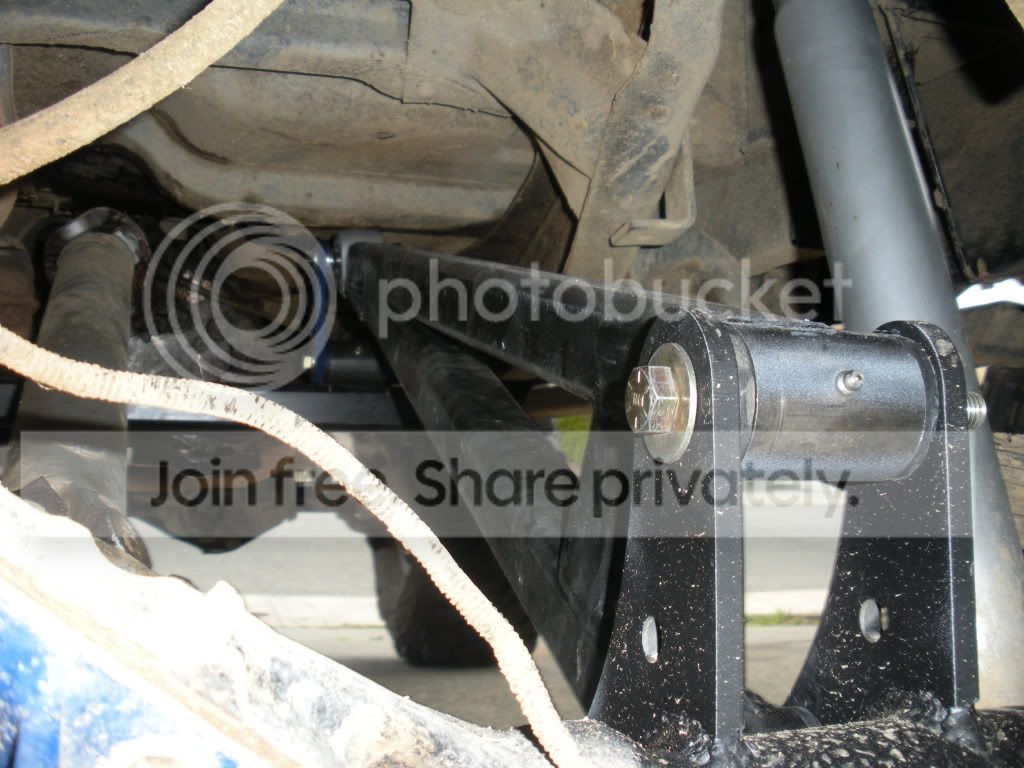
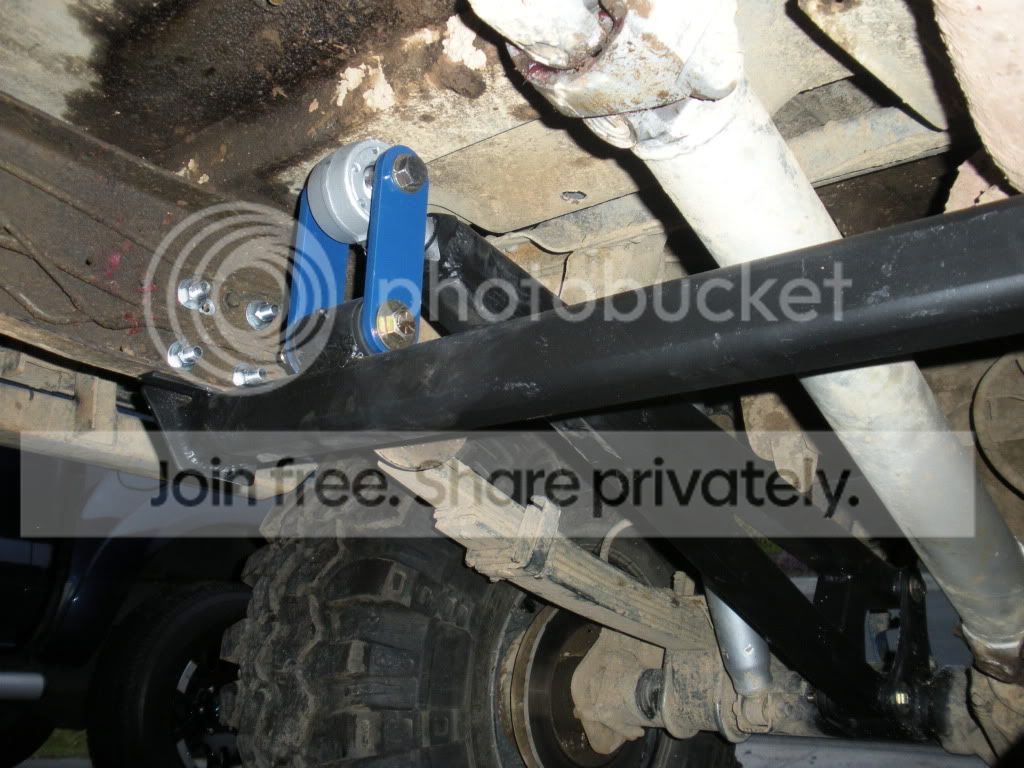
CK5
Register an account today to become a member! Once signed in, you'll be able to participate on this site by adding your own topics and posts, as well as connect with other members.

Adjustable shackle for anti-wrap bar?

Blue85

Yooper
 Premium
GMOTM Winner
Joined
Jul 26, 2000
Posts
16,765
Reaction score
9,780
Location
Keweenaw
It looks like CK5 has a "mainstream" design for preventing spring wrap. That is, a two-tube bar from one axle tube, tying to a cross-member with a shackle. Here is an example from Frizzlefry:
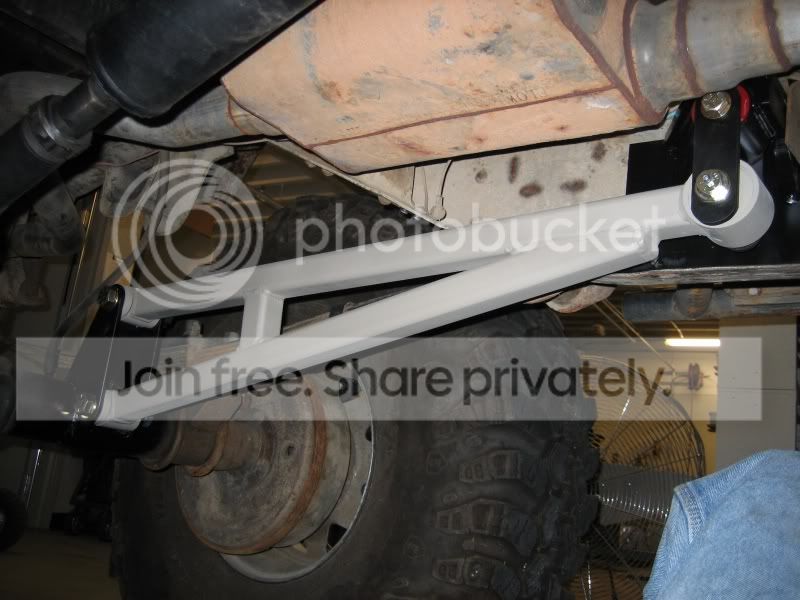
Img_0118.jpg


I'm making plans to build one, but I have a question about ride height. As you load the back of the vehicle, the traction bar will force the pinion angle to change. Is this good or bad? Can a practical build make the geometry work in your favor and keep the angle out of the pinion U-joint as the suspension cycles?

Or should you make the shackle longer with 2 or 3 sets of holes so the height of the bar can be adjusted? You could add a second height for towing or taking the top off, etc.
 
A traction bar of the design shown should not force the pinion angle to change, that's why there is shackle on the end of it to begin with. If a traction bar was forcing a pinion angle change during suspension cycling then it would be binding the springs also.
 
Of course the traction bar is forcing the pinion to a certain angle. That's what it's designed to do. The shackle is there to allow front to rear movement of the axle.

The leaf spring is arched, so as it is compressed, the angle of the pinion changes. The traction bar geometry is different, so it's not possible to make these two motions match exactly. The springs are forced to change shape slightly. This isn't the same thing as the binding you get from a traditional ladder bar, because you aren't asking the spring to change length, just "S" shape slightly. Now if your springs couldn't be forced to do this, you wouldn't be looking to add a traction bar anyway. If you disagree, go out and disconnect the shackle on your traction bar, raise or lower the back of the vehicle and see if the distance between the cross-member and bar end changes.

Maybe it's too small of a detail to worry about, as the design is pretty much proven. The geometry of the bar could be used to keep the pinion angle just how you want it throughout the cycle, but this might not be the ideal amount of anti-squat.
 
Agree 100% with Blue85.

Also, if you want to keep the UJ angle to a minimum, make the bar the same length and height as your driveshaft. However, keep in mind that the length and height of that bar determines your IC, which determines your antisquat. You definitely don't want to make it too short or too high. The longer and lower you can make it without it getting in the way of obstacles or the truck the better you will be, because it will start to look pretty dumb or get in the way before the IC would be too low or too far forward most likely.

Also, no matter where you make it (obviously the frame end will be forward of the front leaf spring eye), the UJ angle throughout it's travel will be better than it was with only leaf springs (assuming you make the UJ angle correct at ride height with the traction bar), so I would set it up for IC more than UJ angle.

I see what you mean on the shackle length adjustability. A lot will have to do with your initial placement of the shackle. Also, rather than make one shackle with 3 sets of holes. If you really want to do that I would probably make 3 different length shackles so when you are done it's cleaner. For the price that Kert charges for shackles it's probably not worth your time unless you have access to a waterjet or laser, or CNC plasma. I doubt you will end up changing it just for pulling, wheeling, etc. I think you can get it to work for all around well enough.
 
Last edited:
Like I said before, the shackle on the end of the traction bar allows the arc of motion to change to adjust to the same arc as the springs. Theoretically if you cycle the suspension (springs) with our without the traction installed the pinion angle will be identical. The traction bar is not forcing the pinion to be at a certain angle, rather it is preventing the springs from turning into an excessive "S" shape which thus causes the pinion angle to go to an extreme angle. The distortion of the springs into an "S" shape is caused by the torque input into the pinion.
 
Like I said before, the shackle on the end of the traction bar allows the arc of motion to change to adjust to the same arc as the springs. Theoretically if you cycle the suspension (springs) with our without the traction installed the pinion angle will be identical. The traction bar is not forcing the pinion to be at a certain angle, rather it is preventing the springs from turning into an excessive "S" shape which thus causes the pinion angle to go to an extreme angle. The distortion of the springs into an "S" shape is caused by the torque input into the pinion.


You can say it as many times as you want, it's still not correct, except your last sentence. The traction bar doesn't have enough degrees of freedom to allow the spring to go back and up while at the same time staying relatively straight between the front spring eye and the spring shackle (which itself is moving), which is what it would do if the traction bar wasn't there, and no torque is applied. The traction bar can let the axle move front to back as it moved up and down, but then the pinion angle has to follow the angle of the rotation of the traction bar and the pivoting of the shackle.

The traction bar holds the pinion so it can not pivot up and start spring wrap. The front of the traction bar will allow the axle to articulate, or move forward and back, but as it moved forward and back, the front has to follow the path of the arc of the shackle, and the arc of the pivot of where the shackle mounts to the frame. The one thing the traction bar prevents, is the pinion from rotating up or down, and thus spring wrap. But they do not follow the same path of travel (spring angle and traction bar angle). However, it's close enough that the leaf spring conforms to the traction bar angle, and thus can't wrap out of control and cause wheel hop.
 
did you ever get to fabing a anti wrap bar up. I am interested in your solution, or just going by the old stand by. I need ideas because I will need one for my rear 64's
 
For those arguing the design, anything that you add will affect the pinion angle in one way or the other, it's what you want it to do that determines which design you go with.
Even if you go with a 4 link, you still have to decide how you want you pinion angle to be at each position.
The style shown in this thread is good for preventing the spring wrap, and if the shackle eye is put closer to the output on the tcase it will be minimal change, if you put it closer to the front spring eye you will keep the geometry that the stock vehicle would have had without the bar under mild acceleration where spring wrap is non existant.
Making the shackle adjustable will not really serve much since you can't really make adjustable throughout the suspension cycling without a computer and sensors, and to adjust it everytime you load the truck would be worthless IMO.
 
I have the parts, but have to move the exhaust before I can build.

I'm leaning towards setting the pinion angle right for normal ride height and not worrying about the rest. With the right geometry, the pinion angle will be improved over leafs alone, but it will look like a small increase in spring rate.
 
I'm not sure how easy the adjustability will be. You will have to force the pinion one way or the other to set it to a different hole in the shackle.

I set my pinion for 0* with a CV shaft and built everything with it at that angle on flat ground. I have no issues with angle changes throughout both directions of travel.

My bar pretty much matches my driveshaft exactly in length and angle. It has a LOT of anti squat built into it. If I have a lot of traction it pushes the rear suspension up quite a bit. When it slips it does result in some bounce, but the springs never distort so it is working and from what I have been told this is a by product of this design.

DSCN4602.jpg


DSCN4609.jpg
 
When the leaf springs compress/droop, the axle moves not only up and down, but also forward and backwards. The axle will rotate a tiny bit as well, but not much. The shackle on a traction bar of this design allows for forward/backward motion, but not up down motion. Because the axle is captured on both the top and the bottom by the bar, when the axle moves up and down, if the shackle side of the bar was unhooked, you would see the bar will move up and down the same as the axle. With the bar hooked back up, when the suspension is cycled, the bar will force the axle to rotate which will cause the springs to "s" a little bit. While this design is an effect means of stopping axlewrap, it is not a perfect design because it only allows for some natural movement of the suspension.
 
Curious if one of these would work on our heavy ass trucks or if it would just break with some use... :dunno:

-----> Bam Bar

Looks like a pretty good idea to me judging by the geometry and the way it works.
 
This is an improvement on the antiwrap bar, instead of having it front to back, they have it going up, and the shackle is front to back.
In a way it does a bit better in some situations because it's not parallel to the springs.
The only problem for me would be space, not enough to make a long one, and the longer it is the less it will deform the spring.
:dunno:
Curious if one of these would work on our heavy ass trucks or if it would just break with some use... :dunno:

-----> Bam Bar

Looks like a pretty good idea to me judging by the geometry and the way it works.
 
I'm not sure how easy the adjustability will be. You will have to force the pinion one way or the other to set it to a different hole in the shackle.

I set my pinion for 0* with a CV shaft and built everything with it at that angle on flat ground. I have no issues with angle changes throughout both directions of travel.

My bar pretty much matches my driveshaft exactly in length and angle. It has a LOT of anti squat built into it. If I have a lot of traction it pushes the rear suspension up quite a bit. When it slips it does result in some bounce, but the springs never distort so it is working and from what I have been told this is a by product of this design.

DSCN4602.jpg


DSCN4609.jpg

Brian what size heim is that? I like that better then a standard bushing.
 
My bar pretty much matches my driveshaft exactly in length and angle. It has a LOT of anti squat built into it. If I have a lot of traction it pushes the rear suspension up quite a bit. When it slips it does result in some bounce, but the springs never distort so it is working and from what I have been told this is a by product of this design.

So how do we calculate the anti-squat? The torque on the bar is a function of the driveshaft torque, gear ratio, stiffness of the springs, etc., but on any given truck it's pretty much constant. That is - the balance between squat from weight transfer and anti-squat from the bar. So for this fixed torque, the force on the end is a function of its length. The longer the bar, the less lift.
 
I took my first drive with the anti-wrap bar yesterday. My first impression is that it prevents the rear suspension from moving as much. There is no squat or anti-squat. Acceleration is flat as a pancake. I could jump to conclusions and say that I got lucky with a "neutral" design, but there is also barely any dive on braking. Body roll also seems reduced.

It just seems like the design causes a higher effective rear spring rate. Now for the rear to sag a little bit you not only overcome the standard spring stiffness, but you also must "S" shape it a bit. This effect should be very small at the ride height for which the bar was fitted, but moreso as you move further. Mine was setup with fiberglass top on and initial drive was with top off. More experiments must be done...

Brian, how long is your bar? Looking at your floor, it must be about 6" shorter than mine.
 
so some years ago I had a samurai with a spring over and longer springs in the rear. You think we have bad axle wrap issues!

Built a traction bar and did some measuring. My back end squatted almost and inch and a half when I accelerated without the traction bar. Did this test several times with me watching and a buddy driving. Truck acted like I had very little antisquat. Almost all of this travel was because the springs were bending hence losing some height. Traction bar on, the truck did not squat at all on take off because the springs were not becoming S shaped.

A traction bar just lets the springs deal with what they were intended to deal with. Holding the truck up and moving to deal with irregularity on the driving surface.

A leaf spring is a very poor design to deal with rotational force ( which axle wrap is), so when you deal with said rotational force by another means, it allows the leaf spring to just do everything better.
 
Top Bottom