CK5
Register an account today to become a member! Once signed in, you'll be able to participate on this site by adding your own topics and posts, as well as connect with other members.

Cage design/measurement tips

One thing that has me worried is in that rangerstation article. it says I should run 2" .120 wall vs 1.75 .120 wall. Should I step up to 2" or should I be fine with 1.75" I haven't bought my die yet, just trying to get everything in order before I purchase everything.
 
One thing that has me worried is in that rangerstation article. it says I should run 2" .120 wall vs 1.75 .120 wall. Should I step up to 2" or should I be fine with 1.75" I haven't bought my die yet, just trying to get everything in order before I purchase everything.

I see a debate coming...
- My opinion is it depends on a few things, design of the cage, weight of the rig, and use of the rig.
I am going with an 8 point design and will use 1.75" tube. I will also put my JIMMY on a diet.
 
The article says those are BITD (Best In The Desert) roll cage rules 2007. I don't know what KOH requires, but desert usually means high speed.
 
depending on price and availability I may do .134 1.75 rather than .120 so I think I answered my own question.
 
remember if you are building to a rule or spec sheet, when they say .120 wall minimum, you must start with .134 wall.

Bending a .120 wall tube the wall becomes thinner on the outside of the bend and you are now outside the rules. Every drag track i have ever seen only checks tube thickness in the bend.
 
Ok just wondering what everyone is using to check the degree of the bend? Angle finder ect. I have started playing with my pro tools hd105 with degree ring. Now I have bent some stuff up at 90 degrees on the bender when I put the angle finder on its like 88 degrees. I preloaded everything and still can't seem to get a perfect 90 degree bend. Just wondering if there is a more accurate way of measuring while the tube is still in the die? I just have the cheap hf angle finder is there a better one?
 
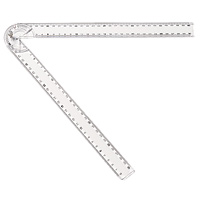
I bought a big clear adjustable one.. pretty cheap at homo depot... it's about 2' long, so it extends well past the die in either direction...

hate to say it, but I don't even use the degree ring, at all... i check all my angles with that.... and trial fit, if it needs a couple more degrees, I'll reload it and tweak it....
 
I bought a big clear adjustable one.. pretty cheap at homo depot... it's about 2' long, so it extends well past the die in either direction...

hate to say it, but I don't even use the degree ring, at all... i check all my angles with that.... and trial fit, if it needs a couple more degrees, I'll reload it and tweak it....


Hmm I'll have to look, what department was that in? I guess its fine if I have to reload and bend a bit more, just seems like there should be a better way.

edit: something like this
20612-01-200.jpg

http://www.rockler.com/product.cfm?page=5362&filter=angle finder
 
I use an angle finder, protractor, & a carpenters bevel gauge.
I get the best results with the carpenters bevel gauge without paying attention to the specific degree.
image_277.jpg

images.jpg

stanley_bevel.jpg

image_277.jpg

images.jpg

stanley_bevel.jpg
 
yup, that's the one.. it was in the tool isle, with all the levels and such...


oh, I'm sure it all works much better when ya figure out your springback, software, etc, etc... it's just kinda the way I found it easiest... it's not often I'd have to reload one.. really only when the angle I "thought" I needed ended up not being right when fitting it up....


by far the biggest thing I found annoying is fishmouths... it's all fine and dandy when your doing a single attachment node of one tube at a 45 or 90... but when you start having 3 or 4 tubes coming together in a node at funky angles, it's a chore... can always take more off, hard to put back thing...
 
Ok just wondering what everyone is using to check the degree of the bend? Angle finder ect. I have started playing with my pro tools hd105 with degree ring. Now I have bent some stuff up at 90 degrees on the bender when I put the angle finder on its like 88 degrees. I preloaded everything and still can't seem to get a perfect 90 degree bend. Just wondering if there is a more accurate way of measuring while the tube is still in the die? I just have the cheap hf angle finder is there a better one?

I have found the same thing. I'll start my bends a degree or 2 negative and bend right to the mark or a degree past and I still seem to under bend by a degree or 2. I just reload it and tweak it. Better than over bending it for sure!
 
oh, and for said fishmouths, a quality die grinder and many of these are invaluable imo...


carbide-burr--rotary-burr-and-insert-201.jpg


hehe, I must 30 or 40 carbides in every shape imaginable...
 
oh, and for said fishmouths, a quality die grinder and many of these are invaluable imo...


carbide-burr--rotary-burr-and-insert-201.jpg


hehe, I must 30 or 40 carbides in every shape imaginable...

ugh my woman is gonna freak if I spend any more money on tools. I think I'll get by with what I have :)
 
yeah, and good carbides ain't cheap...

I do the majority of the work with a chop saw, but the carbides are nice for fine adjusting... regular 4 1/2" stone wheel or flap disc grinder can get ya by too....
 
I always underbend too. That is better than overbending though.

I used a carpenter's bevel gauge but it just wasn't long enough.

I made a really large one with two alum yard sticks. Just buy two matching ones & bolt them together using the fatory hole in the end. If they are too long cut both sticks down to two foot, & use the one foot pieces to make a second one.

Only time I use the degree wheel is when I am duplicating tubes. I'll right down the degree of the bends for the first one & then it is easier to copy that tube.
 
The article says those are BITD (Best In The Desert) roll cage rules 2007. I don't know what KOH requires, but desert usually means high speed.

depending on price and availability I may do .134 1.75 rather than .120 so I think I answered my own question.

remember if you are building to a rule or spec sheet, when they say .120 wall minimum, you must start with .134 wall.

Bending a .120 wall tube the wall becomes thinner on the outside of the bend and you are now outside the rules. Every drag track i have ever seen only checks tube thickness in the bend.

If I was building a cage in a blazer today for me, i would use 1.75" .120 wall. This is against most people that you will see or talk to. My reasoning is that I have spent a lot of time now in my KOH/desert car and with correct design and layout 1.75 is fine. Keep in mind I would move stock parts to make sure the cage went together right.

If you are trying to meet a racing spec section keep in mind that in the Desert world they only "suggest" Cage tubing sizes. They actually don't have cage rules, except SCORE they do have rules and a cage inspector that is paid. Just about everyone else looks at the general layout and soundness of the cage.

I ran with; hammerking/KOH, BITD, CHCA last year and my car doesn't meet any of their "suggested" tubing sizes for the weight of the car however, anyone that has seen my car knows it'll take a tumble or two. I have passed every tech inspection without issue for three years now.

I have not had anyone want to drill my cage yet, probably never will, but from what I know, which isn't drag cars, .120 means the tubing you start with not what the tubing thickness needs to be in the middle of a bend. I can respect that Drag racing is slightly different that what I do so therefore you have different rules and standard practices.

Just what I have learned and seen in the last few years, take it or leave it
 
Top Bottom