
CK5
Register an account today to become a member! Once signed in, you'll be able to participate on this site by adding your own topics and posts, as well as connect with other members.

Exhaust heat wrap...

The exhaust is hot during and for awhile after the engine is running. Anything other than that, and it will hold the moisture in.

I suspect a lot of that plays on the humidity of the region you live in(?) and how often the vehicle is driven. The more often it's driven the less the problem would be. It may also have something to do with the salt used in many places in the winter.

It should accomplish the same thing anywhere on the exhaust system. How close to the engine is the bushing location? If it's far enough from the engine, it may not affect the poly depending on the distance between the pipe and bushing. I'd go with a sheet metal heat shield or routing the pipe a bit differently if possible.

It isn't close to the engine, it will be close to the pipe after I get the exhaust in. I can't just redo the crossmember. It took many hours of thought and bending to come up with the crossmember. So it's either under the torque converter with the exhaust (where it might get hit with rocks) or run it close to the poly bushings with a wrap and a shield if needed.This is what I am working with.
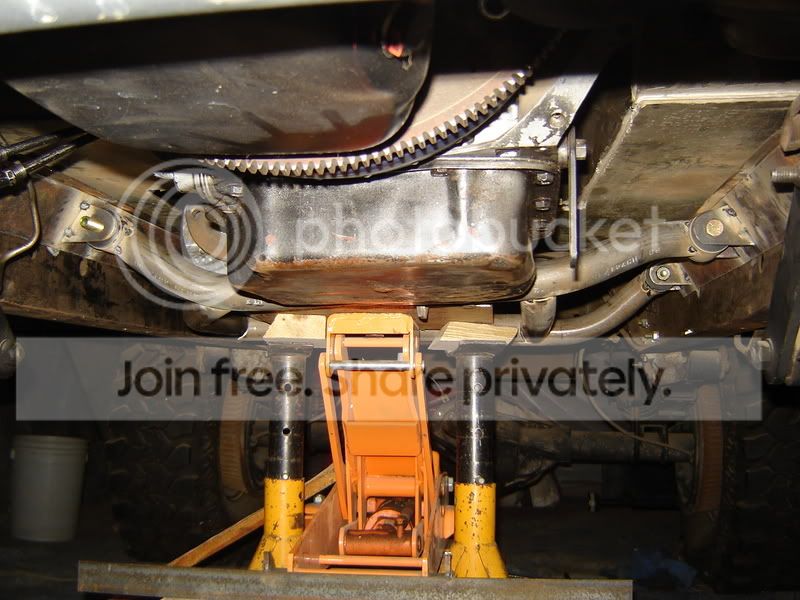
stuffforsale001.jpg
 
The exhaust is hot during and for awhile after the engine is running. Anything other than that, and it will hold the moisture in.


So comparing bare dry steel to wrapped bare dry steel the wrapped would rust faster?
 
So comparing bare dry steel to wrapped bare dry steel the wrapped would rust faster?

Huh, I thought I said something about this. Oh yeah, I guess I did. :rolleyes:

I suspect a lot of that plays on the humidity of the region you live in(?) and how often the vehicle is driven. The more often it's driven the less the problem would be. It may also have something to do with the salt used in many places in the winter.

If you don't understand how humidity plays a role in rust, think of Arizona vehicles, and ones from anywhere else in the country. If you don't understand the concept of insulatiion, and how permeable insulation could cause issues, apologies.
 
ss headers are $600 and up, usually 800 to 1000...
 
Huh, I thought I said something about this. Oh yeah, I guess I did. :rolleyes:


If you don't understand how humidity plays a role in rust, think of Arizona vehicles, and ones from anywhere else in the country. If you don't understand the concept of insulatiion, and how permeable insulation could cause issues, apologies.


I understand completely. I just disagree that the wrap makes it rust any faster. Humidity is humidity. Permeable insulation is no more permeable than no insulation.
 
subscribed...i want to know some people that have had headers rust out due to wrap and what header/coating on the header was on them...i want some proof im with kert on this one
 
obviously that depends greatly on the grade and quality of the stainless..

but yeah, your way less likely to have any kind of issue, even wrapped...

this brings up an interesting sidenote for me.. I'd love to figure out what this stuff is the marine manufacturers are using. it's proprietory to this company.. it's like a cloth/carbon fiber/fiberglass wetted out with some sort of epoxy or something..

it doesn't fail, and you can put your hand on it...


HPIM1355.jpg
 
That's like saying because gore-tex breathes it doesn't keep more moisture in than if it wasn't there. Cloth is permeable...set a rag on wetted ground and see if it retains moisture longer than an uncovered area. If moisture is drawn to the metal as it cools in certain conditions/climates, it would be the exact same thing.

Hell, for all we know it has nothing to do with rust, it could be because of something like higher retained heat causing problems with the exhaust somehow. You'd have to do some serious testing to know for sure what the reason is, and it wouldn't be quick.

Or, you could try and get the header manufacturers to explain themselves.
 
Your comparisons are kinda opposite though aren't they?

Gore tex refering to sweat trying to get out through an insulation. Same with the rag put on the wetted ground.

I can see where your going with the higher heat on the tubes being an issue.

In my experience its not rust that is the issue.
 
Top Bottom