CK5
Register an account today to become a member! Once signed in, you'll be able to participate on this site by adding your own topics and posts, as well as connect with other members.

1/2 vs 3/4 ton brakes, front particularly

dyeager535

1 ton status
 Premium
Joined
Dec 13, 2000
Posts
31,571
Solutions
1
Reaction score
2,910
Location
Roy, Washington
It is possible the parts listings (rockauto) are wrong (used 1986 K20 and K5 to compare), but from what I can tell, some 3/4's share the same calipers and master as the 1/2 tons. Not dealing with hydroboost. There are two piston diameters listed for the 3/4 tons (JD7 at 3-5/32" and JB/JD6 at 2-15/16")

I can tell the 3/4 ton backing plate is different, but so is the rotor. Both in diameter (11.86" vs 12.5") and it looks like "offset" for the caliper.

This is probably going to end up satisfying my curiosity more than solving a problem, but if the "small" calipers interchange, does that mean the large piston 3/4 caliper will fit the 1/2 ton backing plate and rotor? There are at least two different front pad sets listed, depending on size of the rear brakes.
 
Last edited:
The calipers are externally identical, so I see no reason the 3/4 ton version wouldn't fit the 1/2 ton backing plate.
 
The calipers are externally identical, so I see no reason the 3/4 ton version wouldn't fit the 1/2 ton backing plate.

Interesting. At least in my case I can't see a reason to go with the larger piston calipers, but since the masters interchange, that would mean you could potentially run the larger front calipers and matching master.

Any idea if the rotor surface ends up being in a different location (offset) on the 3/4 ton than the 1/2's? Obviously sourcing a 12.5" 6 lug rotor would be the issue, but if one were available, that would be a fairly significant increase in braking potential with minimal work.
 
same outside dimension of caliper body . piston little bit bigger in the caliper bore .

this also would mean bigger master to move the correct fluid volume for same pedal travel .

if not you could get a low pedal and think its air when its just low volume of fluid flow = more travel to get same effort .
 
same outside dimension of caliper body . piston little bit bigger in the caliper bore .

this also would mean bigger master to move the correct fluid volume for same pedal travel .

if not you could get a low pedal and think its air when its just low volume of fluid flow = more travel to get same effort .

Probably, technically, could start running into issues with the proportioning valve too. I didn't look those up to see how many they ran.

Since GM used the same master/calipers on some 1/2 and 3/4 tons, and all the 3/4's had larger brakes in the rear, apparently GM felt it wasn't too big an issue. Then again, GM brakes in the 80's and early 90's tended to be pretty spotty across the line, not sure if that was a vintage thing, or GM just being cheap. It may be that the larger front rotor coupled with the larger drums somewhat equaled out in terms of the masters and calipers being the same.

I assume no one has seen 6 lug 12.5" rotors for these trucks?
 
Probably, technically, could start running into issues with the proportioning valve too. I didn't look those up to see how many they ran.

Since GM used the same master/calipers on some 1/2 and 3/4 tons, and all the 3/4's had larger brakes in the rear, apparently GM felt it wasn't too big an issue. Then again, GM brakes in the 80's and early 90's tended to be pretty spotty across the line, not sure if that was a vintage thing, or GM just being cheap. It may be that the larger front rotor coupled with the larger drums somewhat equaled out in terms of the masters and calipers being the same.

I assume no one has seen 6 lug 12.5" rotors for these trucks?

The 3/4 ton front rotors are bigger, that leverage factors in to balance with the rear brake system.

12-1/2" rotors pretty much don't fit with 15" wheels which were the standard for 6 lug stuff, so wouldn't be surprised if that was near non-existent.
 
I have a question about this as well. If you do an 8 lug conversion to a 10 bolt and reuse your 1/2 ton calipers what brake pads do you use with the new set up?
 
Keeping your 10 bolt? Stay with 6 lugs, get larger rims (17 inch preferred), and step up to 4 piston calipers and huge rotors!
Disk over hub makes easier brake work, and the stopping power is incredible.

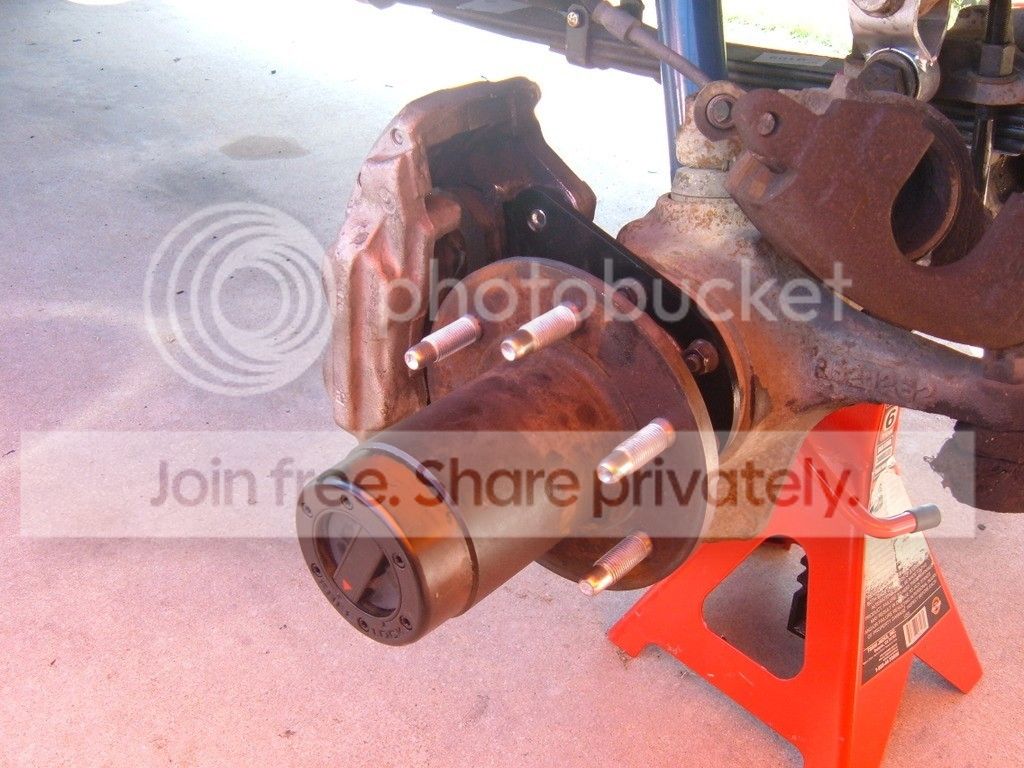
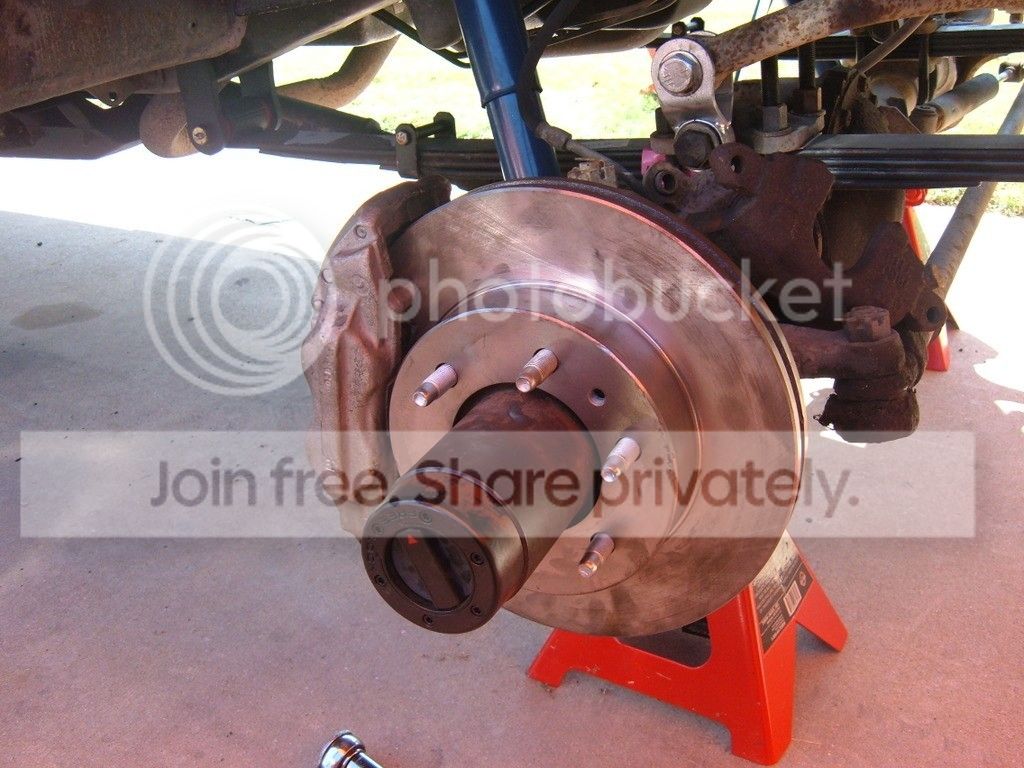
Xi1WRQ_zps7nhnrpzp.jpg


jrLrEl_zps8qeitz02.jpg


Thorparts.com caliper mounts (not listed, must call)
Hummer H3 calipers and rotors
14x1.5mm lugs
 
I have a 14bolt sf 8-lug in the back. I have all the parts for the 8-lug conversion for the 10 bolt. Just don't know what pads to put back on. Going to stick with 15" wheels just going to grind down the calipers where needed. The wheels are going to be 15X8 with 3.5 backspacing. I have heard that not much grinding will be needed with that backspacing.
 
You shouldn't need to grind much (if any) at all with that backspacing. Will depend on the particular rim though. FWIW, I've got a set of 15x10's with 3.5" backspacing that clear the calipers on my D60 with no grinding...the 4.5" ones required an ass load of grinding to clear though.
 
As mentioned above the 1/2 and 3/4 ton calipers are identical in outer dimensions. When I swapped my old 10-bolt from 6 to 8 lug I never disconnected the calipers or changed the brake pads. I'm pretty sure the 3/4 ton backing plates offset the calipers outward slightly, and pretty sure the 3/4 ton 8 lug hubs set the wheels out further. When I did the 6 to 8 lug conversion I also went from 3.5" BS 6 lug wheels to 4 1/4" BS 8 lug wheels, and even with more BS it seemed the 8 lug wheels stuck out further. Can't find it right off hand but thought for sure ORD had something on their website at one time stating that 3/4 hubs made it wider.

Don't remember any obvious difference in stopping power on my K5 when going 6 to 8 lug, but also had changed from the 10-bolt rear axle to a 14FF. After going to a D60 front axle I then used the original front calipers and put them on the back.

Shouldn't be a whole of trouble to get 3.5" BS 15" wheels to fit on the front 8-lug 3/4 ton setup. As mentioned above I used 4.25" BS wheels which required a decent amount of grinding but nothing excessive.
 
As mentioned above the 1/2 and 3/4 ton calipers are identical in outer dimensions. When I swapped my old 10-bolt from 6 to 8 lug I never disconnected the calipers or changed the brake pads. I'm pretty sure the 3/4 ton backing plates offset the calipers outward slightly, and pretty sure the 3/4 ton 8 lug hubs set the wheels out further. When I did the 6 to 8 lug conversion I also went from 3.5" BS 6 lug wheels to 4 1/4" BS 8 lug wheels, and even with more BS it seemed the 8 lug wheels stuck out further. Can't find it right off hand but thought for sure ORD had something on their website at one time stating that 3/4 hubs made it wider.

Don't remember any obvious difference in stopping power on my K5 when going 6 to 8 lug, but also had changed from the 10-bolt rear axle to a 14FF. After going to a D60 front axle I then used the original front calipers and put them on the back.

Shouldn't be a whole of trouble to get 3.5" BS 15" wheels to fit on the front 8-lug 3/4 ton setup. As mentioned above I used 4.25" BS wheels which required a decent amount of grinding but nothing excessive.

Good to know. I think you are correct in that the 3/4 ton set up is wider. Thanks for your input.
 
On my 1988 V10 Suburban, when I swapped out the 1/2 ton axles for 3/4 ton axles, I just hung the stock front calipers off to the side, and rolled the GM 10 bolt out of the way, and then rolled the Dana 44 under, and hung the stock calipers back on. Drove it that way for quite awhile. Could not tell any noticeable difference in brake pedal feel. Still had the stock master cylinder and proportioning valve.

Then I had to repair wheel cylinders, so I swapped to rear disc brakes while I was at it. When I did that, I moved the smaller 1/2 ton calipers to the rear axle, and bought new larger 3/4 ton calipers for the front. Still using the stock master and proportioning valve. Pedal still felt exactly the same.

Then I blew up the Dana 44, so I swapped in a Dana 60. Used the stock Dana 60 calipers on the front. Still have the small half ton calipers on the rear, with the stock master cylinder, and the stock proportioning valve.

Brakes work great.

Martin
 
When I did the 6 to 8 lug conversion I also went from 3.5" BS 6 lug wheels to 4 1/4" BS 8 lug wheels, and even with more BS it seemed the 8 lug wheels stuck out further. Can't find it right off hand but thought for sure ORD had something on their website at one time stating that 3/4 hubs made it wider.

A 3/4 ton hub has the wheel mounting surface out further. That is why a K10 front hub cap has the cone to cover the cast iron hub, just like a K30 front hub cap, but a K20 front hub cap does not require the cone.

Martin
 
On my 1988 V10 Suburban, when I swapped out the 1/2 ton axles for 3/4 ton axles, I just hung the stock front calipers off to the side, and rolled the GM 10 bolt out of the way, and then rolled the Dana 44 under, and hung the stock calipers back on. Drove it that way for quite awhile. Could not tell any noticeable difference in brake pedal feel. Still had the stock master cylinder and proportioning valve.

This is what I did, but I am running 13" G3500 brakes in the back. With stock hydraulics and 1/2-ton front calipers, the back bites just a little bit too soon when I'm empty. When loaded, it's perfect. When unloaded, it's not annoying enough for me to care. If I ever tear down the front of that truck again I'll prolly opt for 3/4-ton calipers.
 
I have a question about this as well. If you do an 8 lug conversion to a 10 bolt and reuse your 1/2 ton calipers what brake pads do you use with the new set up?

Use any pads you like, they all fit. I'm using the "big" front brake pads (8600gvw+ K20 spec) on a 6 lug 10 bolt, you can also use b-body caprice/Impala pads they all gain some surface area over the stock 1/2 ton and light 3/4 ton pads
 

Latest Posts

Top Bottom