
Positive battery terminal is getting crowded. Winch, amp, alternator, head light relays, fuel pump relay. What are y’all doing for battery power distribution? Been searching and gathering ideas but always interested in more.
CK5

You are using an out of date browser. It may not display this or other websites correctly.
You should upgrade or use an alternative browser.
You should upgrade or use an alternative browser.
12v power distribution
- Thread starter centexk5
- Start date
Been looking at this for some of the smaller circuits but not sure about the heavy draws such as winch and amp.
https://www.bluesea.com/products/5026/ST_Blade_Fuse_Block_-_12_Circuits_with_Negative_Bus_and_Cover
https://www.bluesea.com/products/5026/ST_Blade_Fuse_Block_-_12_Circuits_with_Negative_Bus_and_Cover

Winch and inverter are run from second battery, power leads connect to one of these,
https://www.amazon.com/Blue-Sea-Sys...ocphy=9031412&hvtargid=pla-451012010543&psc=1
I run a 2 relay starter, so battery straight to 1st relay ,cole hersee,
Any power taps can be taken there.
Also the alt buss bar on fire wall.
https://www.amazon.com/Blue-Sea-Sys...ocphy=9031412&hvtargid=pla-451012010543&psc=1
I run a 2 relay starter, so battery straight to 1st relay ,cole hersee,
Any power taps can be taken there.
Also the alt buss bar on fire wall.
Last edited:

Gentleman Jimmy
1/2 ton status
I went with the Optima battery that has side posts and top posts. I used the top posts for amp power and 0 awg ground to frame. Then the side post for the engine and accessories. The Positive side of most newer truck/suv gm side post battery cables has a cable that is typically used to power the fuse panel under the hood. I used that to power my 12v bus bar ($20 at napa but I found one at the junk yard) and ran it through a 150 amp circuit breaker. I also used some 10g off one of the posts to power a small 12v constant fused distribution block under the dash for my power seats, window relays etc... One of the best tools I ever bought was a Dymo Rhino for labeling all my wires, a year or two down the road with no labels makes troubleshooting take forever.


Been looking at this for some of the smaller circuits but not sure about the heavy draws such as winch and amp.
https://www.bluesea.com/products/5026/ST_Blade_Fuse_Block_-_12_Circuits_with_Negative_Bus_and_Cover
Keep the big stuff like the winch on the battery and saved the small stuff for the aux fuse box. I’m almost done installing a very similar Blue Sea fuse panel in my Blazer.

I went with the Optima battery that has side posts and top posts. I used the top posts for amp power and 0 awg ground to frame. Then the side post for the engine and accessories. The Positive side of most newer truck/suv gm side post battery cables has a cable that is typically used to power the fuse panel under the hood. I used that to power my 12v bus bar ($20 at napa but I found one at the junk yard) and ran it through a 150 amp circuit breaker. I also used some 10g off one of the posts to power a small 12v constant fused distribution block under the dash for my power seats, window relays etc... One of the best tools I ever bought was a Dymo Rhino for labeling all my wires, a year or two down the road with no labels makes troubleshooting take forever.
View attachment 367880
I used the same style of distribution blocks. Got mine from GMT400 trucks in the boneyard. But I've seen them on many other GM cars built from the late '80s through the '90s.
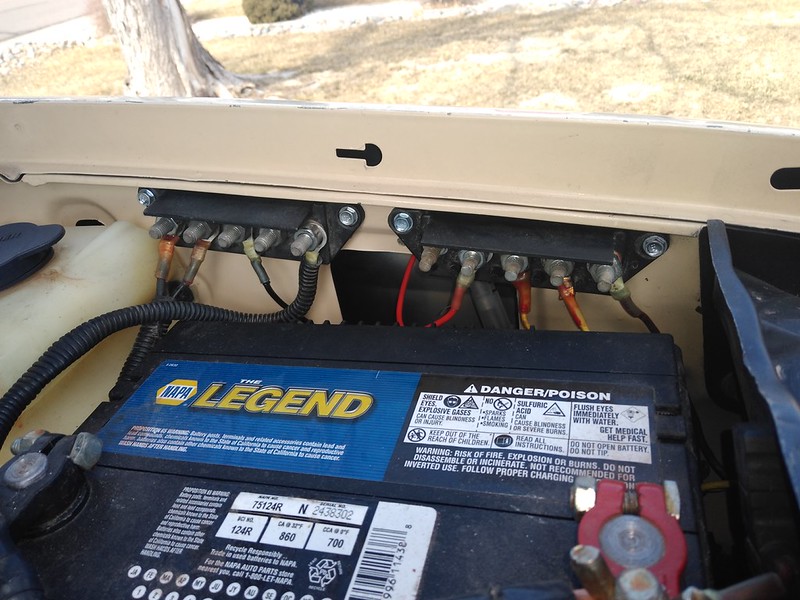

I don’t mind the heavy stuff on the battery but if there’s other ways to do it I’m interested. For sure not running the winch and amp through the fuse block. Was never an option.
Just for the sake of saying it.... with respect to distribution blocks and/or breakers for a winch, I found that a Warn 8274 can spike up to 500a during a hard pull so be sure what you buy can handle the job.

Kain
3/4 ton status
this for positive and a black one for negative that i have not mounted yet
https://www.ebay.com/itm/250A-7-poi...e=STRK:MEBIDX:IT&_trksid=p2060353.m1438.l2649
https://www.ebay.com/itm/250A-7-poi...e=STRK:MEBIDX:IT&_trksid=p2060353.m1438.l2649
I’ve got a breaker on the winch so that’s good. Just hate how I’ve got a bunch of wires hanging off the post. All of my ground cables are 0ga and the power cables for the starter and alternator are 0ga as well.

Blue Sea products tend to get a lot of love, that's one manufacturer to consider.
I'd like to find something like the Eaton Bussman setups: https://www.waytekwire.com/item/46345/EATON-s-Bussmann-Series-15305-5-2-4-RTMR-Mini-Fuse/ but that use sealed connectors/cavities. The Eatons are a clean unit, and have a fair number of cavities for relays and fuses, but they could be sealed, and they don't lend themselves as well simplicity-wise as they could...it would be a lot nicer if you could use a relay to switch a block of circuits off and on with ignition, and also run a block of battery 12v without a ton of wiring, but in most aftermarket solutions I've seen, you are either imited to a single 12V input, which doesn't allow for clean (less wires) switching of circuits, or if not a single input, every fuse requires its own 12V, which also looks messy IMO. That's one thing the factory fuse panel does well that I havent seen replicated in the aftermarket boxes...using brass strips, GM was able to power multiple circuits with one 12V feed.
There are some pretty cool units in the $200 range, but it looks like those are controlled by computers. (31S-000-0 is one, for anyone curious)
Still need to separate out your high draw items, but it's not too terrible running three wires off the battery terminal...auxiliary fuse block, starter, and a high amp junction block for the fans and/or the winch. With a short cable run maybe that plus the fans is doable on a single junction block on say, the core support.
I'd like to find something like the Eaton Bussman setups: https://www.waytekwire.com/item/46345/EATON-s-Bussmann-Series-15305-5-2-4-RTMR-Mini-Fuse/ but that use sealed connectors/cavities. The Eatons are a clean unit, and have a fair number of cavities for relays and fuses, but they could be sealed, and they don't lend themselves as well simplicity-wise as they could...it would be a lot nicer if you could use a relay to switch a block of circuits off and on with ignition, and also run a block of battery 12v without a ton of wiring, but in most aftermarket solutions I've seen, you are either imited to a single 12V input, which doesn't allow for clean (less wires) switching of circuits, or if not a single input, every fuse requires its own 12V, which also looks messy IMO. That's one thing the factory fuse panel does well that I havent seen replicated in the aftermarket boxes...using brass strips, GM was able to power multiple circuits with one 12V feed.
There are some pretty cool units in the $200 range, but it looks like those are controlled by computers. (31S-000-0 is one, for anyone curious)
Still need to separate out your high draw items, but it's not too terrible running three wires off the battery terminal...auxiliary fuse block, starter, and a high amp junction block for the fans and/or the winch. With a short cable run maybe that plus the fans is doable on a single junction block on say, the core support.
Another heads up is for fuel injection users.
I’m not sure what GMs take is (see disto blocks above) but all the aftermarket EFI manufacturers recommend terminating to the battery
All aftermarket electronics want you to terminate at battery, is The MBA CYA way of making sure your connections power and grounds don't cause issues that make them look bad. If your/our rigs have good Battery connections clean grounds, it shouldn't mater where the component power and ground taps are made .
Very true on terminating circuits at the battery vs a distribution block. In the photo I posted the blocks are at my auxiliary battery. Most circuits are going to the camper and accessories. One of which is my Ham radio. Which most radio guys say the same thing about connecting both power and ground to the battery to eliminate possible noise.
I still ran mine to the distribution blocks. I'm using an 8ga wire from the battery to each block that might be 10" long. The positive is fused as well. With solid connections there isn't any added resistance that would cause any issues.
I do have a positive distribution block on the other side at the main battery. I did move my two main power sources for my ecm to that block to clean up everything that was on the battery. I have not had any issues with mine being set up that way.
I know most of the aftermarket efi systems are very clear to go directly to the battery so your results may vary from mine. I just wanted to clean up what was starting to look like a rats nest.
I still ran mine to the distribution blocks. I'm using an 8ga wire from the battery to each block that might be 10" long. The positive is fused as well. With solid connections there isn't any added resistance that would cause any issues.
I do have a positive distribution block on the other side at the main battery. I did move my two main power sources for my ecm to that block to clean up everything that was on the battery. I have not had any issues with mine being set up that way.
I know most of the aftermarket efi systems are very clear to go directly to the battery so your results may vary from mine. I just wanted to clean up what was starting to look like a rats nest.
My thing about terminating at the battery post, is one day there will be corrosion, an over charge a crack in a battery case or just a $h*tty battery.
Then what kind of a connection will these other devices have? The repair cost and time to re do all the connections or possibly even replace wiring.
I like @ZooMad75 bus bars I may need to steal that.
Using the 2 starter relay method, is no different than oem as far as power circuit is concerned you are still getting power from the starter end of the battery cable. So instead of being at the battery you are are at the other end of the first connection.
Then what kind of a connection will these other devices have? The repair cost and time to re do all the connections or possibly even replace wiring.
I like @ZooMad75 bus bars I may need to steal that.
Using the 2 starter relay method, is no different than oem as far as power circuit is concerned you are still getting power from the starter end of the battery cable. So instead of being at the battery you are are at the other end of the first connection.


