CK5
Register an account today to become a member! Once signed in, you'll be able to participate on this site by adding your own topics and posts, as well as connect with other members.

350 lean on one bank, but not the other

Blue85

Yooper
 Premium
GMOTM Winner
Joined
Jul 26, 2000
Posts
16,782
Reaction score
9,824
Location
Keweenaw
I'm planning a long road trip next week and I haven't figured this out yet so want to tap some CK5 minds.

Quick description of the setup:
  • Regular Goodwrench 350 (are they even 8.5:1?) Has 110-120k miles
  • TPI setup
  • ECU is megasquirt, controlling spark and fuel
  • Ignition is 4 coil waste spark, using Ford EDIS module and coils (EDIS module decodes crank sensor and drives the coils. Megasquirt just tells it how much advance to use).
  • Batch-fire injection with separate tables and O2 sensor for the left and right banks.
  • Dual exhaust with a catalytic converter on each side.
  • AFR feedback only has authority to adjust the pulsewidth +/-5%
Truck starts normal, idles great, fuel pressure is correct (44psi without engine running, drops into the 30s with vacuum). Runs great up to about 3000rpm. Then the bank 2 O2 sensor starts to read lean. Under heavy load and higher RPM the engine starts to rattle. Bank 1 reads like it always has. Both O2 sensors seem to react quickly and at low RPM they agree, so I tend to think both sensors are good. Each ignition coil is connected to a plug on each bank (with waste spark, the complementary cylinders spark at the same time. 1, 8, 4, 3, 6, 5, 7, 2 means 1&6, 8&5, 4&7, 3&2 will spark at the same time).

Here's what I've done so far (none successful):
  • Plugs pulled and all tan color
  • New plugs (R45TS, as usual)
  • Replaced plug wires on bank 2 (thinking one was arcing somewhere, still letting the plugs on bank 1 fire normally.)
  • Put fuel pressure gauge on the windshield and verified that pressure is holding steady while AFR declines on one bank.
  • Listened to fuel injectors with stethoscope and all sound the same.
  • Verified with timing light that ECU timing matches physical
  • Redneck catalyst temp test by holding hand close to inlet and outlet of both cats. Dang, everything is hot! Not sure I learned anything.
  • Found a small metal shaving on the crank sensor.
So what do you think is wrong?
  • Weak or dirty injector?
  • Weak valve spring?
  • Plugged catalytic converter on bank 2?
  • Junk in the fuel rail?
  • Weak ignition module?
  • mixed up plug wire order?
  • Timing is just too advanced?
  • My old rusty headers are leaking?
 
I'd lean towards anything that only affects the Bank 2 readings...

Rusty headers could be drawing fresh air into the collector pre O2 sensor. There could be a restriction that affects the fuel flow to that bank only.

Easy thing to do is swap O2 sensors side to side. See if the readings switch.

As long as the engine isn't misfiring, and the the plugs are uniform, I wouldn't suspect an individual cylinder...
 
I was just going to say try swapping o2 sensors around.
I’ve never messed with dual table but are there separate injector settings for each bank? Maybe opening time or voltage offset could be different between banks?
 
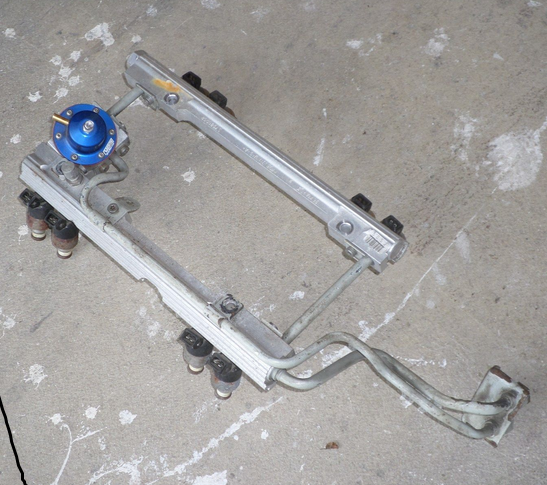
I was going to swap the O2 sensors, but it looks like I need a new socket - they're in there pretty good. I thought that an exhaust leak would actually have less impact at higher RPM, as it should be leaking "out" instead of "in". I would be inclined to think it's just a bad measurement if I didn't hear the rattling. I'm just assuming it's pinging from being lean. The lazy injector idea doesn't make complete sense to me because a slower open/close time would reduce the effective pulsewidth at all engine speeds. As RPM increases the pulsewidth is similar, but happening more often, which implies a shortage of fuel. Maybe there's some debris or other restriction so the pressure can drop on one rail or one injector? The rails are like this. The test port is on what I call bank 1. It's a bit of work to disassemble the plenum and runners to get to the rails.

tpifrl.png


I suppose I could also have a weak injector driver or some wiring failing so as average current goes up the voltage drops. Perhaps I have enough harness to swap the injector wiring side to side.

There is only one set of injector parameters. I did mess with fueling being alternating or simultaneous and also swapped to single table control and there was no real change.
 
A little more fuel never hurt anyone.. I would suggest getting an ir temp gun and read each cylinder temp to help isolate the problem even further. You could also do a leakdown ,and or a compression test to make sure your valves are seating correctly.
 
Compression shows about 155 on all of them, except 2&4 are more like 145. That's cold engine, nearly closed throttle. I would worry more about the low ones if that seemed to be the same side that's having trouble. I'll have to verify this, that bank 1/2 are defined the same for injectors as they are for O2. I unplugged injector #3 last night and bank 2 read dead lean. (Seems like I would have noticed this before if they were swapped!)

I forgot to mention all injectors read right around 14.3 Ohm. The coil secondaries are 13.6k and 13.6k, which all looks fine.
 
I would suggest getting an ir temp gun and read each cylinder temp to help isolate the problem even further.
I've been meaning to pick one up. If a temp disparity showed up only at RPM load, it might not be possible to measure. If one is hot, that implies a stuck injector or bad valve spring. If they're all the same it almost has to be fuel supply or plugged cat.

I see no flicking on the vacuum gauge, but there isn't much vacuum when this is happening anyway.
 
What are your afr’s showing under this condition?
Have you verified the afr #’s your ms is seeing match what the wide band is putting out. (Voltage offsets). What wide band/s are you using?
 
Dual narrow band. One in each header collector. I ditched the WB after a few sensor/controller failures. Bank 2 also has an AFR gauge on the pillar and that gauge does match the MS readings.

I tore the fuel rails out, disassembled everything and ran some solvent through the injectors. Patterns all look good. Nothing suspect in there. I did swap the injectors side to side, so I'll see if that makes a difference. I did swap the fuel pump a couple weeks ago, which was helping to feed my suspicion here.

It's hard for me to believe it's spark at this point since new plugs and wires made no difference. Plus each coil fires an odd plug and an even plug, so a bad coil, bad module or bad timing should affect both banks.

I wanted to believe that I had swapped 2 wires and being 45 degrees off was close enough to fire the charge at low speed, but dumping it out unburned at higher speeds. But any 2 I could swap would be off way more than that.

I'm tempted to pull timing and add fuel to bank 2 to make it better because I have to be on the road in a couple days.

Just weird how it idles so smooth and pulls hard down low. Also seems weird to make normal vacuum if one cat is plugged. When it pings I can close the throttle and vacuum jumps right up over 20.
What else can cause the ping?
  • Lean
  • Too much spark advance
  • Too hot (I've never seen above 190)
Can a bent pushrod or broken valvespring explain this?
 
Do you have a screen shot of your ign timing table?
 
Can't seem to get a screen shot from the mobile, so can will have to do.

20180811_182115.jpg
 
Your wot timing seems ok but I think your total should only be around 47 or so, then taper down to 30-36.
 
I've been through several tanks of fuel. I think it started before dunefest because bank 2 was reading a little lean, but it felt and sounded OK so I climbed lots of hills. I would say it got progressively worse on this last trip. Didn't really start to ping until the trip back, but I was fighting a number of minor issues.

I will try dialing timing back, but I think I've been running that table for several years. I did a quick search on my tuning PC and didn't see other more mild tables. I started this conversion with good documentation and have a 3 ring binder of wiring diagrams, schematics, etc. Its the last 8 or 9 years that don't have good notes.

I made an EGR block-off plate while I was in there today. There's been no vacuum line to it for 10+ years, so might as well eliminate another variable.
 
Last edited:
Have you verified your timing lately with a light? Maybe your crank sensor or wheel has moved and advanced it?
 
I think your diging awfully deep before verifying O2 sensors. Not that it's bad to confirm the rest of the system.

Just my 2 cents
 
If the pinging seems severe,it can be caused by a red hot valve,spark plug electrode, or chunk of carbon lighting off the mixture early..a weak valve spring might let a valve get hot enough to cause pre-ignition..
Excessive back pressure could too..if it cant get all the exhaust out it'll build up heat..on older engines, EFE or heat riser valve stuck closed could cause it too..

Disabling the EGR may make it more likely to ping..removing it and blocking it off might cause issues too,some are designed so the plunger on the EGR is what blocks off the exhaust recirculation flow..
Flat camshaft intake lobes can lean out the mixture on the affected cylinders ,but you'd also note lack of power too..

I'm not very well informed as far as computers and sensors,etc,but these items will cause pinging on most any engine regardless..
 
Have you verified your timing lately with a light? Maybe your crank sensor or wheel has moved and advanced it?
Yes. I did this a few days ago. At first I thought the light showed about 10 degrees less timing than the ECU did. I cleaned a little metal chunk off the crank sensor and then it seemed to be within 1 degree. For EDIS to work right the sensor has to be 5 teeth ahead of the missing tooth (36-1), so it's set up that way mechanically. This lets the EDIS "limp" at a fixed 10BTDC if the signal from the ECU goes away. With 36 teeth, each is 10 degrees.

I suppose the balancer could slip and throw off timing light readings, but since my light shows the balancer 0* in the same place the ECU thinks it is, that theory doesn't work.

I think your diging awfully deep before verifying O2 sensors. Not that it's bad to confirm the rest of the system.

Just my 2 cents
Tell me more of your experience. Have you ever seen an O2 sensor react quickly and go full rich and lean but be measuring the wrong value? I've really only seen them go silent or get really slow. I would be more inclined to ignore the O2 signal if I didn't hear the rattle.

Disabling the EGR may make it more likely to ping..removing it and blocking it off might cause issues too,some are designed so the plunger on the EGR is what blocks off the exhaust recirculation flow..
Flat camshaft intake lobes can lean out the mixture on the affected cylinders ,but you'd also note lack of power too..
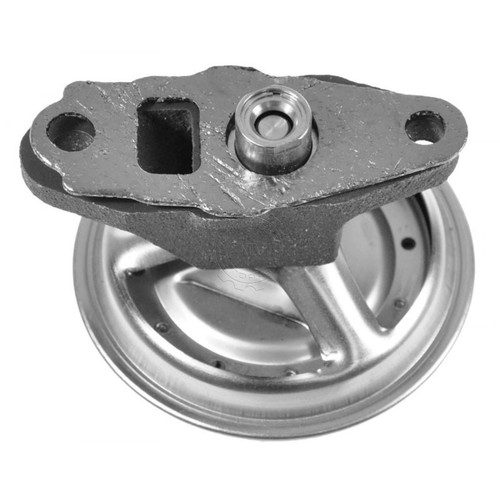
The EGR has been disabled since before I did the tuning, so that effect should be accounted for in the tables already. I was just surprised to see a lot of carbon on the pintle and in the exhaust passages of the intake. This made me wonder if somehow the valve was opening a bit and throwing things off, like when the exhaust pressure started getting higher. But the EGR feeds into the upper plenum, so all cylinders should be affected equally. This EGR flows exhaust gas up past the pintle and then through another opening to the intake tract. The flat plate I made should separate the two. Here's a block-off plate for this intake (it looks a fair bit nicer than mine :whistle:)

555-14901.jpg

s-l500.jpg
 
Last edited:
Progress report for today. After taking off the top end and cleaning the rails and injectors, I swapped the injectors from side to side. Fortunately it ran fine after getting everything back together. Then I ran auto-tuning and drove around. It was making quite large changes to both VE tables, up to 15%. I was starting off at very low loads and slowly increasing, eventually getting over 4000RPM in 2nd gear. I didn't hear it rattle, but I need to spend more time on it another day. I will probably have to hand smooth the tables and tune some more before trusting the settings.

You shouldn't have to re-tune an engine if you don't change the setup. It should stay the same for a very long time.

Also, plugged cat(s) seems less and less plausible as a I drive since the engine revs fast and on throttle closing the vacuum shoots up instantly to 22+.
 
I think that is really all a narrowband O2 sensor does. It might as well be a switch. It just shows lean or rich. Not really any resolution. Obviously there’s an issue if it’s pinging though.
 

Latest Posts

Top Bottom