CK5
Register an account today to become a member! Once signed in, you'll be able to participate on this site by adding your own topics and posts, as well as connect with other members.
Thanks for the reply. :waytogo:

So I think that we are on the same page again. I just don't see the body moving around a bunch. With the tub hard mounted at the A and B, down to the slider, triangulated to the frame and a hard mounted rear crossmember, it just shouldn't move much. I still need to do the C, but that shouldn't be too hard, just a couple of tubes somehow using the same bolt holes as the rear hitch.


If anything, I should be done with mine first. If it all rips to shreds and I start the rig on fire out of frustration. That should be a clue that I was wrong and you should go a different route. :D
 
I say go all hard or all soft. So if you are mounting the body hard to the cage and frame, get rid of the soft body mounts and replace them with plastic or metal. You don't want any of the hard mounted points to become the primary stress points.
 
I say go all hard or all soft. So if you are mounting the body hard to the cage and frame, get rid of the soft body mounts and replace them with plastic or metal. You don't want any of the hard mounted points to become the primary stress points.

Totally agree, but do you really think that they are going to become an issue the way that I have the outer cab hard mounted?

I just can't see where I would get any type of body roll, to where it would give sufficient strain to the hard mount points. I could see it if the hard mounts were more to the center of the rig, but on the outer shell in at least 6 points A,B and C plus the engine cage, I don't see a lot of movement.

Although, maybe the twist during articulation would cause some, but still, that would mean the the cage, tub and frame all were twisting with the same force.
 
Torsion (twist) is going to be the issue.

Ladderframes are notoriously bad for it (you'll see good demos in the H.A. book). When you've got one tire up in the air, and the other side drooping completely out all of the weight of the vehicle is on the "Bump" side tire and almost nothing is on the "Droop" side. There is a huge diagonal-torsional force running through the length of the frame/chassis in an example like that.... and it's really hard to prevent.

I think your "checksum" to prove that you're design is stiff enough would be to get everything built and mounted the way you want. And jack up one tire as much as you can. Take a "before" measurement between the windsheild frame and the a-pillar bar, and another one "after" to see how much defection is happening. (This assumes that you don't weld the a-pillar to the cage beforehand)

There is no doubt that you are stiffening up the center of the truck and frame (below the cab). The challenge is that you also need to make the front 1/3 of the frame and the rearmost 1/3 of the frame just as stiff as the middle....otherwise you will stress the frame (ie. paperclip-effect) at the point where the stiff frame ends and the looser, more flexible parts of the frame begin.

I have no doubts that you'll figure it out, it will just take time to think everything through completely.


-G
 
Totally agree, but do you really think that they are going to become an issue the way that I have the outer cab hard mounted?

Possibly, the body mounts spread the load through the entire mount piller to the sheetmetal. Your mounts are good, but there may be times where all of the weight is supported by your mounts. I'd rather it be all rigid, or all soft. Anywhere in between risks putting all the force on the rigid mounts. Now, it might in fact work fine, but if you can make it stronger by simply replacing soft mounts with hard, why not?

Besides, if its mounted rigid anywhere, it pretty much defeats the purpose of having a soft mount, because it won't do anything, no benefit at that point, it may support some of the weight sometimes, but NVH will surely be transferred to the cab anyway.
 
That's kinda what I figured would be the killer of the deal. Between just us, the frame is where I'm still worried.

I installed that inner frame brace dead center. This, I'm guessing gave a huge amount of strength to the center section only. I hope that when I do, do the "checksum", I don't see a hug problem in what I have built. I have a plan for the front, if I do see torsional stain between the inner brace and the FUSH. This would include boxing the frame, but where it comes tricky is I'd need to bolt the front box section onto the inner frame stiffener.

Man, I really never thought that I would get to this point on the build when I was hacking out rust. lol

I need my damn book. Ordered on the 3rd and it's still not here.

As always, thanks for the insight guys. :bow:
 
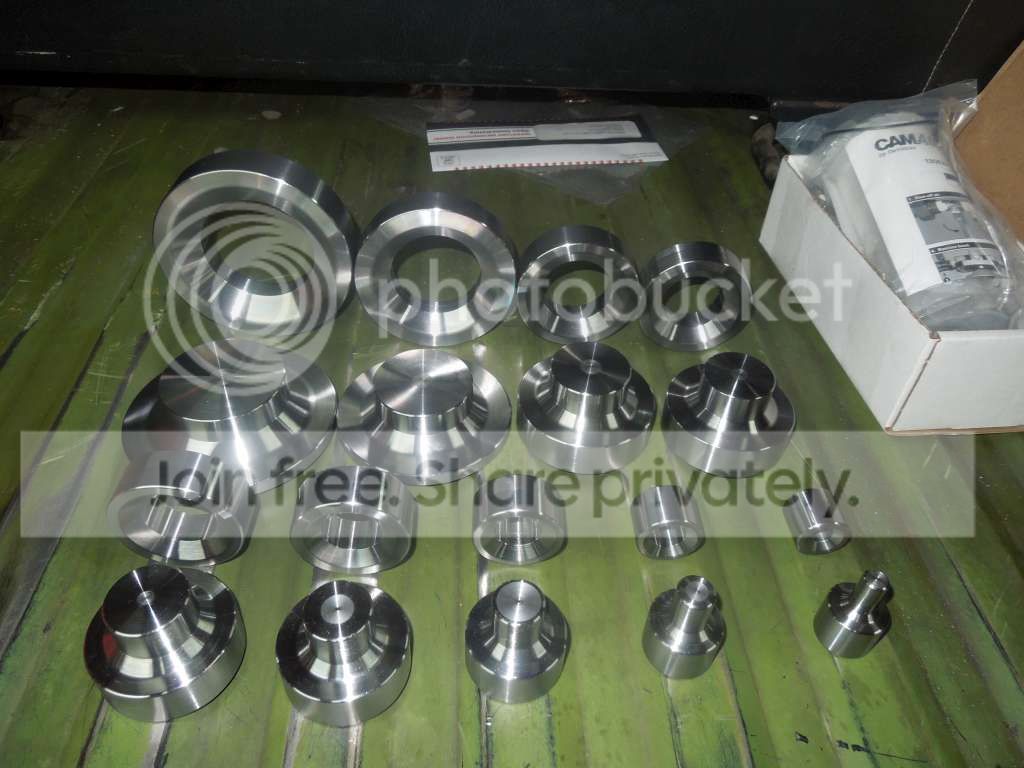
Some future dimple die goodness...


AAA815122-1024.jpg


Oh...I think so.. :woot: :pimp:
 
better be careful next time you get into a drinking contest with Z, or you'll end up with speed holes all down the quarter panels!


I miss that dude. I sure wish that he was or could be around more.

By the way, speed hole in the quarter, would mean that I lost. I just don't see that happening going against that whippersnapper. :pimp:


:popcorn: :D
 
Okay so my take on this whole thing.

You have no rocker boxes hence the want for support on the firewall. But like has been said you are still going to have torsional forces working against you in a bad way. The real problem here is the fact that you won't see the problem until there is a larger problem. So it is hard to correct on the fly.

So I tend to agree with going solid everywhere. I think you should use your fancy new dimple dies and put em to good use. I vote for several body attachment points to the sliders, welded to the body and then bolted to the slider, that still gives you the chance to take everything apart for paint and final assembly. I would then replace all the body mounts with aluminum pucks.

The thing about hard mounting everything like that, or rather the complaint I hear most of the time is I don't want the vibrations transmitted. In all honosty these trucks are old, wind noise is massive, big mud tires ( even radials) are loud and vibrate alot, leaf springs react slowly and on and on and on and on. I don't think its a legitimate concern. I have ended up hard mounting 4 different trucks. 2 big Chevys, a CJ5 and a bronco 2. None of them really had to much of a difference in NVH ( noise vibration harmonics) They already vibrated made lots of noise and had all sorts of weird harmonics.

If you end up going this route though you need to go all the way. Mount the cage to the body in several spots, easy enough to bolt on the extra mounting spots.

Now go get yourself 200 bucks worth of hole saws and some 14 or 12 gauge sheet steel and get to it!!!!
 
Thanks Eric. I really love it when you big hitters come in and help me out. :bow: :bow:

It looks like the consensus is strait up hard mount....So...


Hard mount it is, and I know that I can do it.. That's just crankin' the tunes and welding some knack knack patty whacks together.. :woot:

Have ya guys seen these? Think a couple would be worth it?

http://www.pirate4x4.com/forum/tool...de-hole-cutters-usa-made-w-discount-code.html
 
Thanks Eric. I really love it when you big hitters come in and help me out. :bow: :bow:

It looks like the consensus is strait up hard mount....So...


Hard mount it is, and I know that I can do it.. That's just crankin' the tunes and welding some knack knack patty whacks together.. :woot:

Have ya guys seen these? Think a couple would be worth it?

http://www.pirate4x4.com/forum/tool...de-hole-cutters-usa-made-w-discount-code.html

Heavy hitters :haha::haha::haha::haha::haha::haha::haha:

I just hit the garage crank the tunes and fire up the welder:D

I have used the carbides before. Pretty dang nice but I used them in thick metal. They cut a better hole than the normal saws
 
Mike,

Check out the Jancy annular cutting tools.... They are a VERY nice compliment to your blingy new flare hole dies.

They are super sharp, and much cleaner cutting than a traditional hole saw. When you plan to flare a hole, you want the hole to be nice and crisp so the end result looks professional. Holesaws can walk around a bit as they cut and can leave the hole looking a little battered and ragged-looking.


-G
 
Mike,

Check out the Jancy annular cutting tools.... They are a VERY nice compliment to your blingy new flare hole dies.

They are super sharp, and much cleaner cutting than a traditional hole saw. When you plan to flare a hole, you want the hole to be nice and crisp so the end result looks professional. Holesaws can walk around a bit as they cut and can leave the hole looking a little battered and ragged-looking.


-G

Are you talking about the sluggers or the solid ones you can plumb coolant through.

Fancy stuff fo sho. I have never used either one though
 
I had to back and check my own build thread....

http://coloradok5.com/forums/showpost.php?p=2566104&postcount=646

Those are the Snap-On annular cutters for the smaller hole sizes. The Jancy ones are a similar cutting head and pilot bit, but obviously have a larger diameter for the flare hole dies I bought.

I've cut up to 1/4" with them with a lot of WD-40, but they are really meant for thinner sheetmetal stock. Good stuff.... I really love working with quality tools whenever I get the chance.

-G
 
Dimple dies....oooohhhhhh.....aaaaaahhhhhhh

sweet man. I look forward to see what you have planned for those.
 
Top Bottom