
CK5
Register an account today to become a member! Once signed in, you'll be able to participate on this site by adding your own topics and posts, as well as connect with other members.

Air compressor help

lectric80

3/4 ton status
Joined
Apr 4, 2007
Posts
9,704
Reaction score
219
Location
Grantsville, Ut
My dad picked up this Campbell Hausfeld compressor for my little brother, but because the head is leaking he was a little iffy about it. I went ahead and took it and want to get it set up in my garage, hopefully I can use it to help with body work on the Camaro and possibly eventually paint.

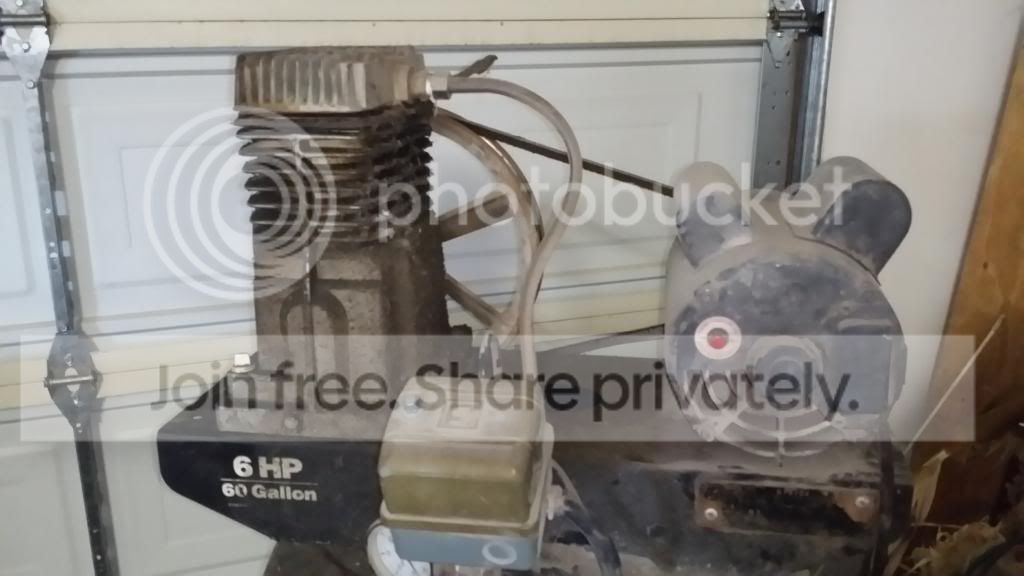
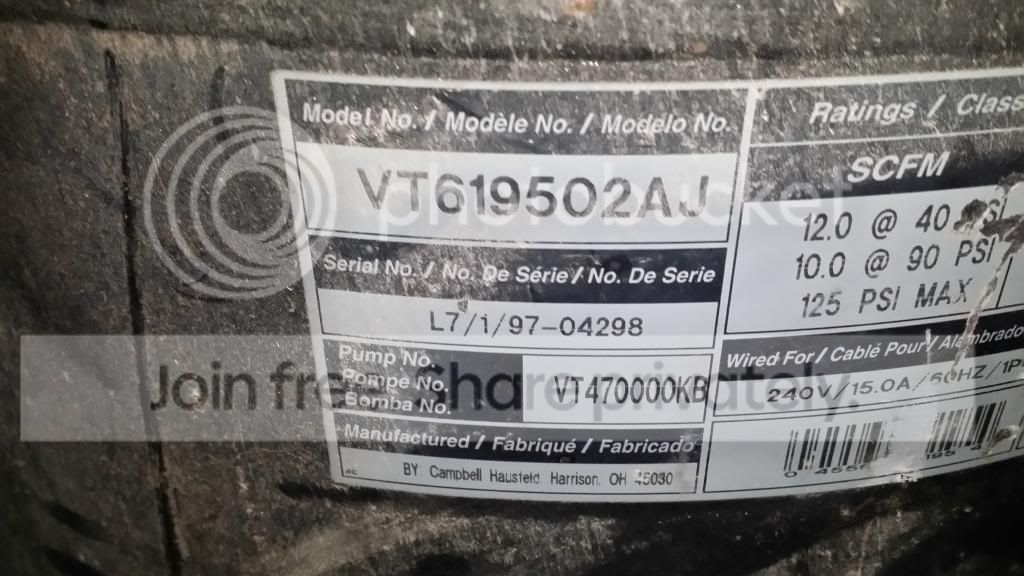
Anyway, a little detail, it is a 60 gallon, twin cylinder 6 HP unit. It is pretty obvious, at least up close, that is was blowing oil out of the back cylinder at the upper gasket. The problem I have is I need to identify the pump head for certain, the PO stated they had replaced the pump head at some point, so I make sure I get the right gasket set. Is there supposed to be any markings on the head? The tank appears to be from 97 based on info on the tag, but I don't see any markings on the head itself to identify it. He picked it up for $250, which is what I'm paying him, so if I had to go worst case scenario I could always replace the whole head and still be within the value of the unit I think.

Here are a few pics for reference:

Overall:
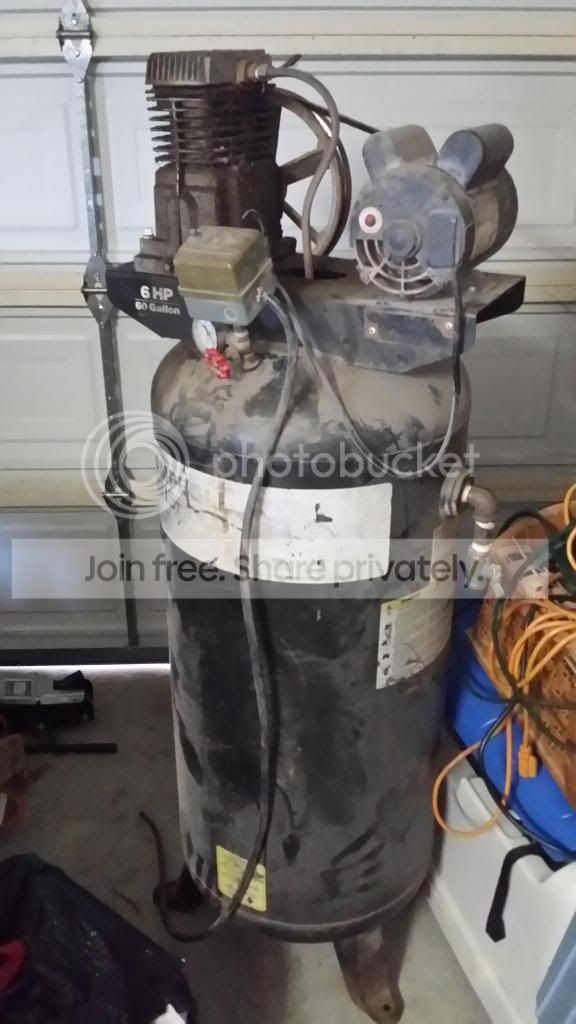
Head close up(side):
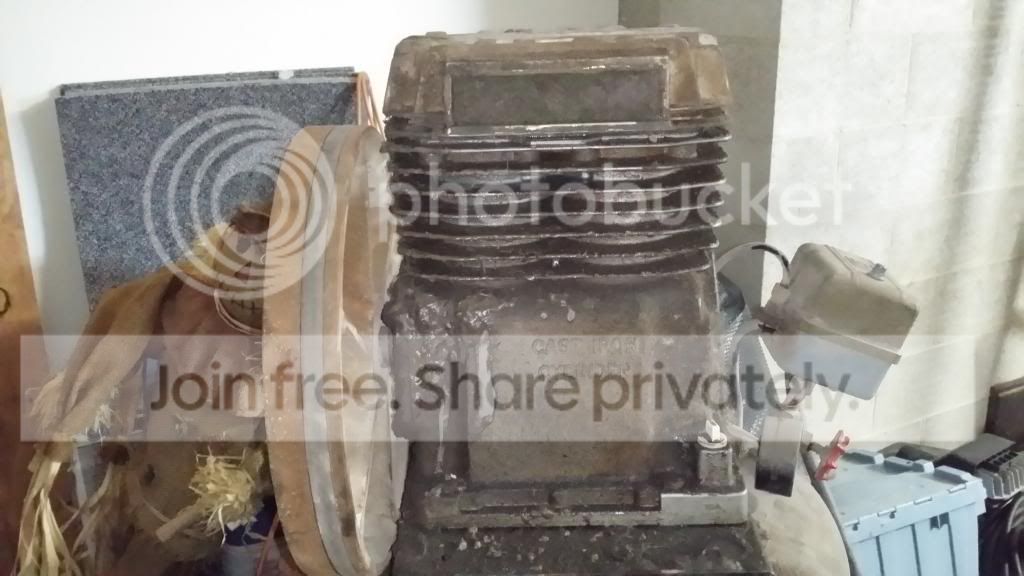
Front view close:
ID tag:
Motor ID tag:
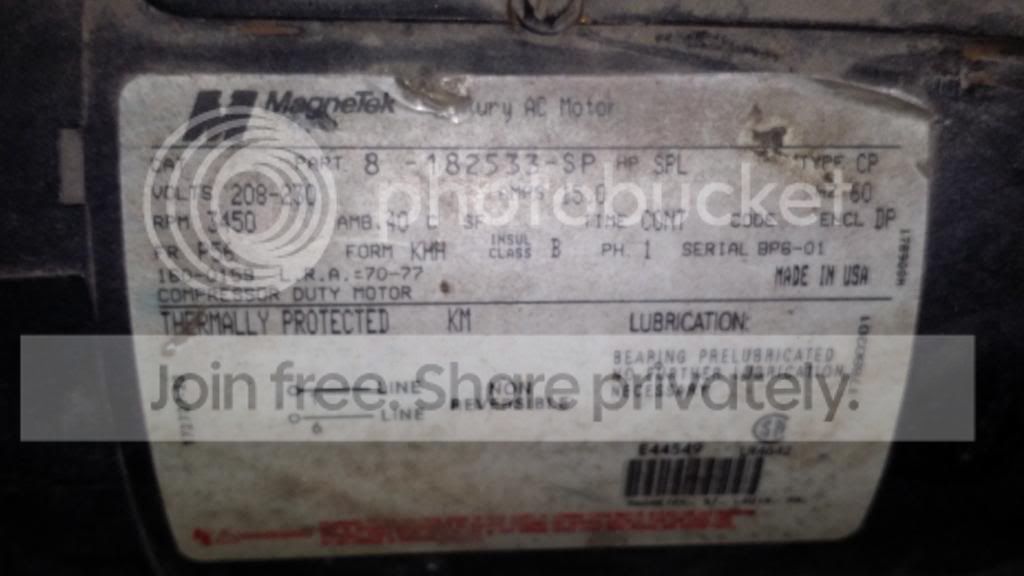

So, any tips on identifying the pump head? Any tips on mounting it, as I have never actually had a big compressor.

Working on the garage this weekend to hopefully get it cleaned up and figure out where I want to place the compressor. Also need to get with a buddy of mine to run the power out from my secondary range circuit as we don't use it and I want the 220 in the garage for this and a welder or two.
 
You may be able to get a whole new pump cheaper than you can fix that one. Most times when you fix one issue with a worn out pump, another one will pop up.

Google up Eaton Compressors in Ohio, I had one of their big compressors for years. When I had a problem with the pump and called about re-build/repair they sold me a whole new pump cheaper than the parts.
With a new pump, you essentially have a new compressor as the motors rarely go out.
 
grandger(i know this spelling is not right) used to sell the materiel to cut your own head-gasket materiel, did it before in vegas with a cheap harbor freight unit
 
Don't plan on painting with that compressor, you will not be happy as the CFM's aren't large enough to support painting.
 
When I looked into fixing mine, I found that it was MUCH cheaper to just buy a new pump.
 
After doing some research this weekend, it appears that Campbell discontinued this pump and they make a replacement that has slightly higher CFM to bolt on. Most likely just going to go that route.

As for painting, final paint will be done by a shop with a booth because the Camaro paint is a multi-stage job and I'm not skilled enough to do it myself. I'm mostly looking at spraying the primer so I can basically do the majority of the body work and save me some money when it comes time to spray.
 
Do your self a favor and check the inside of the tank for rust before you spent anymore money. Also replace the pressure relieve valve.
Not worth taking a chance on any used compressor....If you want to scare the sh!t out of yourself, just do a search on compressor explosions.
 
I dont see why its not good enough to paint with...I painted a few of my trucks with a Speed-Air 2 cylinder pump on a 60 gallon tank that only had a 1.5 HP motor--yeah,it ran a lot,but it did just fine,and I was using an old "air hog" spray gun that was a copy of a JGA Devilbiss,a newer one like a HVLP or gravity feed one would use much less air...

I've seen paint sprayers from the 50's that were just dinky one lungers with a 1/3 HP motor and NO air tank...they were used with old school spray guns too...

The things I had trouble using with my compressor,that only topped out at 110 PSI and had maybe 6 CFM output at 90 PSI,was things like a DA sander and bondo board sanders,and air cut off tools and impact guns..you had to wait for it to build up full PSI and then it wouldn't be long before it turned back on again...
I never had the thermal overload cut out on me no matter how much it ran though,even when painting my van with it,which took a good hour or more...(I gave up painting vehicles at home because I had problems with moisture getting in the paint from the compressor,complaints from neighbors about the overspray and odors,etc)...

You may want to check out the www.surpluscenter.com website and see what they have for new pumps on sale--they have had some good ones there cheap before..
 
Do your self a favor and check the inside of the tank for rust before you spent anymore money. Also replace the pressure relieve valve.
Not worth taking a chance on any used compressor....If you want to scare the sh!t out of yourself, just do a search on compressor explosions.
I planned to do that when I pull the pump, which is the first thing that needs to happen anyway. As for the pressure relief, yeah I've seen the results in the past and I will be replacing it.
Edit: I should also point out that I'm leaning towards mounting it outside my garage and building a small enclosure for it. Mostly to keep the noise down inside while I'm working, but also for the possibility of catastrophic failure.


Painting is one thing I just don't know how to do at this point, but I do plan to learn. The problem is that the Camaro paint is a silver metal flake base, candy green apple, clearcoat and finally satin black accents, and I just don't feel comfortable doing that for my first paint job. However, I can spray the high build primer and the sealer, as well as replace what little rust is there and have it ready for paint. That should lower the cost if I supply all the paint and just need to pay someone to spray it.
 
Last edited:
Ok, another question along the same lines is garage air line. Basically I'm leaning towards the Rapid Air system, as their basic package includes 100' of tubing and pretty much everything I would need to set up a basic supply system for my garage and cost is pretty decent at about $140. A Garage Pak system is going to be closer to $300 and is limited to one wall, while the Rapid Air system could be run to both walls in the garage, giving me more flexibility long term.

So, what does everyone here run? Any systems that you have found are better? Either way it will be run through a water seperator, but I don't want to try PVC.:haha: My garage is certainly not huge, but it is oversized for a 2 car garage (nearly big enough to have my Durango, Camaro and Toyota pickup in it at once), so I really don't want to be dragging hoses everywhere. Just thinking a system that could supply air to hose reels.
 
Compressor

I'm not a specialist by any means, but I can offer the information I've came up with while building and researching the compressor I'm putting together. Hope it helps.

As for the compressor, I wouldn't even hesitate to replace the single stage pump/cylinder with a 2-stage. The 2-stage is simply a pump with 2 cylinders. This will easily keep up with any task you throw at it and who wants to listen to the air compressor trying to keep up for your entire project. The big difference between the 1 and 2 stage pumps is that your compressor will recover a lot faster doing small CFM demand projects and also handle the high CFM projects.You could even upgrade to an 80 gallon in the future if you want to. The 6HP motor will be able to handle a high CFM pump. If your going to do anything then you might as well build up a compressor that you will never have to touch again no matter what project you throw at it in the future. Spend a little money now and get a nice pump. You can find 14-19 CFM pumps everywhere from ebay to harbor freight for $120-$180. Do not buy a dry pump (no oil). They will not last. They are very easy to swap out. I'm currently putting one together with a 5HP motor, two stage pump delivering 17.5CFM @ 40/15.2CFM @ 90 with a 60 gallon tank. Just to put the costs into perspective, the compressor build up that I'm doing would range from $1,200-$2500. So when you look at the cost of a new pump it is almost irrelevant compared to what it would cost to purchase a compressor with that level of air delivery. A home depot 60 gallon single stage low CFM compressor is around $500 and that is no better than buying a 25 gallon as for CFM delivery.
 
It is already a twin cylinder pump, but flow isn't nearly at 14 CFM. Not a huge deal though, I think it will be enough for most anything I will be throwing at it. The replacement pump will still be twin cylinder, but at least staying brand correct, the average pump is about $250 online and puts out slightly higher CFM. Noise won't be much of a concern if I put it outside the garage as I'm leaning towards, unless I try to run at night when the neighbors are sleeping.:haha:
 
I'm not a specialist by any means, but I can offer the information I've came up with while building and researching the compressor I'm putting together. Hope it helps.

As for the compressor, I wouldn't even hesitate to replace the single stage pump/cylinder with a 2-stage. The 2-stage is simply a pump with 2 cylinders. This will easily keep up with any task you throw at it and who wants to listen to the air compressor trying to keep up for your entire project. The big difference between the 1 and 2 stage pumps is that your compressor will recover a lot faster doing small CFM demand projects and also handle the high CFM projects.You could even upgrade to an 80 gallon in the future if you want to. The 6HP motor will be able to handle a high CFM pump. If your going to do anything then you might as well build up a compressor that you will never have to touch again no matter what project you throw at it in the future. Spend a little money now and get a nice pump. You can find 14-19 CFM pumps everywhere from ebay to harbor freight for $120-$180. Do not buy a dry pump (no oil). They will not last. They are very easy to swap out. I'm currently putting one together with a 5HP motor, two stage pump delivering 17.5CFM @ 40/15.2CFM @ 90 with a 60 gallon tank. Just to put the costs into perspective, the compressor build up that I'm doing would range from $1,200-$2500. So when you look at the cost of a new pump it is almost irrelevant compared to what it would cost to purchase a compressor with that level of air delivery. A home depot 60 gallon single stage low CFM compressor is around $500 and that is no better than buying a 25 gallon as for CFM delivery.

Think you better read up on the difference between a single and two stage compressor.

What is the difference between a single and two stage compressor?


The simplest way to explain the difference between a single stage compressor and dual or two stage compressor is the number of times that the air is compressed. In a single stage system the air is compressed once and in a dual stage the air is compressed twice.

In a single stage piston compressor the air is drawn into a cylinder and compressed in a single piston stroke to a pressure of approximately 120 PSI. Then it is sent to the storage tank. All rotary compressors are single stage.

In a dual stage compressor the first step is the same except that the air is not directed to the storage tank, the air is sent via an inter cooler tube to a second, smaller high pressure piston and compressed a second time and compressed to a pressure of 175 PSI. Then it is sent through the after cooler to the storage tank.

Customers sometimes confuse the fact that a piston compressor has two pistons with it being a two stage design. Most single stage pumps are twin cylinder design as this is easier to balance than a single piston. If the cylinders are the same outside diameter it is a single stage pump.

In a dual stage pump the first stage cylinder is always a larger diameter. Also a dual stage pump will always have an inter cooler tube or finned housing attached to the pump to cool the air before being compressed a second time.

This higher pressure allows greater storage in the tank. An 80 gallon receiver tank will hold 83 cubic feet at 100 PSI. The same tank holds 120 cubic feet at 150 PSI.

More importantly a dual stage compressor can easily maintain a header pipe pressure of 125 PSI. This is ideal in order to have 90 PSI at the end of the hose for the air tool inlet. A single stage compressor will let the header pressure drop below 90 PSI. This will lower the tool inlet pressure below 70 PSI affecting air tool performance.
 

Latest Posts

Top Bottom