CK5
Register an account today to become a member! Once signed in, you'll be able to participate on this site by adding your own topics and posts, as well as connect with other members.

alternator wiring confusions

mwood1985

1/2 ton status
Joined
Jan 20, 2011
Posts
294
Reaction score
0
Location
Marietta Ga
ive spent the last couple hours trying to research it and im thoroughly confused. the previous owner cut a lot of wires out of my 88 blazer. I put my 70s 350 in it with a carb and hei distributor. I figured out the wiring for the lights but the alternator has me stumped. there is 12 volts with the engine running. if I use a wire to jump directly from the alternator BAT post to the positive terminal on the battery I get 13.59 volts. I have a 2 wire plug internally regulated alternator. delco 10 style I believe. where exactly does each wire go? also with the engine running the courtesy lights are BRIGHT and only are on with the engine running. the headlight switch seems to have no control of them and they have power even with the fuse out. cut the engine off and turn the switch to run and no lights. could they be wired into the alternator somehow ?
 
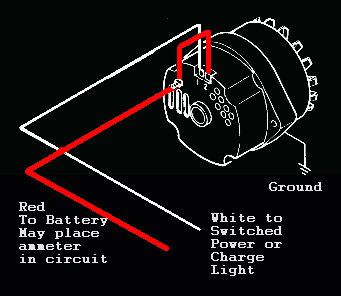
I found this let us know if it helps

alt.gif
 
Three wire. One stud, and the two wires that have a plug.

This main red wire on the stud is outgoing power from the alternator. The wire on the stud needs to go to a junction block. One wire from junction block goes to positive battery terminal (that's what the small gauge wire on the main battery cable goes to). This recharges the battery.

From that same junction, another wire should feed into your main fuse panel for incoming power.

Two wires that should plug into the alternator should be labled 1 and 2, if you look closely at the body where the plug goes. Usually it's a brown and white wire.

#2 is the brown wire. voltage sensing, tells your alternator how much voltage to produce. This can also go to that same junction block. It needs to go to a junction block to compensate for voltage drop. This is what will give you your 14.4v charging, otherwise you'll be at 12v.

#1 is your white wire. Your field/excite wire tells your alternator to charge. Also goes to your idiot light/gauge.


At least I think I got that right, it's been a while. I think I've written this a few times. Think I'll go find it.
 
Last edited:
It's bed time, I'm too tired to find any of my other posts.


MODS (think I'd remember some names by now) Want me to build a write up for this with info and pics explaining how why when and where.
 
The #1 wire needs a 12V source thats only hot when the key is in the "ON" position...the #2 wire can be hooked directly to the stud on the altenator where the thick red wire goes,but that may result in it over charging,that #2 wire has either a resistor or the "ALT" dash lamp wired in series with it from the factory,to reduce the input voltage some...if you let it get a full 12V,it will charge at its maximum output constantly usually,the resistor or resistance of the bulb reduces the voltage it "senses" so it will allow the regulator to work normally...
 
Yes, #1 field/excite, power supplied like mentioned above when in the on position to excite the field windings. The alternator cannot start charging until there is voltage on the field windings and a magnetic force is created. #1 to charge light, ignition cylinder, power source. (So technically it's backwards). #1 field/excite goes to idiot light and ignition cylinder, not #2 sensing wire.

It's nice being awake :) Mainly I'm reiterating what you said for my own benefit :D


#2 "Remote voltage sensing" This is where we differ. Yes you can put it directly on the stud, but here is why you should not, and this is why GM did not. It goes to the regulator (we're talking internally regulated of course, 3 wire Delco 12-SI type) to determine how much voltage is present. If you put it on the stud, there's no compensation for voltage drop, it will think you're just fine, because it's going directly on that stud 1-2" away, no multiple connections, length in wire, etc.

This is why you put it on a junction block (stock configurations have one usually near the battery). Because further downstream you can and will have voltage drop, so for example 14.4v output on the BATT stud, might mean 13.5v at the junction block, 12v at your fuse panel, 11v at your power window switch and 10v at the power window motor.... And for us that like to whine, 8v for that slow AZZ passenger window :haha: (Yes exaggerated)

You want the voltage sensing wire far away from the power source (alternator). The regulator will do it's best to keep the system at 14.4. If it's on the stud, it thinks it's ok, but sure enough downstream it's already dropped. So if you put it downstream on the junction block, the regulator will boost to 15.4v at the BATT stud to compensate for the 1v voltage drop down at the junction block, and keep a optimum 14.4v. Overcharging is bad and good. Bad overcharging is like 18v, your regulator is having issues, something's wrong with it. Good overcharging is 13,14,15, maaaaybe 16v, just all depends on what it needs. If your voltage is low, it boosts it to maintain (usually 14.4) voltage in your system.


I broke it down barney style for the OP and others who search.


I think I do need to make a very detailed and easy to understand write up. Probably best with pictures specifically for Chevy square body wiring. Because it all does change, idiot lights, ammeters, volt meters, different cars, trucks. It's all the same at least in principle and theory, just WHERE it runs can be different. I could have a sub area for 1 wire 10-si style externally regulated alternators for older trucks as well. (though I'm anti-1 wire) There's a lot of confusion on how and why. I mean, even something as simple as why your older 1 wire externally regulated alternators go through your horn relay :) And why you more than likely don't NEED that shiny expensive 140amp alternator you think you do.
 

Latest Posts

Top Bottom