CK5
Register an account today to become a member! Once signed in, you'll be able to participate on this site by adding your own topics and posts, as well as connect with other members.

BBC swap - now gets hot**MOD UPDATE

pismo, what condition is your radiator?

What water pump do you have?

What temp guage?

I have a 489 in my truck I just built last summer and I ended up with a big aluminum radiator.

You need controlled high airflow, suifficient water flow (I have an edelbrock pump), a big enough radiator, and make sure you have the bypass hose. Big blocks don't have a bypass in the block like small blocks do. They need that.

A 4 core or better should be fine, as long as it's clean and functioning well.
 
The radiator is the stock '79 as far as I know, and I had is flushed and serviced about ten years ago.
The water pump is a stock BBC I think, it was on the engine when I got it and seems to flow well.
The temp gauge is a Stewart Warner and has always been accurate and a good, solid gauge.
It has a 1 year old heavy duty fan clutch on it and a good shroud...so I think I might go to a 180* t-stat and see how it goes, then possibly Windstar fans. But I need to know what year to look for a try to get.


pismo, what condition is your radiator?

What water pump do you have?

What temp guage?

I have a 489 in my truck I just built last summer and I ended up with a big aluminum radiator.

You need controlled high airflow, suifficient water flow (I have an edelbrock pump), a big enough radiator, and make sure you have the bypass hose. Big blocks don't have a bypass in the block like small blocks do. They need that.

A 4 core or better should be fine, as long as it's clean and functioning well.
 
The radiator is the stock '79 as far as I know, and I had is flushed and serviced about ten years ago.
The water pump is a stock BBC I think, it was on the engine when I got it and seems to flow well.
The temp gauge is a Stewart Warner and has always been accurate and a good, solid gauge.
It has a 1 year old heavy duty fan clutch on it and a good shroud...so I think I might go to a 180* t-stat and see how it goes, then possibly Windstar fans. But I need to know what year to look for a try to get.

My bet is that the radiator is bad. I haven't seen a radiator that will last 10 years.
 
My bet is that the radiator is bad. I haven't seen a radiator that will last 10 years.


I've seen many last much longer than that but I certainly wouldn't assume that a decade old radiator is "good", I agree with Scott and I'd seriously look into having your radiator checked or getting a new one.
 
Replace the radiator and you'll fix your problem. Another question how old is the thermostat? Perhaps just replacing that will fix a problem with a sticky tstat. A low temp stat wont cause overheating unless your cooling system has other problems. Even still not caused by to low of a tstat.

Edit: saw those reads on prev page and was just what I was going to refer. :doah::waytogo:
 
If I am going to replace the radiator...should I go aftermarket aluminum or the previously mentioned 1994-98 BBC Suburban radiator? What radiator support changes would I need to make for that?
 
If you change the rad I'd go for one from a 81-87 6.2 application, it's still a 4 row but wider than the typical gas 4 row unit.

Definitely try the t-stat first.

I'm sure it's not the problem but if you don't already have a 7 blade fan that would be a good upgrade to the cooling system as well.
 
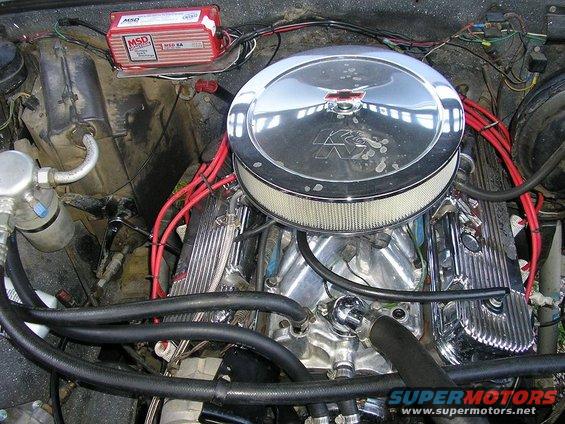
Here is a pic of the coolant hoses (and A/C line clamped to the alt. brkt.). Can you tell me which way the coolant flows in all the lines to make sure I have it plumbed correctly? I also have a 6-blade fan with the heavy duty clutch...can I get one with more blades and would it help??
coolant-hoses1.jpg
 
Here is a pic of the coolant hoses (and A/C line clamped to the alt. brkt.). Can you tell me which way the coolant flows in all the lines to make sure I have it plumbed correctly? I also have a 6-blade fan with the heavy duty clutch...can I get one with more blades and would it help??
coolant-hoses1.jpg

I think you have too many bypasses. The hose next to the heater hose in the water pump that goes to the intake manifold, take it out and plug the holes. Then run it and it should run cool/normal temp. You are bypassing the radiator and most of the hot water is just recirculating in the block and not going through the radiator at all.
 
Interesting! So remove the short little stubby hose? Then use the other bypass on the top of the pump to the heater core? I do not have any heater hose going to the radiator either since the left (in the pic) bypass goes to my coolant filter, then to the heater core. Then the other hose leaves the heater core and goes to the intake. I just plugged the radiator heater hose port.
 
Fwiw, on my old 454 I had a hose from the water pump to the core and another from the core to a nipple on the pass radiator tank. I also had the shorty bypass from the pump to intake. With a 4 row rad, heavy duty fan clutch (dually w/ 4.56 gear application), a 7 blade fan and a 192* thermostat mine never ran hot (knocks on wood) and stayed rock solid on 195*.
 
I'm thinking it all looks good. leave that shorty bypass on there. water flow through the core shouldn't matter what direction it takes. the waterpump pushes it to the core, and it returns on the manifold. Is your waterpump the correct rotation?
 
OK, so Im coming into this late and Im far from an expert. I have been running a big block for about 7 years now (454) and had some of the same issues your having early on. My experience is big blocks tend to run hotter and are harder to keep cool than your average small block. Add to that the mods you described and its bound to be a little harder to keep cool. Its just my opinion, but the 180 thermostat does slow the flow down allowing more heat dissapation at the rad. In my case, I started at about 220 degrees and added a 180 therm, flowkooler water pump, flexalite electric fans, a 4 core big block rad, hood louvers, a hayden oil cooler, pulled the trans cooler out of the rad, and finally a high performance aluminum radiator from a place called Alumorad.com and finally it runs around 180 under almost all conditions. My motor is pretty modified and I run it hard in mud, dunes, etc and it stays pretty cool now. Check out alumorad.com and read their article "radiator myths". For me, the bottom line was I just kept at it until I got where I wanted to get.No one thing fixed my problem and as hard as I ran it, I didnt expect that a stock cooling system was going to cut it. Turned out I had to make quite a few mods to make it all work
 
Olan - good link to the alum rad place. Prices are decent. Since I will need a rad soon, I may consider getting the 6.2 unit for $280. My stock BBC also tended to get hot. In summer I run a 160* t-stat, in winter 180*, and it keeps the heat in the correct operating temp.

Hoses look correct. I would keep that little shorty bypass in there.
 
Myths in the Radiator Myths

I read through the myths on alumorad's site. I appreciate the effort to sell aluminum radiators but physics is physics. Yes heat transfers through the tube to the fin. The more tubes the more contact points the more transfer. yes there is a law of diminishing returns but going from 2 to 4 tubes cores will not achieve it anytime soon. The reality is copper costs more and is demanded more for real heat transfer applications largely because is has 2xs the BTU transfer rate of aluminum. Copper costs more to produce because it requires more skill and time than simply gluing and crimping plastic tanks on Aluminum cores. True aluminum is lighter weight for all you k5ers who are worried more about mpg and global warming than cooling your engine.

Years ago the cheaper copper and brass radiators used a 1/2 inch or 5/8 inch tube with a lap seam solder bond. A better design emerged in a 3/4 inch lock seam welded tube and copper radiator manufacturers use it today. Joints may fail and are repairable but the idea that copper radiator tubes burst under pressure is a false and misleading effort to sell Aluminum radiators.

Aluminum radiator manufacturers have convinced the world that producing a product designed to fail that used lower cost materials manufactured by lower skilled labor in a third world country is a great way to sell product again and again. It does not mean it cools a k5 any better.
 
Is there a disadvantage to not running a heater hose to the radiator tank? I could not run the one to the top of the intake manifold. I hooked this engine up with the same pump and hose configuration as the truck I pulled it out of...but I have no history of running it to see how it operated.
 
All intersting info. All I know is that when I changed from a new copper rad to the aluminum one of the same size, with all other things being the same, I dropped about 10 degrees in engine temp. I tried two different 4 core copper rads with the same results. In my case, I used an all aluminum rad, not one with the crimped on tanks. Couldnt tell ya why it works, but it helped alot. Weight was not an issue for me, but the aluminum rad was way lighter.
 
On my 350, I have a heater hose going to the radiator, and the other goes to the intake manifold. It goes to the back near the distributer, but I don't think it matters. You can always try different hose routes for free before you plunk down the cash for new and possibly unnecessary parts.
 

Latest Posts

Top Bottom