CK5
Register an account today to become a member! Once signed in, you'll be able to participate on this site by adding your own topics and posts, as well as connect with other members.

Boat carb, cam, engine questions.... 355 chevy.

Fabrimacator21

1/2 ton status
Joined
Feb 21, 2009
Posts
2,447
Reaction score
0
Location
Redding
Due to recent events and a run in with some of brb's buddies (don't ask):rolleyes: I'm in need of some money quick. So it's looking like the blazer may be the victim. :( I'm planning on pulling this http://www.coloradok5.com/forums/showthread.php?t=254589 motor out and dropping in a junker 350 to sell it.

The crate motor is a good canidate for the boat which has a 305 200hp sbc in it right now. Looking to hit somewhere around 65mph with the 350 in it.

Specs on the motor are in the link... it's pretty much the same combo as the 350hp corvette 327's from back in the day but a 350 instead of 327. My question is what carb cfm should I be looking at for it? Would a stock carb off a 327 work? I have zero experience with carbs on actual truck/auto motors so here comes the stupid question... will I need to tune it? I'm a little worried about just throwing a carb on a new motor and hoping it's not running lean somewhere. I know plug reading helps but aside from sticking a o2 sensor on it how can you tell if it's getting the right amount of fuel throughout the powerband?
 
Last edited:
Assuming you are talking about the boat you have posted about before.
I would not put that engine in that boat. From the specs in your link it looks like it would move a light car very nicely. But getting a heavy boat out of the hole is a different matter. 10 to one is too much compression for anything but a drag boat.
Detonation will be your enemy. Your tuneing must be perfict. Too much timing and or lean mixture will kill that engine in a very short time. IMHO That engine would not last long in a boat. It may not have enough torque on the bottom end to get it out of the hole without a low piched prop. That would kill your top end and you may end up with a boat slower than it is now. I have known people who built some hot car engines. when they dropped them in a boat they were very disappointed.
A boat engine is a totally different animal than a car engine.
 
Hmmm.... so if I lowered the compression a little should it be ok? Maybe use some thicker head gaskets or different heads? 91 octane is about all we have out here. Maybe some octane booster?

The boat gets out of the hole very nicely with the 200 hp 305 thanks to the 17 prop and power trim... The trim makes a huge difference. However I'm a noob to this stuff so I really don't know how much more pitch will affect it.

Just gonna take a wild guess here but I'm gonna guess that the 355 has to be making at least another 50-75 ft lbs at take off rpm (but like you said, marine motors are a different animal so it might have a tq cam in it)... and another 150 hp up top. A cam swap is not out of the question either. My original plan was to put a tq cam in it and prop it high to save gas mileage while still getting a nice top end gain.
 
youre selling the blazer cuz you need money..... your looking to spend quite a bit to put this engine in your boat......

just sayin.

other than that, the engine should be fine from my understanding, youll need to "marine-ize" it. im not a boat guy, but i know the thermostat, cooling system, freeze plugs, and probly a few other things are marine use specific.

I would drop a line to mercruiser, tell them the stats of the boat, and the exisiting stats of the engine. I agree a lower compression will be necessary, maybe 9:1 instead of 10:1, but mercruiser will probably be able to give you some suggestions for jetting and settings on the carb for marine use.

if all else fails, as handy as this forum is on blazers.... you might consider looking for a boat forum and making some friends there.
 
don't you need a marine carb too.

Or is that Naval?
 
That is a good idea..... I have done a little research and apparently I will need a marine carb.

As far as spending money to put it in I don't see it being too much... maybe 150 for a different cam, and we'll see on the heads. I have a bunch of holley tbi stuff too that I'm gonna sell so I should be able to get it in the boat and running without spending much out of pocket... maybe 300-400 or less.

Funny thing is I can't find my boat ANYWHERE on the net. 1978 galaxy trihull but it has a v8... can't find it anywhere. As far as I know galaxy went out of business a little while ago. I'll try mercruiser and see what I can come up with.
 
Just a question--wouldn't swapping in a much bigger cam be just as effective as lowering the static compression for his purposes? Would lower real compression and give the engine much more top end, making it more effective for a boat which is usually direct drive and high rpm . . .

I don't know anything about props, or even boats in general really, just thinking about the engine . . .
 
not necessarily a bigger cam, but at least one with more overlap, you are correct would lower effective compression at lower rpms.
 
I ran the numbers for the engine you have in the link.
If your CR is 10 to one and no more. a Comp XM262H would work with your engine.
without dropping the compression ratio. Might want to call them to make sure. The same cam will also work great in a 9 to 1 engine too. It is a Torque building marine cam good up to 5500rpm.
of course you will have to run good gas and not too much timing. No more than 10 degrees IMO. Start off around 6 to 8*
Yes you need a marine carb. Many boats have caught on fire and ruined the owners day from using a carb designed for a car. Marine carbs have slosh kits And vent tubes designed to route gas into the manifold where it cant cause a fire.. Instead of outside the carb in case of flooding. Also you should get a flame suppressor/air cleaner for the top of the carb.
Marine carbs are pretty expensive. Either 650 Holley or q-jet will work depending on what intake manifold you use. You can get a rebuilt for a lot less than new.
For jets i would use what comes with the carb to start. Marine carbs are usually jetted on the rich side. After you get the engine broken in. Take the boat out and do a few short WFO runs and do a plug reading. Make sure it is not running lean or detonating. If it is you will need bigger jets and or less timing.
 
thanks for the cam advice.... I'm gonna play around with DD and see what that looks like. Any ideas on where to find flow info for camel humpers?

I joined a few boat forums but none have any info or sections on motor building. I did find this article though.... Theres a good combo this guy used to get 340 hp under 5k (my I/O isn't supposed to spin over 5k otherwise the oil overheats.)


A few years ago, I spent a couple of hours thrashing a 260 hp 350 Chevy on the dyno, looking for an inexpensive performance kit that could be installed on an engine in the boat. The goal was to produce more than 300 hp without exceeding 5000 rpm, with nothing more than a cam and intake/carb change.

I started with a stock fresh rebuilt engine with stock 1.94 valve heads, fitted with stock marine center riser manifolds, 3" risers, dry exhaust, stock marine cam, and a stock cast iron intake with a marine quadrajet. After the initial break in, the engine produced 249 hp on a 600 rpm/second acceleration pull, and 269 hp on steady pull, at 4500 rpm. I was surprised to discover that at 5000 rpm, horsepower increased to 273. That got me thinking.

After 25 additional pulls to evaluate various cams up to 284°/.469" lift (218° at .050"), carburetor and intake manifold combinations, and a change to 4" risers on the exhaust manifold, the engine finally made 302 hp at 5000 rpm with a Cam Dynamics 272 hydraulic, 14096011 Chevrolet intake ñ a cast iron version of the Z-28 aluminum high rise, stock Q-jet and 4" risers.

A wolverine WG 1159 dual pattern cam with 280 int/290 exhaust duration (214/224 @ .050") and .465" lift out pulled the Cam Dynamics 272 in the 2500 to 3500 rpm range, but by 4000 rpm was falling behind and only made 295 at 5000 rpm. A Cam Dynamics 278 made 310 hp at 5000 rpm and went to 319 hp at 5250, but was unacceptable below 3000 rpm and would make a boat harder to get on plane.
I tried 1.6 rockers on most of the cams, and although probably a nice tuning tool, offered no startling improvements. Fuel specifics for any of these combinations which included a Holley 4781 (850 double pumper) and an 84018 (750 marine) carburetor, were terrible, as high as .75 lbs/hp/hr, indicating that the engine was at it's limit in the breathing department.
Fuel specifics remained poor throughout, in spite of efforts to rejet the carburetors to improve the situation. The rejetting usually lost horsepower or made no significant change, and was undesirable from the point of trying to use off-the-shelf components. The cams were installed as ground, to minimize the technical abilities of the installer.


"Holy cylinder heads Bat Man!"

At the conclusion of the cam tests, I installed a set of 74 cc Dart/World Products heads which I had done minor pocket porting on, with 2.02" and 1.60" valves. With the Cam Dynamics 278 still in the motor, and the Chevrolet high rise intake and Q-jet carb, horsepower jumped to 340 at 5000 rpm, and the fuel specifics went from .73 to .58. The substitution of the 750 Holley marine carb added another 10 horsepower. Best yet, the horsepower at 3000 jumped from the stock 208, up to 223. A total of 44 runs was put on this little mouse during the thrash. I feel confident that optimizing this combination by decking the block or installing the marine .018" stainless head gaskets, and surfacing the cylinder heads to get the true compression up in the area of 9.5 to 9.75, advancing the cam a couple of degrees, and perhaps the addition of 1.6 rockers, carb jetting, timing adjustments, etc., and this combination would be good for 370 hp or better.
Also I may not have a strong enough I/O for a 300+hp motor... still doing research on that.
 
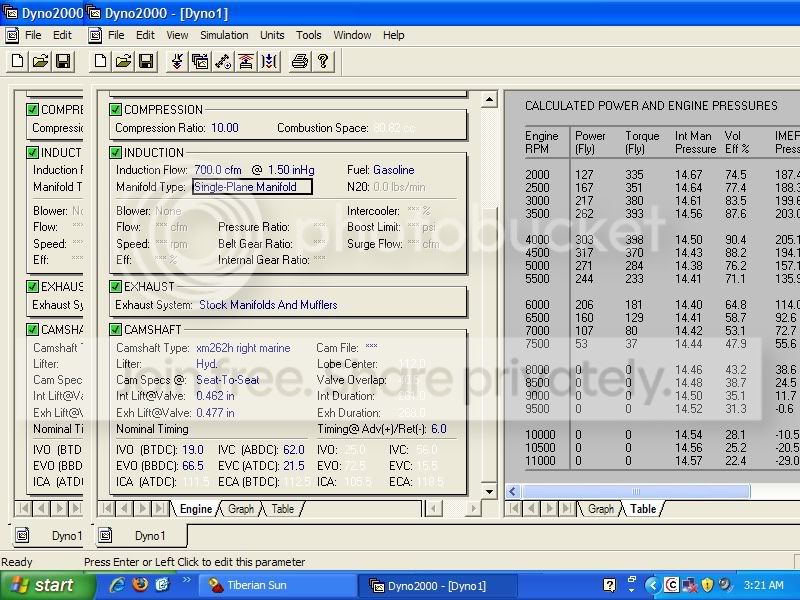
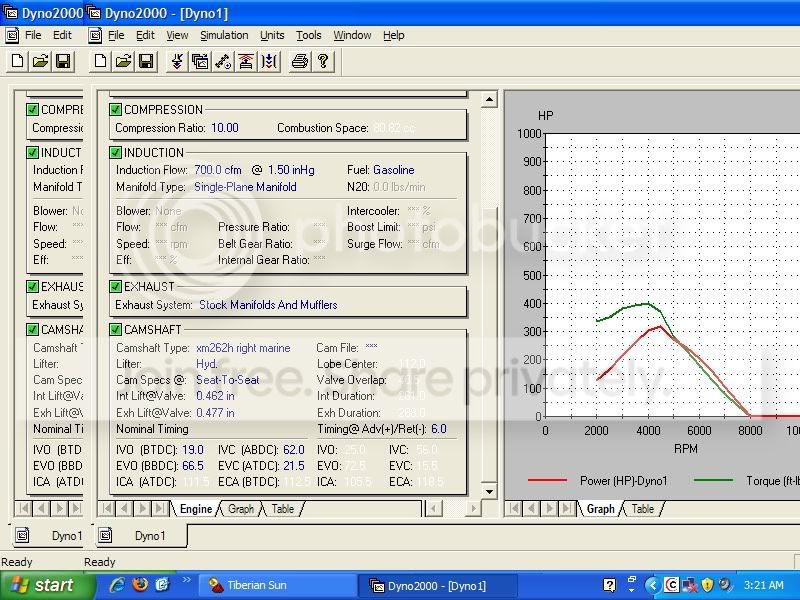
heres the crappy DD numbers.....

sorry for the bad pic.... had to copy and paste into paint.

desktopdynox262boat.jpg


desktopdynox262boatgraph.jpg


peak numbers were 317hp at 4500 and 398 ft lbs at 4k... which is nice because it's all in under 5k. Tq looks really good too... 335 ft lbs at 2k.
 
Top Bottom