CK5
Register an account today to become a member! Once signed in, you'll be able to participate on this site by adding your own topics and posts, as well as connect with other members.

Brother needs help with alt not charging.

GsxrMike

1/2 ton status
Joined
Feb 12, 2008
Posts
1,702
Reaction score
2
Location
Tonganoxie, KS
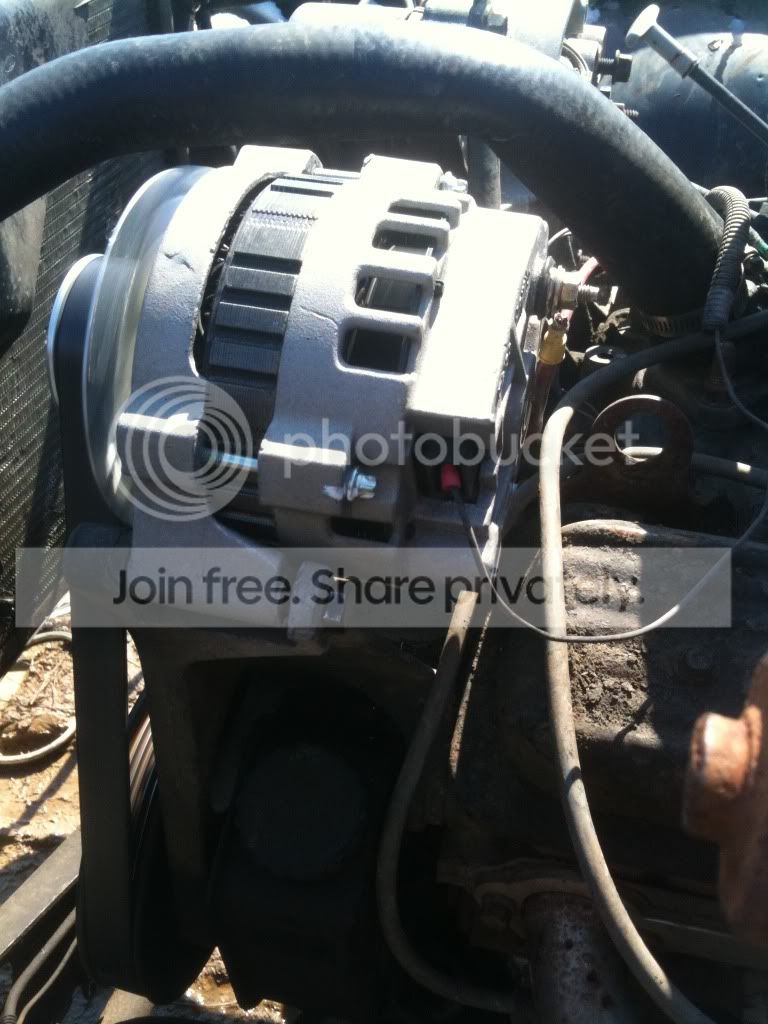
OK, I just typed like two paragraphs but I confused myself so I deleted it all. My brother upgraded to tbi recently and installed this alternator on his blazer (see pic). Ever since then we haven't been able to get the truck to run w/o the battery hooked up. (Alt not charging) A guy told us that one of the terminals on the 4 pin connector needed a 12 volt ignition source to "turn the alternator on". With nothing connected to the 4 pin we get nothing out of the terminal on the back of the alternator but if we connect 12v to the highest terminal on the 4 pin (in the pic) we get 14.6 out of the terminal on the back of the alt. I thought it was fixed but if we disconnect the battery the truck dies instantly. We have ohmed out the wire that goes from the back of the alt to the terminal block on the firewall and on the the + side of the battery and have almost no resistance from the + side to the back of the alt. I don't get it? Any ideas?
88bd7334.jpg
 
Yes you need an "exciter" wire to make this style of alternator charge. Disconnecting the battery is a GOOD way to fry one of the diodes in the alternator.
 
Let me see if i can find some paperwork i have laying around here somewhere. Once i find it i might be able to tell you how to wire it properly.
 
Have you got a 75ish ohm 3 watt resistor connected between the wire you've got running into the connector and a +12V ignition controlled power source? These alternators use that wire for both excitation and also charging failure indication via an idiot light in the dash. If you don't have an idiot light, you need the resistor installed to simulate the resistance of bulb that would have been there stock. Without it, the alternator will not charge.

You shouldn't need to connect anything to the larger spade in the connector for the alternator to work. I have a 90 electric speedometer instrument cluster in my truck, which has an idiot light installed in it for the alternator. I have 12V ignition power connected to one side of the bulb and the other side of the bulb connected to the wire you have connected on the alternator. If it is not charging, the alternator appears as a ground to the light and turns it on.
 
Let me see if i can find some paperwork i have laying around here somewhere. Once i find it i might be able to tell you how to wire it properly.

:bow::bow::bow:

If you get that paperwork out could you also let me know what the other three terminals on that 4 pin do?

And as far as the diode thing, how would it fry a diode? Just by disconnecting it or by accidently grounding the positive cable or something? And is it just with this style alt or any alt? The reason I ask is because I have done it serveral times (at least 10-15) with no problems at all. I used to have to move trucks around in my yard with only one battery and I would throw the battery in, start the truck, remove battery with truck running so I could get them all running and then do some rearranging (I can't speel). I also one lost a battery in a mud hole and drove around for 30 minutes with no battery until I drove past it and realized what had happened. Of course the dumbass that I am shut my truck of to go recover my battery from the mud. :doah:
 
Not sure what the other terminals are for, sorry!

That said, the alternator is only rated for a certain amount of load. Most of these CS alternators are 105 amp, but some are only 80 amp units. If you demand too much power out of them, you'll draw too much current through the diode pack and burn one or more of them up resulting in a partial or full loss of rectification which makes for a pulsating or non-existent DC output.
 
Have you got a 75ish ohm 3 watt resistor connected between the wire you've got running into the connector and a +12V ignition controlled power source? These alternators use that wire for both excitation and also charging failure indication via an idiot light in the dash. If you don't have an idiot light, you need the resistor installed to simulate the resistance of bulb that would have been there stock. Without it, the alternator will not charge.

You shouldn't need to connect anything to the larger spade in the connector for the alternator to work. I have a 90 electric speedometer instrument cluster in my truck, which has an idiot light installed in it for the alternator. I have 12V ignition power connected to one side of the bulb and the other side of the bulb connected to the wire you have connected on the alternator. If it is not charging, the alternator appears as a ground to the light and turns it on.

This sound like my problem. The plug we had connected to a differant terminal than the one I connected the 12v wire to. I will try to reread your post to figure out how to fix the problem but do you think you can draw me up a quick diagram? And which terminal do we need to connect to on the 4 pin? Thanks!

oh yeah, why is it that we are getting 14.6 out of the alt but the battery won't charge?
 
Ok, so far i have discovered that the CS style alternator requires an exciter wire AND a sense wire along with the 12 volt power wire to the large lug on the back.
 
Not sure what the other terminals are for, sorry!

That said, the alternator is only rated for a certain amount of load. Most of these CS alternators are 105 amp, but some are only 80 amp units. If you demand too much power out of them, you'll draw too much current through the diode pack and burn one or more of them up resulting in a partial or full loss of rectification which makes for a pulsating or non-existent DC output.

Thats cool, the alt should be able to run the motor with no problem though right?

Do you know which terminal that the exite wire goes to? I assume it is the 2nd from the top because the plug he had connected to that terminal. I am thinking that maybe the 14.6 that I am getting out of the alt may be the 12v that I am putting into the alt after it goes through the diodes ect. I will stop by radio shack on the way home and see if I can get a 3 watt resistor with a resistance near 75 ohms. Thanks!
 
First off what type connector is on the harness from the old alt? Secondly do you have a gauge or idiot light.

Most of the connectors for the CS alternators are four wire but will only use two of them and the wiring is the same as the SI.


  • [*]S = a heavy gauge wire to the battery supply (horn relay)
    [*]F = not used
    [*]L = a small gauge wire that comes from the idiot light and energizes the alternator
    [*]P = not used
You need to purchase a conversion adapter that is just 2 short wires and 2 connectors. One is a CS connector to plug into the alternator, the other is a female connector to accept the SI plug from your original harness. There are two different types of conversion adapters. One is a non-resistor and the other has some resistance built-in it. The "L" wire that energizes the alternator needs some resistance (35 ohms or more) in it otherwise it will cause the alternator to fail. If you have a warning light in the dash then that bulb serves as the needed resistance and you should use the non-resistor adapter. If you don't have that bulb or have less than 35 ohms resistance in the "L" wire then you will need the adapter with resistance built in. If the "L" wire has more than 350 ohms then there is a problem with that wire and it will need to be fixed.

Non-resistor adapters:
- AC Delco: 8077
- Haywire: 2110
- Painless Wiring: 30707
Resistor adapters:
- AC Delco: 8078


other good reading here.
http://coloradok5.com/forums/showthread.php?t=236217
 
No gauges so no light. Radio shack didn't have any 75 ohm 3 watt resistors. The had 100 ohm 1 watt resistors. Could I use that in place of the bulb? The connector he has only has one wire and that wire connects to the 2nd terminal from the top.
 
So, not trying to stir up trouble -- But why bother connecting the heavier gauge wire from the larger spaded pin to the alternator output post? They are not connected like this from the factory on 88+ NBS trucks, they only have the large post connected to the battery and the brown wire connected to the idiot light in the dash. My truck has charged just fine like this for some time now (several years) and has never offered me any trouble, even with heavy draw on the batteries from winches etc.

And yes, 100ohms would probably be just fine! Alternatively, you can connect a bulb in there somewhere, even if it isn't visible, to make up the correct resistance. I've seen guys use a marker light connector to do this before.
 
I was thinking if I got the two pack of 100 ohm 1 watt resistors I could wire them parallel and get a 50 ohm 2 watt resistor. Sound good? So now that I have that part figured out, which pin do I connect this wire to? The second on front the top?
 
I'd say that running 100 ohms is probably better than running 50 ohms actually! I've seen specs tossed out from 50 - 150 ohms, and don't think it really is quite that critical.

The brown wire is connected to pin L btw
 
Found this! Hopefully it can help someone in the future! I'm not sure if it is correct though? Any thoughts?
smallaltdrawing.jpg
 
I also found this which seems to be more what you guys were talking about.

S = a heavy gauge wire to the battery supply (horn relay)
F = not used
L = a small gauge wire that comes from the idiot light and energizes the alternator
P = not used
 
Here is the deal on blowing the alt. by unhooking the battery.

Diodes have two ratings. Maximum reverse voltage, and maximum current.
Due to the way they are made, the higher the current, the harder and more expensive it is to achieve high reverse voltage.

Since the most important part of an alternator diode is how much current it can handle, and since car makers don't make money by spending money they don't have to, the diodes in your normal alt. don't have a high reverse voltage rating.

When an alt is charging a battery, you can have some serious currents flowing around. Due to factors I am just too sleepy to go into, interrupting a heavy current flow will cause voltage spikes, some of which can be of either polarity.

Also, some of the control circuitry is sensitive to high forward voltage also.
When an alt. loses its voltage reference, the output voltage can spike quite high.

This can not only fry an alt, but it can put voltages on the 12v line in excess of 20 volts.
Computers don't like that.
Points and coils don't mind as much. So the newer the truck, the more likely you will do damage.

Having said all that, you can do it once and blow half the electronics in the truck, or do it 100 times and not have a problem.
Just luck of the draw.

J.
 
Top Bottom