CK5
Register an account today to become a member! Once signed in, you'll be able to participate on this site by adding your own topics and posts, as well as connect with other members.

Building a Heavy rear shaft

80' 427

1/2 ton status
 Premium
Joined
Nov 14, 2006
Posts
4,403
Reaction score
1,303
Location
NEBRASKA
After doing this
600821_10151011637986411_351899111_n.jpg

Trying this
179518_10151011636906411_1996984781_n.jpg


I need to building a thicker driveshaft. I am using a stock driveshaft now. Anyone know what size pipe I can use? I have yet to grind off my yokes but I was wondering what pipe wilschedulel fit over them. I was hoping for schedule 80 or 120. The truck slipped over and bent it. It would have made it where I tried had it not moved over. I did some searching but not much luck on what to use.
 
From what Ive seen driveline builders go larger on diameter than thickness so much.

I would say 3 or 3.5in shaft with .125 wall would be decent.
 
I'd use actual tubing rather than pipe.

Get your yokes cut out and then see what is gona work best for you. I used a heavier wall than what actually fit, just bored the ends to be the exact right size for a press fit.

If you're gona bounce on them like that, i'd go 1/4" thick. Once you dent the tube, all bets are off.
 
As mentioned, there aren't many places that will sell driveshafts thicker than ~.100-120 because they're so hard to balance.

You can certainly build your own and you really only need access to a lathe to make some heavy wall tubing fit your yokes, it will be hard on u-joints.

One thing to consider is to point the pinion up to keep the driveshaft further from obstacles. I did the same thing years ago:

P1010102.jpg


The 90 mile drive home in front wheel drive (Detroit in the front of course) sucked really bad.

I've since pointed the pinion up a bunch to keep the driveshaft out of the rocks and haven't killed another one these last 5 years or so.

One thing that many people don't realize is that the u-joint vibrations will cancel each other whether the pinion points above or below the driveshaft, as long as the angles are the same. There are some "potential" issues with pinion oiling but I've never had an issue (my diffs aren't turned up a ton, maybe 10 degrees or so but I've known people with at least twice that who seem to have no issues).
 
I thought mine were pointed up plenty now. I just need to build my own I guess.

I am building 2 so that next time I can replace and carry on. Despite the fact that trailers are for pussies mine pulled mine back home after I loaded in fwd.
 
after i pretzeled my shaft a couple years ago, i had a local shop build this baby.

newdriveshaft1.jpg


newdriveshaft2.jpg


it's .188 wall tube. the splined section is about 2 1/4" in diameter.
 
Mine is a 2 piece so I really only need heavy wall. I think it helps with my long box truck where a one piece would hit everything.
 
Not sure how much of a PITA it would be, or if there are other reasons not to, but, could you change the mounting of your traction bar so that it and the d shaft are at the same angle/ height? My thinking is that they would both come into contact with something and perhaps share the impact, lessening the chance of failure :dunno: just a thought :D
 
Not sure how much of a PITA it would be, or if there are other reasons not to, but, could you change the mounting of your traction bar so that it and the d shaft are at the same angle/ height? My thinking is that they would both come into contact with something and perhaps share the impact, lessening the chance of failure :dunno: just a thought :D

It was suggested but first it would be a major pain and it is really only 1/2 inch lower now. I may add a rib to the bottom to make it better. Actually it follows the angle very low despite the fact that it is a .5" lower.
 
One thing that many people don't realize is that the u-joint vibrations will cancel each other whether the pinion points above or below the driveshaft, as long as the angles are the same. There are some "potential" issues with pinion oiling but I've never had an issue (my diffs aren't turned up a ton, maybe 10 degrees or so but I've known people with at least twice that who seem to have no issues).

I am so glad that you brought this up. I have wondered if this worked for a long time but was scared it was a dumb idea.

As far as a beefy driveshaft goes, on an offroad rig I would use smaller diameter and thicker wall tubing. Larger diameter will increase strength but it will also decrease clearance, and like cybrfire said, once there's a dent it doesnt matter anymore.
 
One thing that many people don't realize is that the u-joint vibrations will cancel each other whether the pinion points above or below the driveshaft, as long as the angles are the same. There are some "potential" issues with pinion oiling but I've never had an issue (my diffs aren't turned up a ton, maybe 10 degrees or so but I've known people with at least twice that who seem to have no issues).

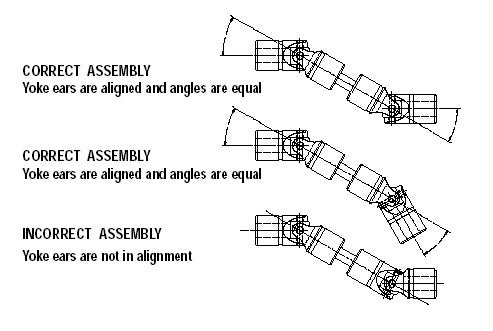
Do you have a graphic to show what you mean by this?
 
Copied from "driveshaft 411" By BillaVista CLICKY
Geometry.jpg


Yep, aware of that setup. Broken back or something like that (middle one.) I've personally never seen it work worth a hoot and especially not on a heavier driveshaft at any kind of rpm.
 
I'd really like to see it in use, but I don't think I would try it myself. :dunno:
 
I'd really like to see it in use, but I don't think I would try it myself. :dunno:

I would think the slip joint would need to almost be a press fit for it to even come close to working. Slightest wobble and the shaft will be like a jump rope.
 
I run a 1350 spicer CV in the rear with 2" .250wall tubing. I've even bent 2" .250 wall like a banana before so I'm using chromo tubing now. But my truck also doesn't see the street. Carolina Driveline can build you one like mine and balance it.

Up front I run 1410 joint at the axle and Tom woods superflex joint at the tcase, Long slip and same 2" .250 wall and I STILL have to grind on the yokes to get enough angle. lots of flex.
 
BTW, most driveshaft yokes are designed to run that bigger tubing and thin wall stuff so you really need a lathe to make shafts with heavy wall tubing and get a little creative, but that what it takes to have parts that hold up.
 
Top Bottom