CK5
Register an account today to become a member! Once signed in, you'll be able to participate on this site by adding your own topics and posts, as well as connect with other members.

Calling all machinists

badger red

1/2 ton status
Joined
Jul 30, 2004
Posts
208
Reaction score
0
Location
south central KS
I'm considering bidding on a 9" South Bend at a local auction next month. From the pics I've seen, it seems to be well taken care of. I'm waiting on a return call from the auctioneer for the model and serial#. Any suggestions of what to look for/check out when I go to the preview? Thanks for your time.

Jeff
 
First and foremost if you can't turn it on and see it run, don't buy it. Check the to see the that chuck spins true to the spindle, check the cross-slide and the biggie is check the ways. Those get damaged so easier from lack of care and can ruin any part you are making in a blink of an eye.
 
They really arent bad lathes at all, we learned on them at vo-tech and had a large 4 jaw chuck mounted on a 25 footer at my last job. There are a few styles, we had the collet style with a whole set of collets. They were used hard and still worked good. The truness of the chuck to the ways like said above is a good one to check also the feed in and out, that the cross-slide should be nice and smooth. But if your not going to do real critical work and its a good price you can prob get parts...the good points to check muddytaz pointed out...
 
Muddytazz--the biggie is the ways--check for rust obviously and I suppose nicks/other damage from stuff being dropped on them? Would I be out of line to take a dial indicator and mag base to check runout if I can see it run and touch it?

Thanks for the suggestions so far...

Jeff
 
A very easy way to check wear on the ways it so take a "V" block, preferably a kinda small one and put it on the ways. A perfect way is 45 deg. There should be no rattle on a new way. You will always find more wear in the common work area, and when you move the V block farther away from the chuck you will see rattle get less and less to where it does not rattle at all, or very little.

I had a 46' Logan that had very, I'm talking VERY little wear on the ways. A good condition way, besides wear on the angle is the condition of the surface of the way. Gouge marks mean it's seen very little if any lubing of the ways, and or it's seen grit and chips getting between the carriage and way causing galling which will cause gouging. Check runout as was said before. If I can not run it & check it's runout of all the important things I would not buy it.
 
Make sure your checking for run out on the spindle and not the chuck, my chuck is a buck chuck which is adjustable. Also if this is for a back yard shop I would go through all the gears and make sure it dosen't have a knock also run the threading and power feeds in the X & Z other than that make sure everything is smooth and call it good and by al means don't pay to much machinery is cheap these days.
 
rdn2blazer--when you say rattle, I assume you mean rocking of the v-block from side to side as you're slilding the v-block across the way? The reason I ask is that I'm fairly new to this--just finished a two-year machining program and have a whole lot more to learn. The machines at school were in good shape, so I'm not used to worn equipment and necessarliy what to look for. I remember seeing your Logan for sale a while back and wishing you weren't half way across the country--seemed to be in good shape for a 60+ year old lathe. I thought your asking price was very fair.

sixb--thanks for your input--good things to know--sounds like stuff I'd check or remember to check after the sale.

Thanks to all again,

Jeff
 
rdn2blazer--when you say rattle, I assume you mean rocking of the v-block from side to side as you're slilding the v-block across the way? The reason I ask is that I'm fairly new to this--just finished a two-year machining program and have a whole lot more to learn. The machines at school were in good shape, so I'm not used to worn equipment and necessarliy what to look for. I remember seeing your Logan for sale a while back and wishing you weren't half way across the country--seemed to be in good shape for a 60+ year old lathe. I thought your asking price was very fair.

sixb--thanks for your input--good things to know--sounds like stuff I'd check or remember to check after the sale.

Thanks to all again,

Jeff


Thanks for the props man. Yes side to side rattle. If it was a perfect way it would seat perfectly on the the 45 deg V block with zero gap on the V surface, but as a way wears it basically changes the angle. You will see a gap develop at the root of the V. The way will still make contact at the top edge of the V block. So then the block will clack side to side. You will see what I mean when you try it. Then try it at the end where there is little to know wear and you will be like DAMN! there is or is not alot of wear in this way. I checked all 14 lathes at my last machine shop with this method. Right at the common work area they all were worn, some more then others, some ALOT more then others.

Ofcourse over a given length it does not matter too much. If there is wear fairly even over a 12" linier area before it tapers out to very little wear, then you know your going to be able to turn a shaft in that length range with fairly little taper to it. But if your turning a 20' shaft you going to see taper to it. See what I mean. A worn lathe does not necessarly make it a bad lathe. It does tell a story though. Lots of use, little maintenence, not being oiled often enough, things like that. It's common for any machine to have a wear are right at the chuck area, just like a Mill has wear usually (most always) righ in the center of the table, cause thats where the vise is used at 99% of the time.

Rust, surface rust is not a huge deal. But deep pitted rust is. I would still buy a surface rusted machine baring it was in good condition, but pitted rust, PASS. Good luck man, hope it works out for ya. :waytogo:
 
rdn2blazer: Thanks for explaining that in detail--helps a lot. I found a Clausing Model 5419, 12 x 36 in Wichita yesterday, have already talked to the owner about looking over the lathe. He's asking $2500, and that includes a 3-jaw and a 4-jaw chuck, an 8-inch faceplate, and the other regular stuff. He also has a 6-position turret tailstock, a collet closer and some other goodies of which I'm not sure if they're included in the price or not. I believe it also has a converter so I can run it on single phase 220 at home. Anyway, it's still running, ready to be checked out, so we'll see what happens.

Jeff
 
rdn2blazer: Thanks for explaining that in detail--helps a lot. I found a Clausing Model 5419, 12 x 36 in Wichita yesterday, have already talked to the owner about looking over the lathe. He's asking $2500, and that includes a 3-jaw and a 4-jaw chuck, an 8-inch faceplate, and the other regular stuff. He also has a 6-position turret tailstock, a collet closer and some other goodies of which I'm not sure if they're included in the price or not. I believe it also has a converter so I can run it on single phase 220 at home. Anyway, it's still running, ready to be checked out, so we'll see what happens.

Jeff


Sounds like a good possibility. Wheel & deal hard, but be nice, that goes a long way. Talk with the guy a good while then do the dealin. Try like hell to atleast get the 5C spindle closer tube and collets if possible. Thats an awesome tool to have. When I sold my lathe I kept all the 5C collets and related parts except for the closer, it was spicific to the Logan. That way when I get another I will have collets ready to go.
 
rdn2blazer: Thanks for explaining that in detail--helps a lot. I found a Clausing Model 5419, 12 x 36 in Wichita yesterday, have already talked to the owner about looking over the lathe. He's asking $2500, and that includes a 3-jaw and a 4-jaw chuck, an 8-inch faceplate, and the other regular stuff. He also has a 6-position turret tailstock, a collet closer and some other goodies of which I'm not sure if they're included in the price or not. I believe it also has a converter so I can run it on single phase 220 at home. Anyway, it's still running, ready to be checked out, so we'll see what happens.

Jeff

I don't know if all clausings are colchesters but a claucing colchester is a great machine and x2 on the 5c setup and esp. the 6- pos turret and all the goodies. Make your best deal and try and get all the accessories you can. They are very expensive to buy new but are very handy to have. It sounds like a well tooled lathe much better than my 16/40 victor but then I have a SQT10M cnc Mazak with live tooling for the fun stuff:D
Good luck and negeoate hard for yourself!

Edit; Lathes are usually 5hp or bigger and that will require a rotary phase converter btw but they work well if sized properly.
 
I don't know if all clausings are colchesters but a claucing colchester is a great machine and x2 on the 5c setup and esp. the 6- pos turret and all the goodies. Make your best deal and try and get all the accessories you can. They are very expensive to buy new but are very handy to have. It sounds like a well tooled lathe much better than my 16/40 victor but then I have a SQT10M cnc Mazak with live tooling for the fun stuff:D
Good luck and negeoate hard for yourself!

Edit; Lathes are usually 5hp or bigger and that will require a rotary phase converter btw but they work well if sized properly.


How do you like your Victor lathe? They are about 20 mins away from me. I see their building all the time. I like thats it's a US made machine, unless their imported parts and just built here.
 
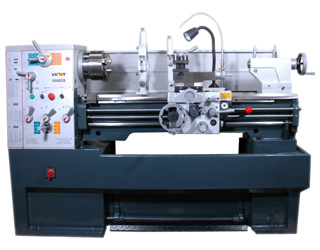
They have this on sale, I might go take a look at it tomorrow.

1640GS Lathe with Newall DRO $7,590


260b.jpg

Machine may be shown with optional accessories.​

Industrial strength lathe combines rigid one piece cast iron base and induction bedways to provide outstanding performance at a great price. FEATURES:
  • Rigid one piece cast iron base
  • Hardened and ground induction bedways
  • Hardened and precision ground gears in headstock
  • 2" spindle bore with D1-6 Camlock spindle nose
  • Inch/metric dual dial
  • Range of 16 spindle speeds from 45 ~ 1,800 rpm
  • 3-point bearing supported main spindle
MACHINE INCLUDES:
  1. Newall C80 DRO (retail value $1,995)
  2. 8" 3-jaw chuck
  3. 10" 4-jaw chuck
  4. Steady rest w/ rollers
  5. Follow rest w/ rollers
  6. Micro carriage stop
  7. Face plate
  8. 4-way tool post
  9. Full length splash guard
  10. Halogen work light
Wired 220V / 3 Phase onlyWarranty: 90 days on mechanical and electrical component parts. No labor warranty.$7,590FOB Rancho Dominguez, California
 
Went and looked at the lathe, It's a decent piece but it just reeks of poor quality import junk. It's their budget model, casting is not as good as their preimum model which is twice as expensive. Ohwell, I can't afford it anyways.
 
Well, I bought it. The PO let me take all the time I wanted inspecting it and showed ran me through the operation of everything--I asked him to from the beginning, since I hadn't been around that particular model before. Pretty friendly guy--we talked for about two hours. A Clausing Model 5914, 12" swing, 36" bed. The ways have a little wear, but not too much for what I'll be doing with it. I have discovered through several web sites (of course I didn't do really good research before I laid the cash down...) that it is a fairly popular lathe and is well liked, but can have trouble with its variable speed drive. Apparently Calusing still provides good parts support for this model except for some major assemblies, so that is good news, I suppose, depending on how much you want to lay out for some of their parts. It's one of those things where you always find more once you get it home.

I paid $2900--lathe, a 6" 3-jaw, an 8" 4-jaw with t-slots, a 5C collet closer mechanism with one collet with expandable jaws for the id of a part, a phase-a-matic rotary converter, a dead center in good shape, a turret tailstock with speedhandle for the adjustable stops and several other small tools/wrenches and a turret tailstock. Once up and running, I'll probably fork over the money for an Aloris quick change--they're proud of them, aren't they!!! But, you get what you pay for and I have a real hard time buying foreign made tools, except some German, Swiss and Japanese stuff--NO MADE IN CHINA.

I have yet to hook it up, as I'll probably wait and talk to Phase-a-Matic Tuesday or Wednesday about the proper connection, although I'm pretty sure I figured it out from their website--seems pretty straightforward. Does anyone have experience with wiring these converters? My experience is limited to basic 110 and 220v house current--haven't dealt with any 3-phase stuff. I wish it came with a steady rest, follower rest and a taper attachment, but it appears that those options aren't easily found to begin with. There is a possibility I know where a second turret tailstock is that I could have for next to nothing or a barter--might be good for trying to find those three things I don't have. Oh yeah-he gave me a face plate that is for a threaded spindle--found the South Bend stamp on the back--didn't realize it before I brought everything home, but I know someone who might be able to use it.

I found a partial copy of the operating and set-up manual on the web, but the serial number range was way past mine. The has misplaced the book--he couldn't remember where he placed it. I told him no big deal, I can call the Clausing Service Center Tuesday and order a manual and parts list.

Thanks for the tips.

Jeff
 
Good for you man, sounds like a good machine. Cleusings is a very old name thats been around forever, there know for making a quality machine tool. You can tell if someone is just trying to be the "use car salesman" with you or not. The fact he spent time with you going over everything shows he's probably an honest guy. So how much experience do you have machining and using a lathe? By all means ask any thing you have in mind, if I can help, or know the answer you looking for I'm happy to help. I'm sure you already know but I can't stress enough about being extreemely careful with this piece of equipment. It can and WILL bite you if you get complacement with it. Eye protection is mandatory 100% of the time.

I wear safety glasses ALL the time running machines. I have worked with guys who just wont wear them. My glasses have saved my eyes more times then I can count I kid you not. Watch you clearences to the chuck jaws, lots of guys forget about checking to see if the chuck will hit the tool holder when doing close chuck work. ALLWAYS make sure you have your part chucked securly, I don't mean cranked as tight as you can, but securly. And based on that watch your depth of cut, if it's chusked with a good bite on the part taking a deep heavy feed cut is not a problem, but if it's a shallow bit or you trying to not distort the part so you have a light bite on it don't try and take a heavy, or fast feed cut on it.

I worked with a guy who had his skull fractured from having a part fly out of a machine and hit him in the head. He survived but man could it have been worse. I could go on and on but you get the idea. If you ever want to talk machine talk PM me and I can give you my number. Just prepare for your ears to bleed. :D
 
How do you like your Victor lathe? They are about 20 mins away from me. I see their building all the time. I like thats it's a US made machine, unless their imported parts and just built here.

I like my victor alot, it's a great machine for what it is and mine is a Tiawain machine but could have been assembled in america like Mazak does now. Really I think mine is old enough to be made in tiawain. The older China/Tiawain tools seem to be way better than the new ones, I have an old enco belt/disc sander that is a great machine just like my victor.
 
Most machine shop owners including myself would rather see a machine being phased out go to a back yard hobby shop than to a competitor or a machine tool dealer.

Also that is good advice on safety the only thing I would add to it is ALWAYS have a handle on your file when your using it up close to a chuck to break the edge on a part, if the end of that file catches one of those jaws it will drive the pointed end of the file through your hand/wrist. And always be careful when chucking on to any cast parts they are never round and always tapered and come out easily.

In my years of working in shops, the lathe and band saw are the most dangerous by far. And IMO a machine shop is way safer than a wood shop so just use common sence and you will be fine.

Also you seem to have done a fair amount of research since you have the lingo down:Dwhich is good.

For tool post there is also Dorian and Yuasa but they are also spendy and I think all 3 are equal quality so maybe get which ever one is cheapest or used.
 
rdn2blazer--He did seem honest, but I'm a little naive sometimes. The fact he took the time to show me some things that were worn tells me he was probably a straight shooter. He was more than willing to answer my questions and took the time to show me how to set up the collet closer and the turret tailstock. I wished I would have pulled the cover off the end to expose the variable speed drive, as I found the cooling fan cracked and it looks like part of the bushing the variable speed belt pulley slides on is gone--a common problem for these models--probably could have gotten him to lower the price a little more. But I do see the green epoxy coating on the shaft and if its on the full length of the shaft when I tear it down, that will be good news. A new bushing is about $25 from Clausing.

My experience is limited to two years at school--just completed my AAS in Machine Tool Technology in May. I'm going part time now, just an Advanced Mastercam class and a Solid Works class. I have a really good job testing aircraft turbine engines--held an Airframe and Powerplant license for 16 years now--and am not ready to change jobs yet.

Good advise on the chuck. I have destroyed a few parts because I got greedy and took too heavy of a cut.

I agree completely on the safety glasses--you're nuts if you don't wear them when you're around all that stuff being slung at you--especially when turning brass.

sixb--you're absolutly right--lathes are dangerous. Good reminder on the file handle--I don't like using a file period without a handle.

I do have a question--the Clausing manual, in the leveling section has a requirement for a level at least 6 inches long that will show a distinct bubble movement when a .003" shim is placed under one end. I found such a level, a Starrett for about $650. I know having your bed/ways as level as possible is very important, but is there an alternative level I could use? How often do you use such a level? Do you have to check your machines at work from time to time? I don't mind laying out the money if I have to, but I'd like to know before I do.

Thanks again

Jeff
 
Also that is good advice on safety the only thing I would add to it is ALWAYS have a handle on your file when your using it up close to a chuck to break the edge on a part, if the end of that file catches one of those jaws it will drive the pointed end of the file through your hand/wrist.


I worked with a guy who had this happen when he first got into machining right out of high school. He was 18, it was the first few times running a lathe, noone showed him how to properly file on a lathe and bam, sure enough, tang of the file stabbed into the web of his hand between the thumb and fore finger. It didn't poke all the way thru but was streatching the top skin taught, ready to pierce thru. Another machinist pulled it out. He showed me the scar from all those years ago. IF you use a file without a handle on it start fileing at mid file so the end of the file is PAST the point of contact with the jaws. I have done this a 10 million time with no issue what so ever. It's the jaw banging the end of the file you have to worry about. Handles are always a good idea though. Hand fileing a piece in a vise without a handle, and you accidently bang the end and the tang pokes your hand a bit hurts bad enough. Ask me how I know. :D
 

Latest Posts

Top Bottom