CK5
Register an account today to become a member! Once signed in, you'll be able to participate on this site by adding your own topics and posts, as well as connect with other members.

can a 44 locked w/513s and 38s hold up??

twoslo4five0

3/4 ton status
GMOTM Winner
Joined
Oct 5, 2006
Posts
6,616
Reaction score
73
Location
Living in a dump, VA
NO...not if you have a heavy foot...:D
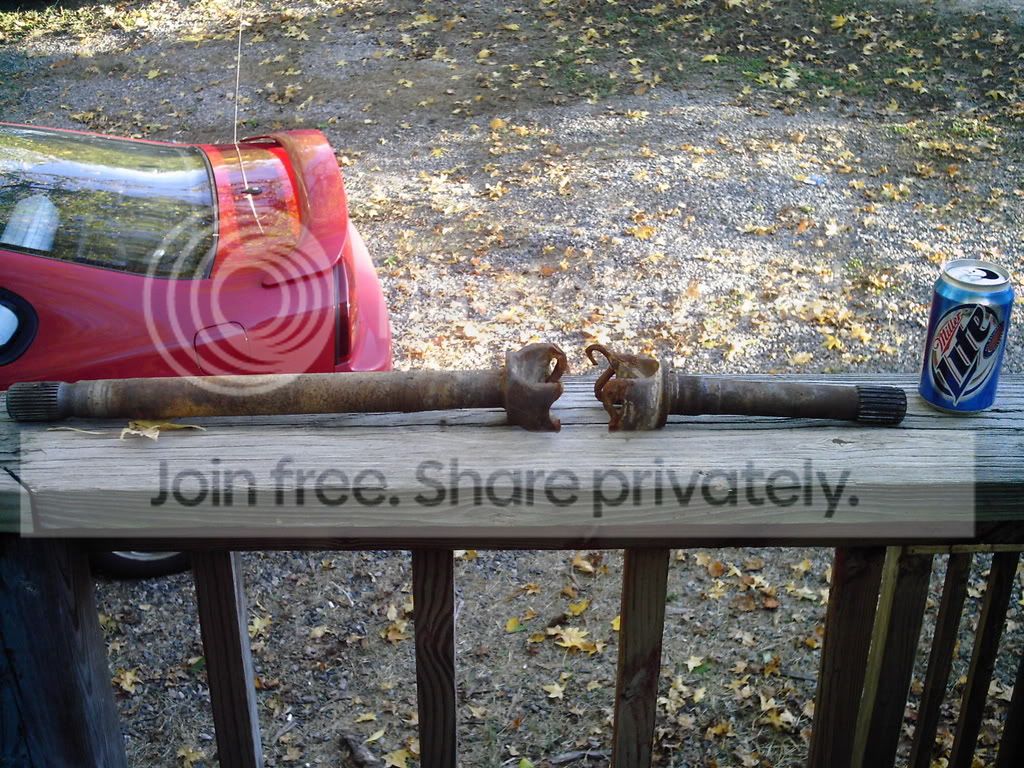
Picture129.jpg

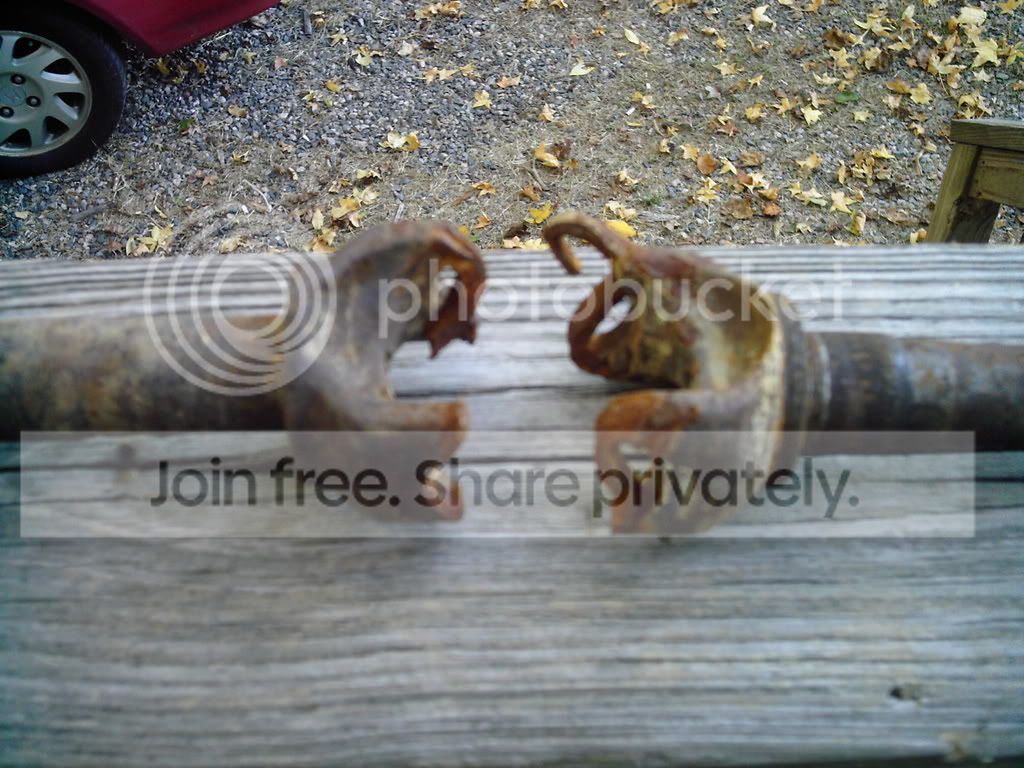
Picture130.jpg
 
To be fair , those axles look really damn old .

Chro mos and 38's could work in a light truck driven by a Bud drinker :thumb:
 
To be fair , those axles look really damn old .

Chro mos and 38's could work in a light truck driven by a Bud drinker :thumb:

i dont drink miller though...i drink bud :D...they have been sitting outside in the rain for about 2 weeks now too...oh and the u-joint was new..
 
From my experience...

The u-joints in the axle shafts are almost always neglected. Out of all the 44 and 10 bolt axles I've seen torn up over the years, most were caused by the u-joint breaking and taking out the axles. Then the axles look just like those in your pics.

I ran a 10 bolt welded up with 4.56's and 40" gumbos for years in mud. I went through several sets of hubs and one axle.
 
I had my 44 open with 38s and it was not to bad, i went to 41s and the axles broke every time i went out wheelin.
 
this brings up an interesting discussion me and a buddy of mine were having the other day...

why exactlly does a 10b/44 inner shaft neck down right before the splines??he said it was because that was the weak point that they had designed to keep anything elce from being damaged...it just seems like there should be some other reason why it necks down...anyone know??
 
this brings up an interesting discussion me and a buddy of mine were having the other day...

why exactlly does a 10b/44 inner shaft neck down right before the splines??he said it was because that was the weak point that they had designed to keep anything elce from being damaged...it just seems like there should be some other reason why it necks down...anyone know??

From an engineering point of view it doesn't make sense.

The splines created stress risers, you want the shaft to be largest at the spline to ensure that the shaft will not fail there.

From the axle article on Pirate:

[FONT=Arial, Helvetica, sans-serif]So, in order to deal with the spline stres raiser, the textbook way to build an axle shaft is to make the operating diameter of the shaft smaller than the diameter of the splines. This not only serves to reduce the stress raiser at the root of the splines, but, if we re-examine the equation for torsional deflection, we can easily see how this reduced diameter also allows the axle shaft to twist more. Recalling how energy is converted, this twisting allows the shaft to convert the energy (mainly into heat through internal friction) as opposed to just transferring it where it would break u-joints, ring and pinions, driveshafts, transmission outputs, etc. As we dicussed under material - the key is then to build the shaft from a high enough quality material to be able to handle this twisting comfortably withing the elastic range.[/FONT]


[FONT=Arial, Helvetica, sans-serif]This "reduction of shaft diameter after the splines" is often commonly referred to (and often with a negative connotation) as "neckdown". This proper neckdown IS NOT to be confused with what the OEM's do (e.g. notorious D44 front axle neckdown). That OEM Spicer neckdown is done either as a manufacturing convenience (to facilitate quick, easy splining) or to introduce an intentional design weak point (so that if the ring and pinion fails/siezes in 4wd the shaft breaks and the wheels remain free and steerable as opposed to the front wheels locking up) - depending on who you ask.[/FONT]
 
From an engineering point of view it doesn't make sense.

The splines created stress risers, you want the shaft to be largest at the spline to ensure that the shaft will not fail there.

From the axle article on Pirate:

[FONT=Arial, Helvetica, sans-serif]So, in order to deal with the spline stres raiser, the textbook way to build an axle shaft is to make the operating diameter of the shaft smaller than the diameter of the splines. This not only serves to reduce the stress raiser at the root of the splines, but, if we re-examine the equation for torsional deflection, we can easily see how this reduced diameter also allows the axle shaft to twist more. Recalling how energy is converted, this twisting allows the shaft to convert the energy (mainly into heat through internal friction) as opposed to just transferring it where it would break u-joints, ring and pinions, driveshafts, transmission outputs, etc. As we dicussed under material - the key is then to build the shaft from a high enough quality material to be able to handle this twisting comfortably withing the elastic range.[/FONT]


[FONT=Arial, Helvetica, sans-serif]This "reduction of shaft diameter after the splines" is often commonly referred to (and often with a negative connotation) as "neckdown". This proper neckdown IS NOT to be confused with what the OEM's do (e.g. notorious D44 front axle neckdown). That OEM Spicer neckdown is done either as a manufacturing convenience (to facilitate quick, easy splining) or to introduce an intentional design weak point (so that if the ring and pinion fails/siezes in 4wd the shaft breaks and the wheels remain free and steerable as opposed to the front wheels locking up) - depending on who you ask.[/FONT]


good stuff right there :waytogo:
 

Latest Posts

Top Bottom