CK5
Register an account today to become a member! Once signed in, you'll be able to participate on this site by adding your own topics and posts, as well as connect with other members.

Causes of getting stuck?

derherr65

Registered Member
Joined
Mar 20, 2008
Posts
42
Reaction score
0
Location
North Texas
What are the reasons(mechanical/physics) a truck gets stuck, in order of most to least likely? Ignore driver error, we all know that's #1. I define stuck as anything that stops forward movement, both in mud and on rocks.
 
Lol this is a funny topic you've started here. I would say number one cause of getting stuck in mud is lack of lockers. On the rocks its gotta be lack of articulation.
 
Lol this is a funny topic you've started here. I would say number one cause of getting stuck in mud is lack of lockers. On the rocks its gotta be lack of articulation.

Lockers are MUCH more important in the rocks than they are in the mud.

A limited slip might help in the mud, it will do next to nothing in the rocks.
 
Simple, lack of traction. Many ways to change that which includes lifts, tires, lockers, articulation, etc.
 
most of what i see is either not enough traction, as in bald tires, or road tires going where boggers or swampers should only go. Next would be either not enough momentum, or too much in some cases. Best way to not get stuck...?......practice, use your 4wd like it should be used.
 
hi center is the most comon ive seen. either the axle center sections bottom out in ruts or rocks or the frame drags or gets cought.
 
I've seen it too many times with auto transmissions, they shift up into too high of a gear and don't give the engine enough rpms and bog it down so it can't make the hill climb or puddle where wheel speed is key.

I agree with lack of lockers and not enough wheel spin.
 
Lack of traction. Good. Works on rocks and mud. We improve traction by stickier rubber compounds, lips and grooves, larger area of contact on rocks. On mud stickier compounds won't help, so lugs and grooves, and larger area of contact.

Sounds like lack of flotation on mud. On rocks, lack of clearance. Flotation is achieved by bigger tires, and lighter weight rigs. Clearance necessitates lifting non-weight bearing surfaces, or anything other than the wheels. Though at some point the need for a lower center of gravity outweighs the need for more clearance.

Ok, good, that was the two I came up with also. But what next? What causes rigs with big tires and good clearance to get stuck?
 
The fact that big ass wide tires dont help like people think they do. Theres two mud scenarios, mud with a solid bottom, mud without. The only time that wider tires help is when you are in mud without a solid bottom and when your in a 4000-55000lb rig it takes some damn big tires to float over the slop with no bottom.

Skinny tires get you down into the mud to the more solid dirt faster.

Personally I believe the only place wide tires prevail is in bottomless snow. Give me skinny meats any other day of the week.
 
Interesting. I've met plenty of soft clay soil that acts like mud without solid ground below it. Regular street tires dropped the front axle to the 'ground' and it was all over. Now on wet grassy hills narrow knobby tires should work, but so should fat knobby tires.

A tractor would be a good comparison, skinny tires on front and fat on the rear. I know the skinny tires sink first, but the radically smaller diameter probably has more to do with it.
 
The fact that big ass wide tires dont help like people think they do. Theres two mud scenarios, mud with a solid bottom, mud without. The only time that wider tires help is when you are in mud without a solid bottom and when your in a 4000-55000lb rig it takes some damn big tires to float over the slop with no bottom.

Skinny tires get you down into the mud to the more solid dirt faster.

Personally I believe the only place wide tires prevail is in bottomless snow. Give me skinny meats any other day of the week.

What about this mud :D

 
In soupy mud, your frame hits the ground and all you rely on is for your tires to paddle through. Like was said above, this is not very possible in a 5000 lb truck, but wide tires generally do better at the task.

But most mud I've been in(Mississippi delta), the 34'' LTB's on my '78 Blazer do better than most, even boggers sometimes.. They are skinny so a hard bottom makes life alot easier.

These tires have shown me that you don't have to have a huge truck to go through some really bad holes, I've followed people with 35'' Boggers and 36x15.5 Swampers.. Only been stuck once and it stuck 2 other trucks and a tractor trying to get it out. 3 days later a dual wheel 4 wheel drive Cat tractor got it out
 
Reviewing some mud bog competitions on youtube. I see your point about skinny tires. But the guys with skinny tires also have VERY TALL skinny tires. Which makes me more suspicious about the diameter as the real benefactor. They also tend to have huge lifts which keeps them from pushing mud with their frames or bumpers. The military mire factor comes into play there.
 
My cause of getting stuck tonight was driving down a creek and attempting to drive over a huge fallen tree in to a water hole that was of unknown depth. I got stuck and busted my brand new front driveshaft. Pic is kinda crappy but here ya go!
picture.php
 
Ok but since you mentioned rocks and mud I suspected we were talking about real life wheeling not rednecks crashing 300 foot tall trucks through BUILT and FABRICATED mud holes.
 
Just thinking of the competitions as worst case scenarios. You're absolutely right, most sane people would go around a 3' deep mud hole, 8' tall wall, etc.
 
What are the reasons(mechanical/physics) a truck gets stuck, in order of most to least likely? Ignore driver error, we all know that's #1. I define stuck as anything that stops forward movement, both in mud and on rocks.


Say you got stuck this last time you went wheeling!

I thought I would bring this back into focus. Read it; learn it; live it!

Originally Posted by Metrodps http://coloradok5.com/forums/showthread.php?t=204295
First you need to be absolutely sure that EVERY single piece of equipment used in the task is strong enough and will not fail and thereby endanger life and limb. Hooks should be pointing up that way if they come off they go down. Realize, that for reasons of practicality and economics, your 4x4 recovery equipment is almost certainly undersized.....you can still do the job, using the correct techniques, but you will be much SAFER if you keep this in mind.


[FONT=Arial, Arial, Helvetica]1) Most people are terrible at actually estimating the gross weight of their rig as it sits on the trail, full of gas, tools, equipment, food, camping gear, people, the dog...everything. Heck, in some cases the real figure can actually exceed the GVWR of the vehicle. Simple advice here - either err WAY on the heavy side, or get your rig weighed in trail trim.[/FONT]

[FONT=Arial, Arial, Helvetica][FONT=Arial, Arial, Helvetica]2) More importantly, the "effective weight" of a "stuck" 4x4 is very often FAR more than 1.5 times the GVW. The following data on how to more accurately estimate the "effective weight", is taken from the world of professional heavy recovery - the guys that recover Tractor-trailers that have flipped on their side for instance, as well as U.S., Canadian, and UK Military recovery manuals.[/FONT]
[/FONT]

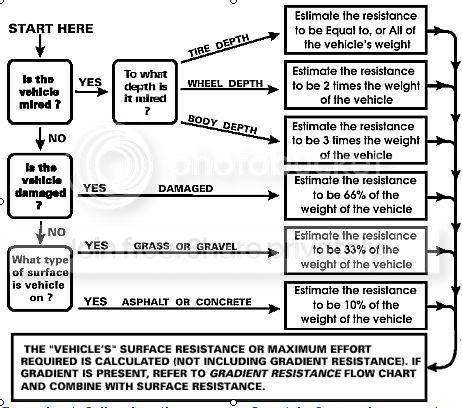
[FONT=Arial, Arial, Helvetica][FONT=Arial, Arial, Helvetica]Once you have accurately estimated or measured the trucks loaded weight (LW) you can calculate the resistance to be overcome in any recovery situation (this is commonly known as the ROLLING resistance). There are 4 types of resistance that must be accounted for to accurately assess the resistance that must be overcome. These are surface resistance, damage resistance, mire (stuck) resistance and grade (slope) resistance. Calculate them all as follows: [/FONT]​


[FONT=Arial, Arial, Helvetica][FONT=Arial, Arial, Helvetica]Surface resistance[/FONT]
[FONT=Arial, Arial, Helvetica]A pull of 1/10 LW will cause a free wheeling truck to move on a hard, level surface.[/FONT]
[FONT=Arial, Arial, Helvetica]A pull of 1/3 LW will cause a free wheeling truck to move on a softer surface, such as grass or gravel,
[/FONT]
[FONT=Arial, Arial, Helvetica]Damage resistance:[/FONT]
[FONT=Arial, Arial, Helvetica]A pull of 2/3 LW will be required to move if the wheels cannot rotate (as if the brakes were fully applied), the pull required to overcome the resistance (drag) the truck id 2/3 or 67% of the LW. Damage resistance includes surface resistance (i.e. you only use one or the other)[/FONT]

[FONT=Arial, Arial, Helvetica]Stuck (mire) resistance:[/FONT]
[FONT=Arial, Arial, Helvetica]A pull of 100% of LW will be required if the truck is stuck to a depth of the sidewall on the tires.[/FONT]
[FONT=Arial, Arial, Helvetica]A pull of 200% of LW will be required if the truck is stuck to the hubs.
A pull of 300% of LW will be required if the truck is stuck to the frame..
Mire resistance includes damage resistance (i.e. you only use one or the other)

[/FONT]
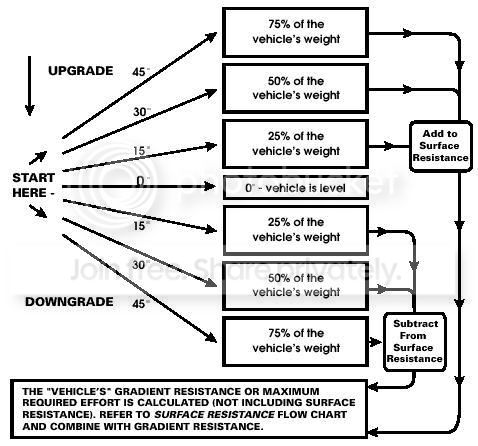
[FONT=Arial, Arial, Helvetica]Grade (slope) resistance:[/FONT]
[FONT=Arial, Arial, Helvetica]Upgrade (vehicle has to be recovered up a slope or grade)[/FONT]
[FONT=Arial, Arial, Helvetica]15 degrees - add 25% of LW[/FONT]​
[FONT=Arial, Arial, Helvetica]30 degrees - add 50% of LW
45 degrees - add 75% of LW


Vehicle recovery on level ground - no correction
Downgrade (vehicle has to be recovered down a slope or grade)
15 degrees - subtract 25% of LW
30 degrees - subtract 50% of LW
45 degrees - subtract 75% of LW


[/FONT]
[FONT=Arial, Arial, Helvetica]Final figure:[/FONT]
[FONT=Arial, Arial, Helvetica]Add surface or damage or mire resistance and grade resistance, and this is your final figure or rolling resistance. This is the amount of pull the winch must apply in order to recover the stuck vehicle.[/FONT]


[FONT=Arial, Arial, Helvetica]Here is the military approach.[/FONT]​

[FONT=Arial, Arial, Helvetica]
surfaceresistance1.jpg
[/FONT]

[FONT=Arial, Arial, Helvetica]
gradiantresistance1.jpg
[/FONT]​

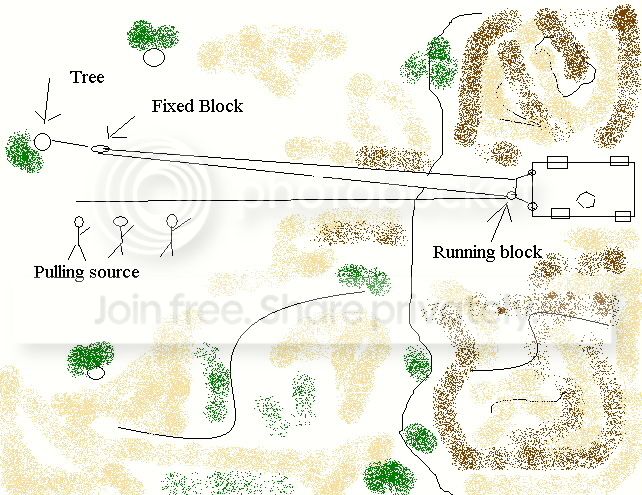
[FONT=Arial, Arial, Helvetica]The way to attack the situation. Using this method you can free a Hummer buried up to its axles Thanks to Mike Rowe and Dirty jobs.[/FONT]
[FONT=Arial, Arial, Helvetica]
stuckexample.jpg
[/FONT]​

[FONT=Arial, Arial, Helvetica]If you want to read on recovery operations search for:[/FONT]
[FONT=Arial, Arial, Helvetica]FM 9-43-2, Recovery and Battlefield Damage Assessment and Repair.[/FONT]​
[/FONT][/FONT]
 
Top Bottom