CK5
Register an account today to become a member! Once signed in, you'll be able to participate on this site by adding your own topics and posts, as well as connect with other members.

Changing from external coil to internal HEI? Catastrophic failure!!!!!

K85 Octane

People Fatigued
 Premium
GMOTM Winner
Joined
Nov 2, 2009
Posts
15,360
Reaction score
5,959
Location
San Bernardino CA
Just a quick and probably simple question that I'm not sure about.

I tossed the old distributor and coil that were in my boat. I'm swapping in a Streetfire HEI. The old coil has a positive and negative post. I'm sure the positive is for the "coil positive" :haha: But what is the negative for? Is this where my tachometer goes, or some kind of ground? With everything ripped out, I'm only left with these two wires.

Thanks :waytogo:
 
Last edited:
Coil in cap HEI is only going to require a keyed 12 volt source (use the proper sized wire) and if you want to run a tach then there's a spot for that wire and that's it. The coil grounds through the distributor body on those.
 
Was it a points distributor, or an electronic distributor with an external coil?

Martin
 
I'm not sure what a points system looks like. It had a "Monster energy can" size coil. The dizzy looked just like my HEI, except there was no coil on top and only a couple wires. Has the plugs on top with a rotor and center pin underneath.

The boat has a tach already, but I can't tell which wire it is. With an external coil, does the tach connect to the ground on the coil? Those are the only two wires having to deal with the dizzy, a positive and something that was connected to the ground terminal on the coil. The engine is basic, no computer stuff whatsoever. There are other wires and sensors in the block, dunno if one of those could be a tach pickup.
 
I'm not sure what a points system looks like. It had a "Monster energy can" size coil. The dizzy looked just like my HEI, except there was no coil on top and only a couple wires. Has the plugs on top with a rotor and center pin underneath.

The boat has a tach already, but I can't tell which wire it is. With an external coil, does the tach connect to the ground on the coil? Those are the only two wires having to deal with the dizzy, a positive and something that was connected to the ground terminal on the coil. The engine is basic, no computer stuff whatsoever. There are other wires and sensors in the block, dunno if one of those could be a tach pickup.

Short answer: the "positive" wire to the external coil is evil, avoid it. It likely goes through a resistor somewhere hidden away, and is no bloody good for anything else. Under load it won't really be 12V, more like seven, so tape it off and tie-wrap it neatly out of the way. Your new HEI dizzy will want a nice, clean, heavy (say, #10) wire to the battery that goes on and off with the key.

The "negative" side of the coil should be the tach pickup that you're looking for. As 4x4High pointed out, the new dizzy has a thing for this; basically it has two plugs, one for "12V" (see above) and one for "TACH", which is that one you called the "ground" side of the coil (it's not grounded, it's the negative side, but close enough.)

Long answer: the old dizzy probably had a mechanical contactor inside, the "points", which is what triggered the coil to zap each spark plug. These points wear away in time, with the high voltage arcing across them, plus go out of adjustment every time you look at them sideways. HEI is electronic, and has less moving and wear parts, which is why it is so cool by comparison.

The old dizzy should have a sliding door or the like on one side, which allow you to adjust the points. If you take the cap off, you'll see the mechanical contacts inside under the door.

HTH.

-- A
 
The coil + is basically 12V keyed. The coil - is the drive from the module and also where you connect the tach. The module is switching the coil to ground to charge it up and then breaking the circuit to cause the high voltage spike in the secondary. By counting how often the module is doing this, the tach knows how fast the engine is spinning.
 
ooooo

wicked knowledge, very interesting

I hope it all works, this is how I've wired it up. I just hope whoever did the timing started with the rotor pointing @ #1 cylinder. This is how I'm starting, all the plug wires are ran, so at worst I just have to move them + or - rotation.

I can't get to the crank bolt or flywheel. How the hell can I turn it over to try for TDC? I hope to have help later, maybe bumping the starter with a finger over #1 plug hole.

thanks fellas
 
Man, be careful, boats are funny. PM Ryoken, he does that kind of stuff for a living.


Unlike trucks, you never want to use a common return for equipment. All marine equipment has a negative wire.

NOT necessarily the wire you mention on the dist.

But if you get stray currents moving through the structure of your boat, you can pick up serious electrolysis and have parts fall off.

Also if it goes on a marine engine, it MUST be "ignition protected".
That does not sound right, but Ryoken will know what I am talking about. I'm having a brain fart on the term.

Folks who swap out marine starters and equipment with truck equipment have a bad habit of getting launched out of their exploding boats.........

Not a lot of fun......

Well, if you are in the boat on the other side of the marina watching, its kinda cool. Just make sure you are not the first on the scene. Fishing crispy critters out of the bay sucks.
Only done it once. That was enough.
 
hey man, I'm so sorry I dropped the ball on your PM... little nuts this time of yr, but no excuses...


I see this thread is sorta/kinda related to the PM.... I'll try to cover everything here....


Fordum is right, I know it may seem silly, but car parts in boats can be very very dangerous... it'll work, it may work for a long time without incident, or it unfortunately may not..

in this case, dizzy's... the key to a marine dizzy is the fact the vent is flame arrested.. marines used to have brass contacts, but not anymore really.. they also run gasketed caps... there is a reason the Coast Guard has the requirements it has... this sh*t has happened..

I know most of you are going "ah, how important can it be", etc, etc... well, I'll tell ya, therer's a reason boats have blower vents, gas fumes in a bilge are no joke.. you forget to run the blowers, fumes, you light motor off, boat goes boom... I see stuff like this on boats, and the presses stop... I cannot in good conscience as a mechanic let things like that go... living with myself after letting Bob, Jane and child go out and BBQ themselves is not one I want to live with...


anyway.. enough of the safety lecture... why can't you get to the crank? got a raw pump attached to the front of it? 3 bolts to take it off usually.. what marine package is this?

keep in mind, most packages have a window on top of the flywheel cover at the back of the motor.. usually you can get a prybar in there... also, if the plugs are out, most motors can be turned over by hand by just grapping the engine belt in 2 locations and turning the motor over a bit at a time... no sh*t...

obviously your gonna need to drop a timing light on it once you light it off......

as to a book per the pm.. for some stupid reason I seem to think I have a book at work that covers those boats... why, i have no clue.. i don't see that kinda stuff often.. i may have seen 1 of your boat in my life... but i'll take a peak on the shelf.. but the more important thing is, what motor package... that can easily be obtained literature-wise usually..
 
I think I have already mentioned this story.......Friend of mine did a lot of trailer work for the local LEs, and got invited to go with the Marine Patrol Safety boat to do inspections.
Pretty good sized boat with inboard engine.
The two LEs were in the cockpit, and he hopped onto the engine cover in back.
Idiot running the boat did not even touch the blower switch.

My friend said he saw the guy turn the key, was just about to give him trouble about a safety officer not running the blower, when water hit him in the face.

He looked around to try to figure out where it was coming from, and realized he was in the bay with the boat burning behind him.
Along with the two guys.

He had ridden the hatch cover out into the bay when the boat blew. The steel cover over the boat slip was blown back, but we never figured out if it blew back and he went through the hole, or if he was blown forward over the bow.

He just had a few minor bruises, but the other two guys were blown into the dash and set on fire.
I think they survived, but needed lots of hospital time and skin grafts.

Your blower does work on your boat...........Right?
 
awesome guys!!

1994 Commander Boat, 21'
Chevy big block with Indmar logs on the valve covers and exhaust
Berkley jet I think
Holley double pumper 850

I put a StreetFire HEI dizzy in. Did I just f*** myself? Sounds like it, and after such a smooth install. Ugg it's very hard to pull more money out of my asz right now.
I like to over use the blower, it's too simple to run it while getting ready.
The engine crank pulley is damn never hidden by the back of the rear seat and it doesn't move without some kind of fierce teardown. All there is is an alternator. I can barely see the timing tag.
 
I'm not gonna tell you it wont run... I'm just gonna tell ya it's a pretty big no-no, and you should definitely look to get a marine dizzy in it at some point...

and not that 21' boats don't get surveyed, or CG certified, but an item like that would DEFINITELY be notated by either one.. I know that's neither here nor there for ya, just a marine notation in general, usually those things arise often on slightly larger boats, 24', 27' and up, when for sale, boarded, etc... some people like to have their boats CG certified and it certainly isn't a bad idea from a safety standpoint.... albeit, not required.. it can be a nuisance as it may cost money to pass...


I'll take a peak this week on literature for ya and see what i come up with...
 
thank you sir! The literature, or store recommendation, would be greatly appreciated!

For my upcoming test run, I'll have the "hood" removed, so the engine bay will be completely open air. This way I can listen to the engine while testing. At least at this time I can tune on the carb and see what kind of timing the motor likes.
 
hey Ryoken (etc), quick couple questions.

Can you guess what kind of idle timing and idle rpm this thing should be at?

Also, how can I work on it while on the trailer? Meaning, running the motor with the garden hose attached some how. My Seadoo is easy, but I don't see how I can with the boat.

Thanks man
 
What kind of water intake does it have?
Holes in the outdrive like the foot of an outboard?
If so, you can use one of those muffs like on an outboard.

If you have the through hull intake on the bottom like a friend's boat, they make a rubber piece that will fit over it and attach either with a hook in the middle that hooks onto the intake, or you can brace it up from underneath with a bottle jack or something.

Also, I have seen a hose fitting on the line inside. I think I saw a raw water pump that had one built in one time.

Just make sure its not the suction line for changing the oil. I saw one with a garden hose fitting that you hooked one of those drill pumps to so as to suck out the oil.
 
the oil one would really suck

Not sure, it's a Berkley (I think) pump. Big sucker sticking out the back. Trim, reverse, and steering...that's all I know. I haven't crawled under there, I've only seen the small scags in the back.

I had it running for a few seconds today. Seems like a good start but it wont stay running. Got some carb and timing tweaking to do. Just couldn't with it dry dock.
 
If the pump is engine driven with a rubber impeller (should be) DO NOT run the engine without water flowing through the pump otherwise you'll be replacing the impeller in VERY SHORT ORDER (like after having the engine run for even a minute without water).
 
ugg

why not, the blazer gave me sh1t every step of the way, why would I expect anything different

thanks scott
 
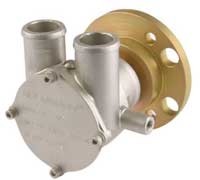
well, since it's not a crank mounted pump, it must be a belt driven pump such as a sherwood or johnson.... probably looks something like this


images


for the record, here's a crank mounted pump...


CRURA057026_thumb.jpg


you need to know where that is, you should be changing the impeller every 2 or 3 yrs anyway...

find it, and trace the 2 hoses.. being a jet, it should either have a scoop thruhull or seacock feeding that pump off the bottom of the boat... just pull the hose off the thru-hull inside the boat and clamp/stick a garden hose in it.... just be aware not to run it for extended high rpm's, as the hose cannot keep up at high rpm's..


sorry, haven't had a chance to peak for a book yet, been pretty psycho, i'll try to get to it monday...
 

Latest Posts

Top Bottom