
CK5
Register an account today to become a member! Once signed in, you'll be able to participate on this site by adding your own topics and posts, as well as connect with other members.

CO2 for airing up, and TPMS

dyeager535

1 ton status
 Premium
Joined
Dec 13, 2000
Posts
31,561
Solutions
1
Reaction score
2,900
Location
Roy, Washington
Does anyone here have TPMS and use CO2 to inflate their tires?

Can't find any information if the sensors can be "shocked" by the temperature of the CO2. They are plastic from what I've seen, I would think the potential difference in temperature could damage/destroy them.

I'd like to play around with TPMS (I got one of the aftermarket setups) but hadn't considered the CO2 aspect.
 
The last couple times I used CO2, ambient was freezing as well, so I had problems with the regulator (worse than normal). Plus a broken valve stem, which I'm skeptical of being a CO2 issue. With those issues, I question how well TPMS sensors will hold up. However if Nitrogen is ok with them, CO2 probably should be as well.

I'm tempted to move away from CO2 due to the cold issues alone, but going with electric or belt drives bring a host of their own problems.
 
The older style Delco-packaged ones ride at the end of the stem on a tiny screw and have the ports to let the gas out go to the sides. However, I've opened up several for curiosity's sake. The only thing I'd be worried about is freezing the Japanese lithium battery on a "long fill".
 
I appreciate the input! If/when I get the chance I'll just try it for the heck of it. Got the setup for cheap, can't complain too much if it doesn't work out.
 
Nitrogen would be the best, not sure how cheap it is thou. I was just pricing nitrogen bottles, 60 cu ft is over $150.00 then fill and regulator. You are approaching ARB compressor range cost wise
 
Nitrogen would be fine, but apparently there is WAY less in an equivalent bottle size, looks like 25% in roughly the same size cylinder.

I don't know what CO2 runs now, but last year I believe I got a 20lb bottle (175 cu ft) for $20. Which is enough to do something like 21 (very rough calc) 33" tires, so five times with a bit left over. I'll air up 2-3 times a trip so even that cost will add up. If what I see (and what I calculated) is right, a 75 cubic foot nitrogen bottle would only net me two fills.

I'm tempted to go with a Gobege 12V air compressor honestly. Maybe downsize to a 5lb CO2 as a backup, as I don't think the oilless electric compressors are probably particularly long-lived. I really only need to deflate/inflate one or two trips a year, one of the oilless ones might very well last many years for me.
 
For what its worth, I carried a small CO2 tank for years. Pic attached. Issue with it are/were regulator freezing up during use and CO2 will permeate the rubber and you will slowly loose pressure. Nitrogen is very stable and we used it in Aircraft tires due to the extreme temp and attitude changes but again requires external tank/filling/etc. Another potential issue with CO2 is the tank can expire. I had this happen and the facility would not recharge so I had to buy another "used" tank.
With that said, I recently pulled the CO2 tank and mount and bought one of the -> Gobege 12V air compressor as they appear to be exactly the same as the Smittybilt compressor but cheaper.
20221005_092331.jpg
 
On my DD I use the old GM compressors found in air ride cars hooked up to a small 2 gallon tank mounted under the truck in front of the right rear tire. It'll take 20 minutes to air up four tires to 30psi between the full tank and the compressor. I've found them to be more durable than Viair. I keep a tank on everything including the trailers because seating a bead without one is impossible.
 
On my DD I use the old GM compressors found in air ride cars hooked up to a small 2 gallon tank mounted under the truck in front of the right rear tire. It'll take 20 minutes to air up four tires to 30psi between the full tank and the compressor. I've found them to be more durable than Viair. I keep a tank on everything including the trailers because seating a bead without one is impossible.

Are those electric as well? I'm not familiar with the air ride stuff. If it lasts, and is available relatively inexpensively, I'm interested. I could probably Google it lol.

What kind of life did you get out of the Viair?

I suspect none of the oilless compressors are going to last long, but if I got six years with minimal use, a "cheap" electric would make sense. One would hope something with the price point of the Viair's would get you some better longevity.
 
Last edited:
On my DD I use the old GM compressors found in air ride cars hooked up to a small 2 gallon tank mounted under the truck in front of the right rear tire. It'll take 20 minutes to air up four tires to 30psi between the full tank and the compressor. I've found them to be more durable than Viair. I keep a tank on everything including the trailers because seating a bead without one is impossible.
You must be talking about the Arnott compressors like they use for Autoride and leveling in Buicks, etc. I've never had one wear out, but I can tell you that they don't hold up to road salt. The large SUVs get them mounted behind the back tire with just a little rubber blanket hanging under for protection. Meanwhile, there's a large open space in the interior just above, behind a side panel. But of course that would make more noise...:doah: They are mostly the same design over many years, but with some differences in how the drier and fittings are set up. I rebuilt a 2000's Suburban one with the main guts from a 90's Olds one. What size fuse goes on them? I doubt the flow rate is very high.
Arnott compressor.JPG
 
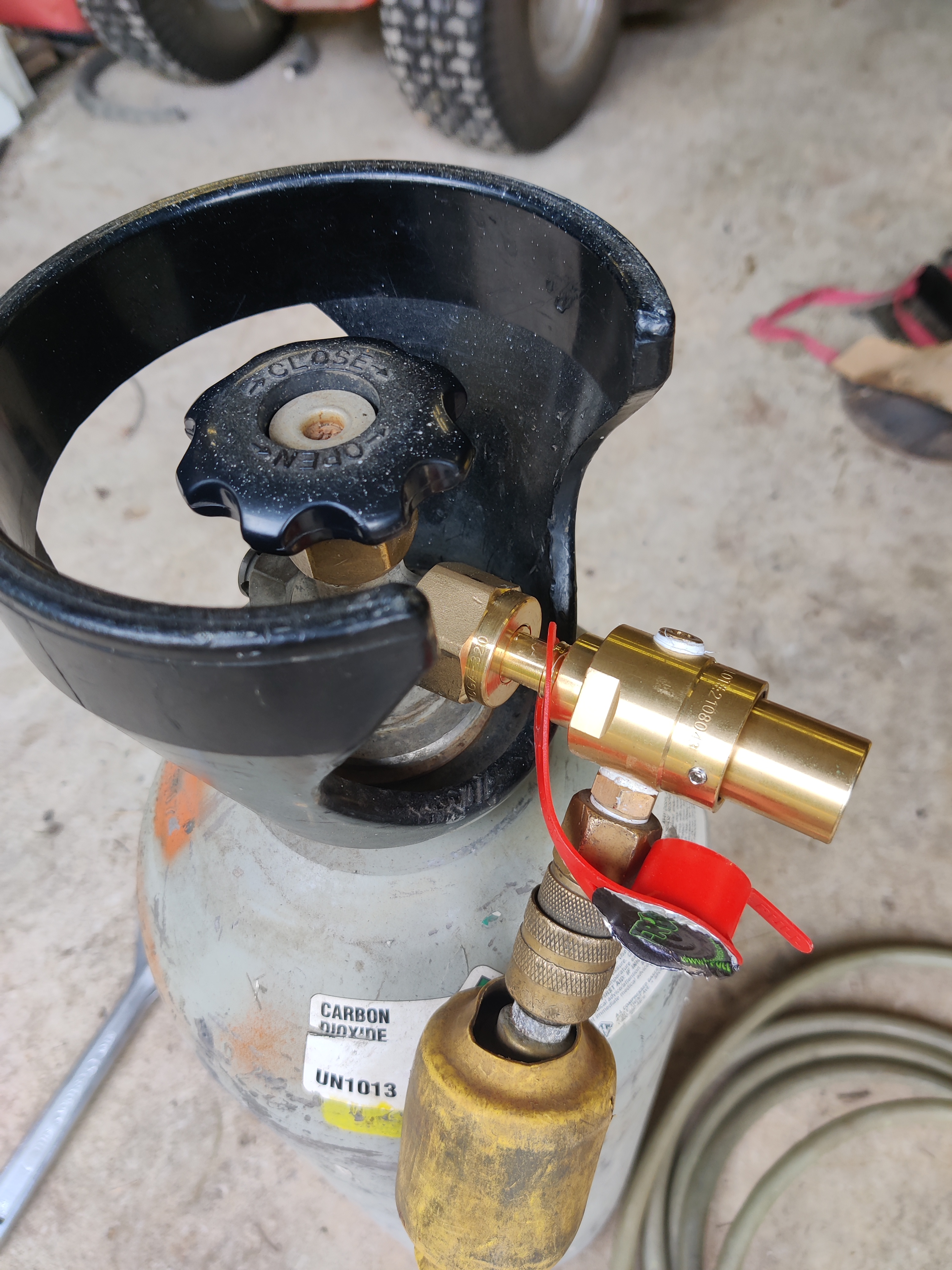
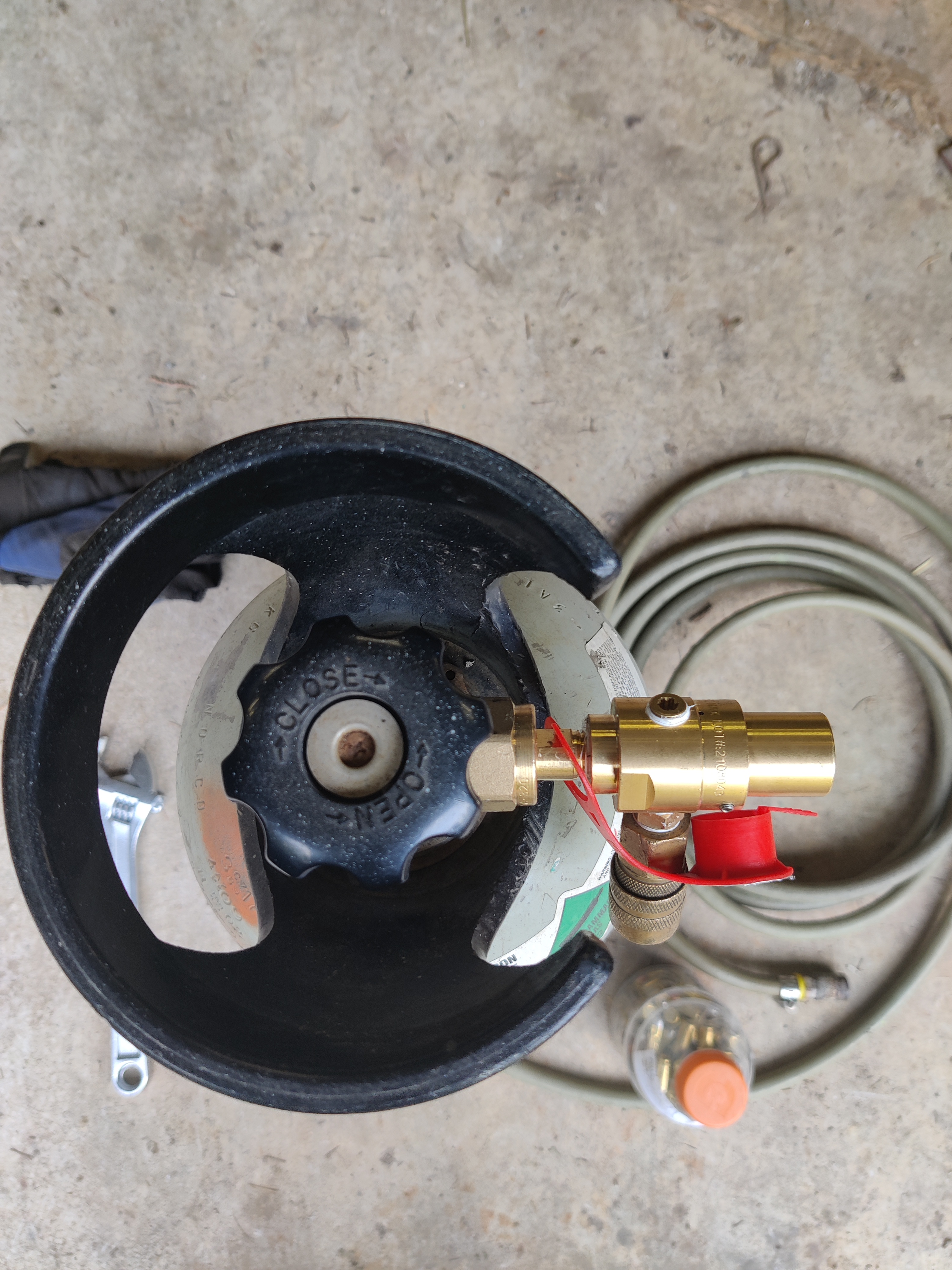
I stumbled across high flow fixed pressure CO2 regulators, think I'll try one of those out this year.

No clue what kind of regulator I ended up with as it came with the bottle I bought used, I wonder if it is a low flow unit used for kegerators. In any case, it decided to act up last year, probably due to the temps, so should be interesting to try CO2 out again with a regulator that could flow better, and may have less issues with the cold.
 
Need to go to really old compressors, think 70s and 80s. Not the new ones. The old ones used a larger permament magnet motor and a cylinder with fins on it and a head with a schrader valve in it. They are handy for other things as they have a solenoid built in to drain air. They were made in Dayton by Delco. I found a neused part number I used last time: 22009578

The flow rate isn't too bad, but they don't really like to go past 100psi. They outperform all of my sub-$120 viair compressors so I quit buying cheap viair.

You can pop off the dryer and JB Weld a fitting on it to hook up an air hose if you don't want to deal with the tiny air hose that comes on them and adapt it.
 
Followup, got the regulator. Thought I had a 1/8 NPT gauge, guess not. Oh well, tank is full. I'll get one before I use it next.

Couple of things I'd change to make it perfect. The gasket is a hard plastic type washer. Probably better longevity than rubber, but it falls out. It also requires a fair bit more force to seal, no hand tight with this. So the regulator is essentially stuck on it unless you want to have a big wrench handy, and then worry about a small washer getting lost. If the connecting pipe from tank to valve was as short as possible, the valve wouldn't be so exposed to getting hit. Handy to be able to just slide a tank into the rig and not worry about what might hit the regulator.

Tested it, doesn't seem any faster than the regulator I had before. I'll test it out fully in the next week or so.

full


full
 
Tested, ambient conditions about the same as last year where I had problems with the regulator. I got 15PSI into each 33" tire fairly rapidly. If I had to guess, maybe 3-4 minutes each.

The regulator definitely froze lol. No issue with flow, but the disconnect was frozen solid so couldn't remove the hose when I was done. Froze both gloves to the disconnect trying to break it free, but just a little bit and body heat let them free.

So success, for the most part. Doubt there is any way around issues in cold/wet weather while the tank is exposed to the elements.
 

Latest Posts

Top Bottom