CK5
Register an account today to become a member! Once signed in, you'll be able to participate on this site by adding your own topics and posts, as well as connect with other members.

D60 alignment, caster, return to center ...

I always assumed an official toe spec would be in degrees, in which case tire diameter would be an important consideration when setting it this way. Is that not true? How the heck do you measure to 1/8 anyway?
You are correct - the spec is in degrees, and the measurement to make it correct would change depending upon tire diameter. The tape measure thing seems to work OK for most folks when it comes to steering feel...but that doesn't mean anything is actually in spec :deal:
 
I run about 3* of caster on my 60. Truck drives amazingly straight/ great return to center. Heres my setup

2" lift 52" springs/ b52's, 7.25" shackles.
Dana 60
Ord Crossover
Hydro Assist

How I set my toe/ caster

First I start with my caster. An important thing, especially if your not on level ground is to find the RELATIVE ANGLE of the vehicle. I do this even if the ground is level, just to ensure everything is perfect. I get a 12' acoustical ceiling grid main runner. Its light, straight and easy to lay on top of the axle tubes. It reaches from the back axle to front. By measuring the angle at which the tops of the axle tubes are to each other you have an exact number to work off of.

I then measure the angle of the knuckles. So if i'm showing the axles at 0.5 (say front end higher than rear end) and im showing 4*+ at the knuckle, I have an actual 3.5* caster.

So once I set my caster I measure my toe. IDK what everyone else does, but I measure toe IN LINE WITH CASTER. Meaning I measure 90* from caster angle. So with positive caster you will be measuring at a higher point on the front of the tire than in the back.

If anyone sees issue with this method, please correct me. But my truck track straight as an arrow. :thumb:

Caster and toe measurements.jpg
 
I made a poor man's toe in measuring stick by using two pieces of EMT conduit that will slide inside one another,like one hunk of 1/2" and one of 3/4",and I cut 4 slits in the larger tube and use a hose clamp to pinch it tight after spreading the tubes apart till they just fit between the rims at the front side half way up,then I move it to the rear side of the rims and measure the gap there,which should be 1/8" to 3/16"...
 
Thanks for all the replies. I'll recheck my toe, but I doubt it's the issue with return to center. As far as caster, I think there are two actual data points in the thread, 3* and 10*, both saying they have good return to center. I haven't found a definitive spec value. One place said 8-11, but other places I've surfed have said as low as 0*. The 7* I have doesn't seem bad, though I'm pretty sure my CUCV is higher. I'll try to measure that tonight.

What else can affect return to center? The D60 is all rebuilt, could it just be tight? I also have a "heavy duty" steering stabilizer, but I think that would only make it return more slowly. Someone mentioned the steering box. It's a fresh/custom rebuild from a reputable shop, but maybe it's tight?

You guys who like your return to center, how does it compare to a modern vehicle? Our newer vehicles return like mad (which I'd never expect from a K5, much less lifted on 35's) so I assume we're all grading on a curve here to some level.
 
My Blazer was all screwed up after I got it "aligned" at a local shop following new balljoints. I ended up taking it to a frame & axle shop out of town where they truly understood how everything works together - they discovered serious shenanigans from the earlier alignment (such as loose balljoint nuts), but that's another story. They got it whipped into shape.

Anyway, for a K5 Blazer, the guy that owned the shop said 2*-4* caster is the spec range and should give acceptable return-to-center. He also mentioned that luxury cars like Merc/BMW/Caddy typically have 8*-10* caster angle.

While it's a system that all works together, he said that toe dominates tire wear and caster dominates return-to-center.

I notice the effect of wheelbase these days - when I was young and just hanging on for dear life it was no thing. These days I appreciate the highway stability of a longer wheelbase. My general highway steering comfort falls off from the Burb to the shortbed, and from there to the Blazer.

Steering boxes can and do go bad, BTW...
 
I haven't found a definitive spec value.

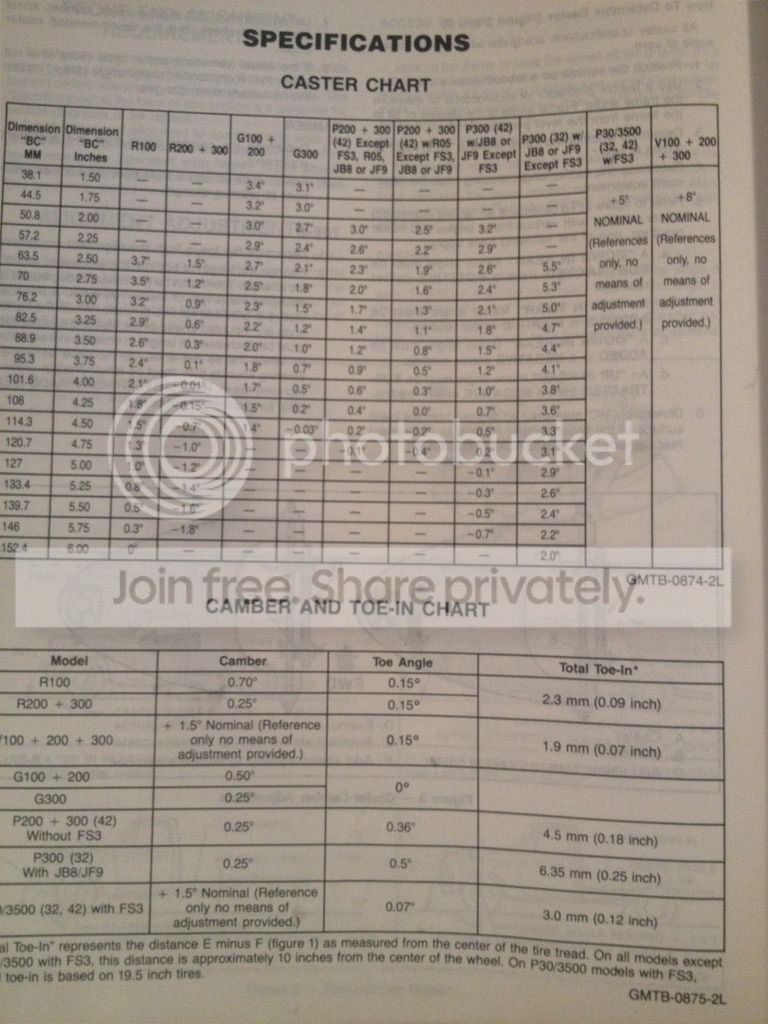
Would a GM manual be considered definitive?

Alignment%20specs_zpseoir8cx9.jpg
 
CUCV (stock, no lift) looks to be about 8 degrees of caster and RTC is good. I doubt the 1 degree less on the K5 is critical. Not sure what to blame for the lame RTC. :dunno:
 
If 1° were not critical don't you think the factory service manual would give a range? If you went to an alignment shop they would most likely want to adjust it rather than let you roll. Does that mean it's crazy critical to adjust, no BUT it's still out of spec.

As for the RTC, IMO, it's tough to compare apples to apples with other trucks with similar caster because of the modified steering box. Any chance you have a stock box you could swap on for diagnosis?
 
If 1° were not critical don't you think the factory service manual would give a range? If you went to an alignment shop they would most likely want to adjust it rather than let you roll. Does that mean it's crazy critical to adjust, no BUT it's still out of spec.

Well, how close does it need to be then? 0.001 degrees? :D Shims typically come in 2 or 4 degree increments, or maybe more. I think there's an implied range of a few degrees, but I don't really know. I'm not going to pay another 120 bucks for shims plus u-bolts to dial in 1 degree unless I'm really certain it will matter.

Can you really take these rigs in for alignment besides toe?

As for the RTC, IMO, it's tough to compare apples to apples with other trucks with similar caster because of the modified steering box. Any chance you have a stock box you could swap on for diagnosis?

No, I turned mine in for core. You're thinking potentially tight steering box?
 
Well, how close does it need to be then? 0.001 degrees? :D Shims typically come in 2 or 4 degree increments, or maybe more. I think there's an implied range of a few degrees, but I don't really know. I'm not going to pay another 120 bucks for shims plus u-bolts to dial in 1 degree unless I'm really certain it will matter.

Can you really take these rigs in for alignment besides toe?


No, I turned mine in for core. You're thinking potentially tight steering box?

I agree there is probably a gray area with respect to the caster (as long as it's real close).

Yes, you can set it up on an alignment machine and take readings. Of course most guys nowadays will flip out at the prospect of needing to adjust a truck like ours, especially when lifted. I would even bet they would price the cost of adjustment so high you wont bother them with doing the work.

If you think you might have a big issue, it might be worth paying the $59.99 (or whatever amount) to set it up and have the shop print the current readings.

As far as the steering box effecting RTC, I would think it shouldn't any more than a reman stock box but you never know. If another CK5'er close to you had a box I'd think it might be worth the labor to do some diagnosis.
 
One thing just occurred to me. I never got my steering wheel perfectly lined up, mostly because it's kind of a pain with the bent style crossover arm. So it's maybe 30 degrees off right now. Any effect on RTC? The only reason I think it might matter is because if the wheel is off, then the box isn't at it's center, and the box has variable ratio. Think there's anything to that?
 
Top Bottom