
CK5
Register an account today to become a member! Once signed in, you'll be able to participate on this site by adding your own topics and posts, as well as connect with other members.

Datalogging with WinALDL

mrk5

The Sticker Guy
Moderator
Vendor
GMOTM Winner
Author
Joined
Apr 20, 2004
Posts
26,971
Reaction score
27,300
Location
Northern Colorado
This is a question in regards to my 1989 R3500 with 5.7L and manual trans.

I was trying to datalog using WinALDL but I'm getting virtually no information. I know the computer is receiving a signal because the values in the first 2 rows changed but none of the others did. There was no data under any of the other tabs. Screen shot of the WinALDL interface below for reference:
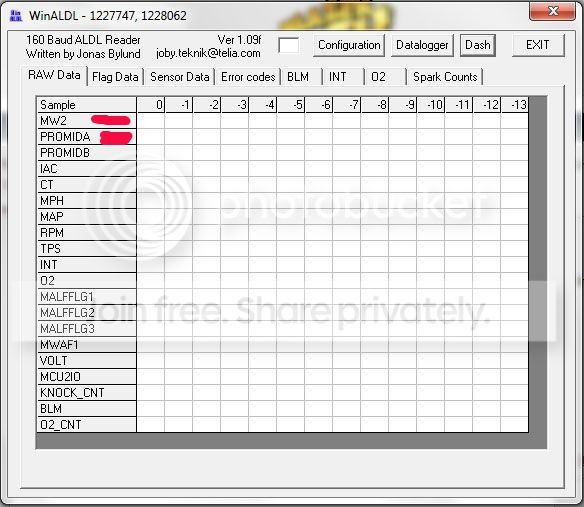
WinALDL-screen.jpg


The first 2 lines with red marks were the only 2 that changed. Clicked the "DASH" button and none of those numbers moved off 0.

The one discrepancy that I noticed was that I couldn't choose the correct ECM for my truck. I have the 1228747. I had selected the more common 1227747 ECM. I'm wondering if that is the reason it's not working.
 
Its usually pretty straightforward. I'd have to turn on the computer to check, but I'd guess the ECM number is the issue. You can try opening the data logger and click "start" or whatever the button is to start logging. That shouldn't make a difference though.

You could also try a different com port setting.
 
Any reason you aren't running Tunerpro RT?

It's free to download (Register if you find it valuable), worth a shot to see if it works without having to try a whole bunch of other things. Heck of a lot less hassle to just download and install something and see if it works properly, vs. trying to troubleshoot software/hardware issues.

Since WinALDL has no more functionality than TunerPro, no downside to at least trying.
 
You may get a couple things to show data if they happen to be in same place as the other ECM.

In the chip is ALDL locations and which data to send out. There are hundreds of different ALDL files. So pot luck to getting data from wrong one and it may not even be correct data.

Swap over to TunerPro RT. It is not comparable, it is superior. All files for 8747 $4F are here:
http://www.gearhead-efi.com/Fuel-Injection/showthread.php?521-1228747-ECM-Information-4F

Cable installation is sometimes tricky but here's how and why:
http://www.gearhead-efi.com/Fuel-Injection/showthread.php?1557-Cable-Installation-to-TunerPro-RT

Making history tables if they are not already done:
http://www.gearhead-efi.com/Fuel-Injection/showthread.php?444-Making-History-Tables-in-TunerPro
 
Thanks for the replies. I had initially downloaded TunerPro because I didn't realize the RT version was free. I have RT installed and downloaded the $4F files. I haven't had a chance to try it yet. I'll report back on how it goes.
 
Haven't played around with winALDL in years, but even if TunerPro turns out to be some hassle getting running (sometimes things just are), it's light years ahead in terms of display and functionality, assuming someone didn't go back and update winALDL, which I doubt.
 
Thanks for the replies. I had initially downloaded TunerPro because I didn't realize the RT version was free. I have RT installed and downloaded the $4F files. I haven't had a chance to try it yet. I'll report back on how it goes.
Lot of guys do that. TunerPro is just to edit the bin/chip. TunerPro RT does that as well as data logging/scan tool.

There used to be a separate program called Scanner Pro. Then the 2 were integrated.

In the OBDI tuning world TunerPro RT is top notch first class software.

We do encourage people to register and pay the $39. so he keeps improving and updates.
 
Okay, TunerPro RT worked great with the $4F file for light duty.

So where can read about what all this means? I don't know what BLM or INT are. Also not sure what kind of numbers I'm looking for on the various readings.
 
This will be a big help to get you caught up!
http://www.gearhead-efi.com/gm-ecm-pcm-conversion/efi-dictionary.html

Save a datalog and zip it to post here and I'll take a look for you as well.

Thanks. I'm not necessarily planning to burn custom tunes, but I'd like to figure out if any sensors need to be replaced; things like that.

I couldn't attach a file but here's a link to a zip file of the 2 logs I recorded today on a short highway drive. https://www.dropbox.com/s/6o39aexrjt69dr0/TunerPro logs 1-8-14.zip Thanks!
 
Read up on what Mark posted, I know he's pointing you in the right place. At least having a basic idea of what the terms/components/functions are, will help make a bit more sense of how things are inter-related.

For really rough terms, 128 BLM/INT is normal/ideal for cruise if everything is stock. It can, will, and does vary depending on a bunch of factors, but for all intents and purposes, that's the norm.

Things like MAP voltage and what not, you need to know what "normal" is, and where you are from there. Same with engine temp. I know my gauge is correct, so I can reference it vs. the CTS reported temp. O2 sensor at steady cruise on flat ground should bounce above and below ~.45mV. If it's staying under or over continuously, there may be a problem.

Setting up the "dash" in tunerpro is nice, if you are watching while the vehicle is running. I haven't done so, Mark will know for sure, but you can probably "play back" the log file in tunerpro, and watch the tunerpro dash, instead of either trying to drive and watch the dash, or having someone else drive while you watch it. The playback feature is pretty neat.
 
Yes, you can watch the playback on the dash as if you were driving. I did that a few times and decided I need to figure out what I'm actually looking at.
 
I had a chance to look at your logs and it's doing fine. No error codes, BLM are in ballpark of correction but VE Fueling table could use some work, as do all stock chips.

BLM = Block Learn Multiplier. Block Learn Mode term is long term fuel trim. BLM value tracks the Integrator but has a delay. If the Integrator increases so does the BLM, but the BLM lags behind the Integrator. The higher the Integrator climbs above 128, the faster the BLM rises. BLM value affects the VE table by adding fuel above 128 and subtracting fuel below 128. This is stored in memory.

INT = The short term fuel trim value is called the Integrator The value of the integrator varies above and below 128 with 128 being no correction. For example, if the Integrator is 135, the ECM is adding fuel because the 02 sensor is reading a lean mixture. If the Integrator is 110, the ECM is removing fuel because the 02 sensor is reading a rich mixture. Anytime the system is not in closed loop, the Integrator will immediately return to a value of 128 and stay there. This is not stored in memory.

Both BLM (long term fuel trim is the term used in newer vehicles) and INT only get changed with O2 sensor feedback. When in Open Loop they are usually 128 or close, some ECM have an upper and lower limit for Open Loop and may be off of 128 depoending on BLM stored in memory.

MAP kpa is just a different reading of vacuum. The voltage is not really important unless diagnostic testing is being done. Stock motor at idle is around 30 kpa depending on elevation and RPM. At WOT it should drop close to 100 kpa, then on deceleration go under the 30 kpa you had at idle.

You can watch TPS % and see that MAP kpa goes up when throttle is opened and down when throttle is closed. Mkae sense?

Temperature is temperature in either F or C.

For tuning or just seeing how and engine runs to compare all readings should be done fully warmed up and with TBI (wet intake) even driven a little. Things change.

You could write a book on all the readings and in the end there is no set number that is perfect for any engine. Takes a little learning to get a feel for it. Now if you have a stock motor and it runs bad at idle and you see a MAP of 50 kpa? You got a vacuum leak which will effect all other readings. But say you have a aftermarket cam? Well 50 MAP kpa is acceptable. Chip needs tuned and you can get this down a bit, or not, but it will run good!

O2 sensor volts does not help much as there are cross counts, so the voltage is always going up and down. It can be helpful on some ECMs at WOT or when Open Loop as voltage will be steady. SO if your doing a WOT run it should be on the rich side like .900 volt.

HTH! :waytogo:
 
I'm curious if a person is to get into burning their own chips, how much does altitude change affect things. A lot of what this truck will be used for is driving from home up the mountains for camping and wheeling. That's a altitude change of at least 5000ft to 9000ft typically.

Would you just tune for 5000ft and not worry about the changes? Or would you log data at both elevations and use the numbers to come up with some sort of average? Or does it even matter much?
 
The map sensor should be taking care of this, the thing to remeber is every 5k feet I beleive the air pressure drops 1 psi so at sea level 14.7 . Basically everything being equal it will need to be leaner, sometimes the elevation causes the engine to run hotter because the air is less dense, this is where flow in and out makes a bigger difference. you have less air to work with so use it more efficiently, timing cannot be as aggressive and you cant put as much fuel to it because the lack of the air.
 

Latest Posts

Top Bottom