CK5
Register an account today to become a member! Once signed in, you'll be able to participate on this site by adding your own topics and posts, as well as connect with other members.

Does my K5 really weigh more in the back?

Blue85

Yooper
 Premium
GMOTM Winner
Joined
Jul 26, 2000
Posts
16,773
Reaction score
9,793
Location
Keweenaw
I stopped by the gravel yard this afternoon and it measured 5940lbs. Then I dropped the front tires off the front of the scale and it measured 3100lbs. I would have expected the opposite. I do have a heavy rear bumper and heavy spare tire back there. Drivetrain: 350 TPI with iron heads, 700R-4, NP208, 14b s/f (disc brakes) and 10b. Front bumper is stock and no winch. It does have 3/4" MDF side panels in the back and a medium size sub box sitting back there. Probably 10 gallons of gas in it. It looks like this:
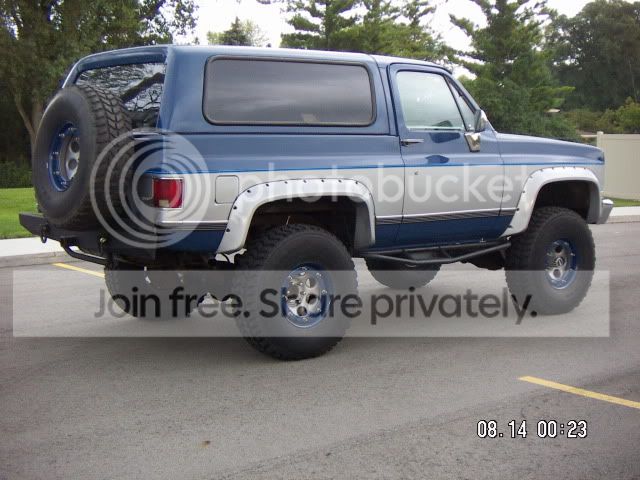
PICT0020.jpg
 
top is heavy, glass is heavy, that spare is heavy, bumper, subs are heavy. But you need actual individual scales to know the right answer.
 
Last edited:
I doubt it... first, i bet if you turned around and put the fronts on, the number would be even higher.. just cuz you only had 2 wheels on doesn't mean it's not feeling some of the rest of the weight of the vehicle... it's not isolating it...

even with a sb, I'd bet the farm the front is heavier...
 
It's not a 50/50 split when weighed like that. More like two thirds or something. If you had only weighed the front it would have been a higher number too.

edit: Ryoken was quicker on the draw.
 
It's not a 50/50 split when weighed like that. More like two thirds or something. If you had only weighed the front it would have been a higher number too.

edit: Ryoken was quicker on the draw.

Maybe there's something I don't understand about those scales, but if it's just measuring vertical force, I don't see how that's possible.

2012-02-21141757.jpg
 
you don't think a driver sitting in the seat would affect the measurable weight on the back tires?
 
you don't think a driver sitting in the seat would affect the measurable weight on the back tires?

Yeah, it would increase the whole weight of the rig too...

If the driver weighs hypothetically 150lbs, let's say hypothetically he adds 20 lbs to the rear measurement. He would then add 130 lbs to the front.

If the scale measured 130 lbs front and more than 20 lbs rear, he would be accelerating in to the sky...just like if you push against a person with 100 lbs force, and they push back with 150 lbs force, you fall down...

F1 = s1 and f2 = S2 otherwise the truck is not stationary.

I don't know anything about those scales, but if they are calculating weight from vertical force, that's how it works.
 
Last edited:
I think you are WAY overthinking this....

simple.. put the trucks back tires on the scale, empty... ok, 3100 lb's... than get in the driver seat... weight goes up to 3150.. based on a percentage of the weight being felt by the back tires.. whether that's 10% of his weight, or 50% of his weight would be based on how far away from the centerline of the back tires it is....
 
I think you are WAY overthinking this....

simple.. put the trucks back tires on the scale, empty... ok, 3100 lb's... than get in the driver seat... weight goes up to 3150.. based on a percentage of the weight being felt by the back tires.. whether that's 10% of his weight, or 50% of his weight would be based on how far away from the centerline of the back tires it is....

This doesn't explain how the force pushing down on an axle could somehow change without changing the weight of the whole vehicle...

Not sure how you think I'm "overthinking" this. A free body diagram is the simplest way you can observe this.
 
Beautiful truck man!

Love the blue and gray.

The top and tailgate probably weigh close to what that 350 weighs. My top alone was 308lbs...
 
My brain sees a fulcrum point somewhere along the truck where the scale is seeing more than 50% of the weight, or basically a false reading? My education level (at least non-automotive related) stops at grade 12, and that was a voc-tech school. So don't rely on me to figure out what you have going on there. Maybe I'm wrong but I would think the reading would be higher (truck stationary mind you) with the front tires off the scale but closer and the weight would be lower with the front tires further away. That's all in my minds eye though. Reality may differ.

The end all be all would be to go back to the scale and weigh the front.
 
My brain sees a fulcrum point somewhere along the truck where the scale is seeing more than 50% of the weight, or basically a false reading? My education level (at least non-automotive related) stops at grade 12, and that was a voc-tech school. So don't rely on me to figure out what you have going on there. Maybe I'm wrong but I would think the reading would be higher (truck stationary mind you) with the front tires off the scale but closer and the weight would be lower with the front tires further away. That's all in my minds eye though. Reality may differ.

The end all be all would be to go back to the scale and weigh the front.

That would be the case if the scale is elevated from the rest of the area, but every one I've ever driven our trucks across is flush with the asphalt.
 
Simple answer, go back and weigh the front, the whole vehicle again, and the back. :D Compare the numbers after that?
 
terry has it right, the only thing not in there is the leveling, if he got off the scale and the nose is up, it puts more weight on the rear, if it's nose is down it puts more weight on the front.
Also the scales are not that accurate all the time.
They are made for big tonnage and they can easily be 40-80 lbs off.
I sometimes get 100lbs difference just by moving the wheels a couple of inches, but when your total weight is 80k, it's not a big deal.
If you want a real weight, you need to do the opposite too an then interpolate, or use a scale made for lighter weights.
I bet with his setup he's pretty close to 50-50

And by the way, these scales only go in 20lbs increments, so no 3150, either 3140 0r 3160:D
I think you are WAY overthinking this....

simple.. put the trucks back tires on the scale, empty... ok, 3100 lb's... than get in the driver seat... weight goes up to 3150.. based on a percentage of the weight being felt by the back tires.. whether that's 10% of his weight, or 50% of his weight would be based on how far away from the centerline of the back tires it is....
 
of course the whole vehicle weight would change.. what difference does that make? all my example does is show absolutely, perfectly clear that weight somewhere towards the front of the vehicle will affect the back tire weight...
 
Well I'll play, going with his current figures he is showing a 52%/48% weight bias to the rear/front. Going with the idea that the scale is on flat ground it should be fairly accurate. Given that he has 60lbs of fuel, speakers, custom rear bumper with what looks to be a 37in military tire all the way back, and a larger rear axle, I will give benefit of the doubt that it is fairly accurate. Of course this is all assuming the scale is level and there is no lip or ramp on the exit or entrance. Tolerances of the scale can be set aside since it will be off on all the weights measured to only a fractional degree same can be said to adding 150lb person into the mix when we are referring to thousands of pounds. Unless this isn't on a level ground then forces will have to be measure on an inclined plane using the center of gravity of the vehicle. Also, sweet truck Blue85!
 
The ground and scale are very level. If a person didn't know it was there, they could drive over it without noticing. It's set up to measure those double trailer "road trains" so when I measure one axle it is on the very edge of a long platform. I was wondering if being way out on the end skews the readings, but I only moved the vehicle like 10' between the two measurements. So both are sort of on the edge of the scale, yet the total weight seems about right to me. I weighed the rig a couple of times at a scrap yard at 5400-something pounds. Since then I swapped 5 35s on alloys to H1 wheels and tires which weigh approximately 1.5 buttloads a piece.

I wish I would have done just the front and just the rear a couple of times to verify that it all adds up, but my turn was up and he weighed it for free so I didn't want to be in the way. The way that scale is set up I could probably put an axle on it from the side as well. I don't know if/when I will go back because their 8-4, 2-day a week schedule forces me to totally rearrange my day to get there.
 
I don't think that's the best force diagram to apply. You should show a 5940lb center of mass and then two distances from the axle centerlines to the center of mass. Then you can show how the weights would change on an incline. Now if I was accelerating or braking during the measurement that would skew the numbers, but I think it would also tick off the scale operator.


Something I forgot is there is a crossmember and anti-wrap setup back there.
 
I was just going with the generalization that the COG would change with an incline changing the weight represented from front to back. But atlas, I'm just getting into all that fun jazz in my college physics class... lol :D
 

Latest Posts

Top Bottom