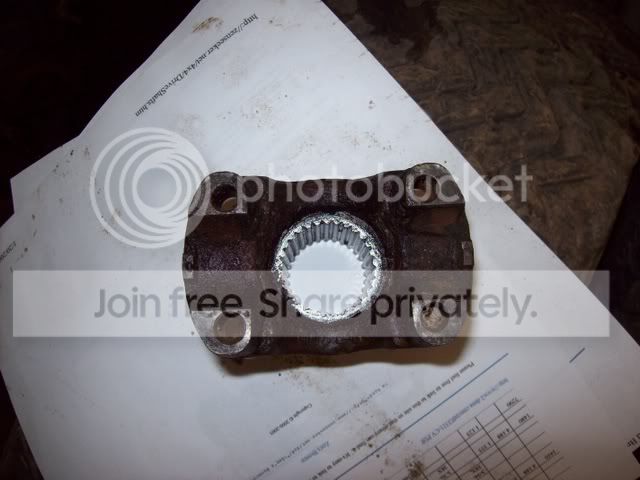
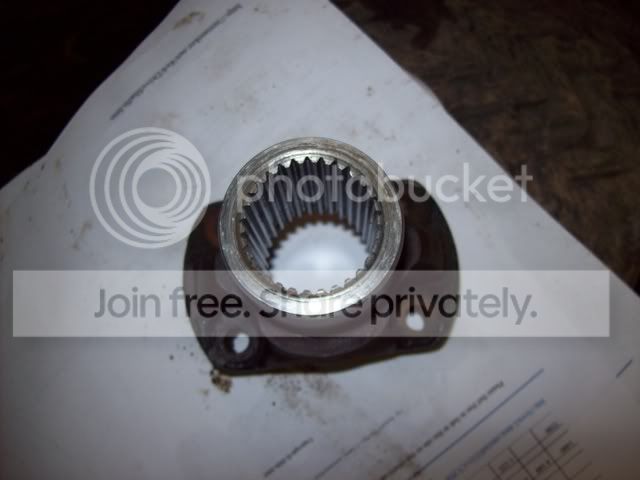
There is no yoke style that fits a 30 spline output. All 30 spline outputs are flange style. GM went to the flange style in 1977 IIRC. Did not matter what trans they had all were 30 spline flange after that year.
Here is some reading if you haven't seen it already.
[FONT=Arial, Helvetica, sans-serif]Front output shafts:[/FONT]
[FONT=Arial, Helvetica, sans-serif]GM used two front output shaft configurations, one had a spline count of 10, the other was a 30 spline. 10 splines came before 1977 (roughly) 30 spline shafts came after 1977 (again, roughly).
One quick way to tell them apart is by the fact that 10 splines came with a 1310 series yoke output, capable of accepting a CV or yoke driveshaft. 30 spline shafts came with the flat flange on the output, capable of accepting the GM 3R series CV joint.
[/FONT]
[FONT=Arial, Helvetica, sans-serif]Strength:[/FONT][FONT=Arial, Helvetica, sans-serif]
Strength wise, the 30 spline is the way to go. The 10 spline shafts have been known to break, usually in abusive applications (big blocks, 40"+ tires, etc). 30 spline shafts seem to hold up well, especially since there isn't anything in a front axle that can take the torque required to break the finer spline t-case shaft. Also, the 3R CV joint should be a little stronger unit overall due to the wider crosses. Practically speaking, it's nice to have the fine spline, but if you're running a 1/2 or 3/4 ton front axle, the front will break long before the NP205 10 spline output. At that point, it comes down to ease of service, yoke choice, and other such factors.[/FONT]
[FONT=Arial, Helvetica, sans-serif]Yoke Choices:
For this one we consulted Tom Wood of Tom Wood's Custom Driveshafts. The 10 spline output [/FONT][FONT=Arial, Helvetica, sans-serif]will accept a 1310, 1330, or 1350 ujoint yokes, and of course the 1310 CV joint.
The 30 spline output will accept the 1330 or 1350 CV joints.
This info is incomplete, we were unable to reach Tom at the time this was written but these are the most common driveshaft configurations in 4wd vehicles.[/FONT][FONT=Arial, Helvetica, sans-serif][/FONT]
[FONT=Arial, Helvetica, sans-serif]Ease of use:
We prefer the flat flange output on the 30 spline output shaft due to the fact that you can actually put a socket on the bolts that hold it together from the front. The yoke style CV joint is a real pain to install since it uses fine thread bolt installed from the rear of the yoke. Nothing like turning a 5/16" fine thread bolt 1/8" of a turn at a time with an end wrench. GRRR. Other than that, there may be details that a drive shaft shop would be best suited to helping you with.[/FONT]
[FONT=Arial, Helvetica, sans-serif]Heavy duty upgrades:[/FONT][FONT=Arial, Helvetica, sans-serif]
There are 2 heavy duty upgrades that you may be interested in. One is the current availability of 1350 series CV jointed drive shafts. The most common configuration of these shafts is a flange connection. There are 2 ways to get these to connect to the NP205. One is to use a lightly modified standard 30 spline front output flange. The mods must be done on a lathe, but it's not much work once it's chucked up.
The other way to connect the 1350 CV is to use a Ford 32 spline NP205 front output shaft and use a specialty flange type output.
The other HD upgrade is using the Ford front output shaft itself. This output shaft configuration is the same as the rear of the NP203 and NP205, so the yokes interchange. You can get about any driveshaft connection you can imagine for this output configuration. And with the 32 spline, you're basically guaranteed it's not going to break. If you have a 30 spline front output already, it's probably not worth swapping the 32 spline shaft in unless you need the yoke options.
[/FONT]