CK5
Register an account today to become a member! Once signed in, you'll be able to participate on this site by adding your own topics and posts, as well as connect with other members.

dual batteries

Hayden334

Registered Member
Joined
Jan 15, 2009
Posts
19
Reaction score
0
Location
cullman AL
what do i need to do to run dual batteries on my 82 k10. can i just hook the extra to my alternator and ground it to the fram. all i want is to run ly winch and lights off it.
 
Last edited:
You really need an ISOLATOR. Some people use a FORD solenoid.

I used a kit by HELLROARING. Its not cheap, but worth every penny. The way mine is setup. Im using the 2nd battery as pure back up.

Meaning, everything is connected to the "starter" battery.

With the kit im using, I have a 3 position switch.

Down - Removes 2nd battery from charging system

Middle - Charges both batteries, but has no draw on the 2nd battery

UP - Connects both batteries for extra juice, i.e. winching, starting etc.

THe reason I wanted my 2nd battery NOT doing anything is because, if you have a parasitic draw or you kill your starter battery, it will usually take the 2nd battery with it. I had a draw on my system (ended up being the Tach was wired hot and was putting a draw on the system) well my battery would be dead after a week, I simply flipped the switch in up position to "activiate" the 2nd battery and started my truck. I found the draw and just put the tach on a Key On switch and never had any issues since.

This is my approach to it.
 
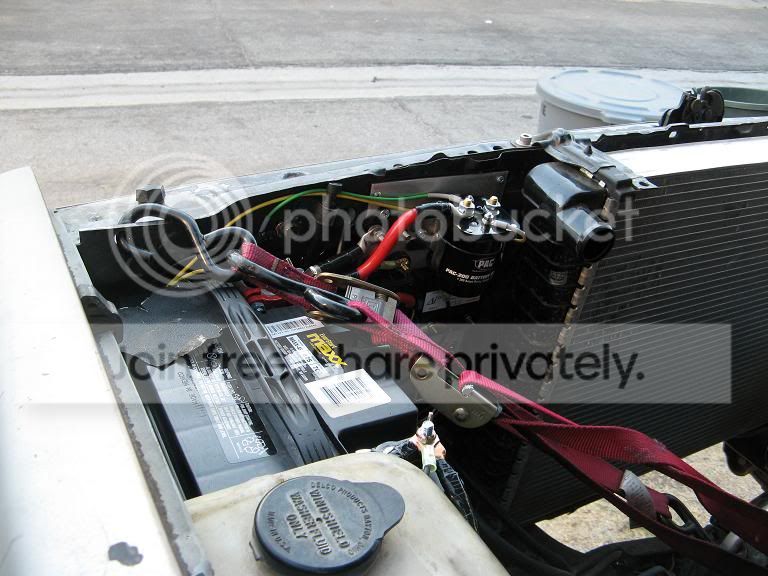
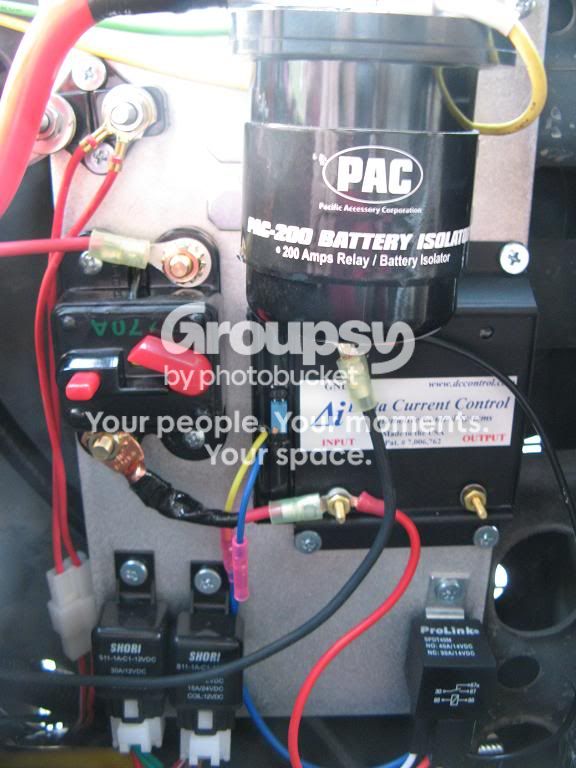
we wired the boy's Blazer so the right battery cranks the engine and everything runs of the left battery. An interconnect relay will connect the two with the push of a button in the event one or the other is dead. This way a day at the lake or tailgating at the game won't leave him stranded. A battery isolator is used to keep the CS-144 alternator charging both batteries.
We eliminated the power connections at the starter and ran them instead to a terminal block for easy access.
 
Last edited:
Been running this one for around 5 years with no probs.
https://www.napaonline.com/Catalog/CatalogItemDetail.aspx?A=BK_7821768_0006398311&An=0

I have my winch and lights hooked up to my second batt. So I can run them with the truck off without fear of draining the main batt. They are both always charging though. You do have to disconnect the isolator if you need to jump start from one batt to the other. Not as nice as the flaming river setup, but cheaper.
 
what do i need to do to run dual batteries on my 82 k10. can i just hook the extra to my alternator and ground it to the fram. all i want is to run ly winch and lights off it.

You need to be careful how it is wired and consider what will happen in the event of a failure.

Example: Extra wench battery wired to alternator with 10ga wire for chargine purposes. Main battery fails and owner cranks engine. Now current for cranking tries to flow from wench battery to starter via 10ga "charging" wire. Smoke and fire follow.
 
You need to be careful how it is wired and consider what will happen in the event of a failure.

Example: Extra wench battery wired to alternator with 10ga wire for chargine purposes. Main battery fails and owner cranks engine. Now current for cranking tries to flow from wench battery to starter via 10ga "charging" wire. Smoke and fire follow.

Reason for an isolator.
 
why not try a boat battery switch?? you can run off bat #1 or bat # 2 or both, or shut off alltogether,you run on odd day's bat 1 ,and even days bat # 2 turn to both for a jump? .. jest my 2cents. :eek1::eek1:
 
or, ya can run a marine switch combined with an ACR for the most flexible possible system without having to even switch from #1 to #2, etc...


ACR... alternator charging relay....


voltage sensing , parallel switch, etc, etc...

http://bluesea.com/category/2/productline/388


plexi2.JPG
 
Well if you have 2 of the same battery, both new or the same age/performance, you can just wire them in parallel. This is like having 1 big battery. So whatever winching/etc. you can do now, this would extend it.

If you want to protect the starting battery while running other stuff, then you are on to all of the isolator options.
 
To see if i Understand this...With an isolator you DO NOT need to have identical, bought at the same time batteries correct?
 
I just threw the 2nd battery in their as a back up and strapped it down. Its completely stand alone from the rest of my system. I mainly use it to jump myself or as a spare battery as i dont have any large pulls on my system from subs,winches etc...
 
I just threw the 2nd battery in their as a back up and strapped it down. Its completely stand alone from the rest of my system. I mainly use it to jump myself or as a spare battery as i dont have any large pulls on my system from subs,winches etc...
I did this for a couple years, just as a back up plan after I added a DS battery tray. Even without jumper cables, you can just trade the positions of the two batteries. Not the MOST convenient setup, but 100x better than carrying your dead batteries through the boonies to get it charged. Plus you have to remember to put it on the charger once in a while.
 
I bought a drivers side battery tray from a member here, then bought a Blue Sea automatic charging relay, a Blue Sea on/off battery disconnect switch, and went to my local West Marine store and custom cut/crimped cables for my setup (and fused them at each positive terminal, of course).

The ACR only charges if the 2nd battery isn't discharged too low, so I had to install the manual switch to hardwire the two together in case my fridge/radio/offroad lights run down the 2nd battery below 12 volts and the ACR won't auto close and charge.

I started using an isolator from O'Reilly's, but there was almost a full volt loss between the input/output. I junked that setup in a hurry.

http://coloradok5.com/forums/Blue Sea dual battery kithttp://bluesea.com/category/2/productline/overview/329
 
II started using an isolator from O'Reilly's, but there was almost a full volt loss between the input/output. I junked that setup in a hurry.

Somewhere between .7V and .9V, to be exact, which is the voltage drop across the diode. It's a solid state isolator, as opposed to e.g. a relay type, and that's perfectly normal for such a gizmo.

That said, I use a relay on mine...

-- A
 

Latest Posts

Top Bottom