

mrk5s system is sweet and simple. Very little to go wrong. Run it on 1+2 most of the time and both batts are in the system working all electrics and getting charged. If you get in a spot where your engine dies you can turn the switch to batt 1, winch yourself out, fix the engine and turn switch to batt 2 to start the engine. About the same as mine but his switch works a tiny bit different.
CK5

You are using an out of date browser. It may not display this or other websites correctly.
You should upgrade or use an alternative browser.
You should upgrade or use an alternative browser.
Dual battery questions.
- Thread starter 85 Jimmy
- Start date

I think I'm going to run it like Scott has his for now. I know ideally you want to run 2 of the same batteries, but would it hurt if I ran a fairly new diehard platinum as one battery and a fairly new red top optima as the other, both the same cca?
Ok, now that I'm doing some homework procrastination, I'm thinking about running an ACR.
Out of these, which is best for our applications? http://www.bluesea.com/products/category/Automatic_Charging_Relays
In Mastiff's diagram, where would you pull the ign source from and what is the purpose of the toggle switch?
Out of these, which is best for our applications? http://www.bluesea.com/products/category/Automatic_Charging_Relays
In Mastiff's diagram, where would you pull the ign source from and what is the purpose of the toggle switch?

the best solution..
http://www.bluesea.com/products/762...rging_Relay_with_Manual_Control_-_12V_DC_500A
you wouldn't use his exact diagram for an ACR..basically his signal wire/toggle switch setup becomes the parallel switch that comes with the above ACR.. and like I have run in my switch layout... run on momentary switch to hold as needed to boost for starting, etc.. or add a DT switch, adding a perm "on" too for longer paralleling to the mix too..
http://www.bluesea.com/products/762...rging_Relay_with_Manual_Control_-_12V_DC_500A
you wouldn't use his exact diagram for an ACR..basically his signal wire/toggle switch setup becomes the parallel switch that comes with the above ACR.. and like I have run in my switch layout... run on momentary switch to hold as needed to boost for starting, etc.. or add a DT switch, adding a perm "on" too for longer paralleling to the mix too..

In Mastiff's diagram, where would you pull the ign source from and what is the purpose of the toggle switch?
You need to find a key switch source. IIRC, the easiest is to tap off the ignition wire to the distributor. You could grab a wiring diagram and get refreshed on what else might be in the engine compartment. In my case, I also found at least one spare keyed source on the fuse block.
The toggle switch is in case you want to be able to keep one battery out of the system. Without it, if a battery died badly, it would still always get connected to your good battery when the truck tries to start. I just have a little toggle underhood, but you could also run the ground side of the relay trigger into the cab and put a switch there.
Relay:
http://www.amazon.com/gp/product/B001YIPXR2/ref=oh_details_o00_s00_i00

If you want to go ACR the ML Series that ryoken listed is the best one to use. It is the only one that can handle starting/winching amp draw threw the ACR itself. The other two are big enough for charging loads but the winch will kill them. If you use the SI Series you can hook a wire on it so it opens up when you hit the winch button but then you would need to parallel the batts some other way.
As far as using batteries that are different that is one of those no-no things. But, I have got away with using a pair of Odyssey batts in parallel for the winch and a old school flooded batt for the truck for years. Both sets seem to charge fine and I'm getting good life from them. I get Odysseys for free sometimes so I tried it. But when all is said and done, it is not recomended practice. Other battery combinations may not work so well.
As far as using batteries that are different that is one of those no-no things. But, I have got away with using a pair of Odyssey batts in parallel for the winch and a old school flooded batt for the truck for years. Both sets seem to charge fine and I'm getting good life from them. I get Odysseys for free sometimes so I tried it. But when all is said and done, it is not recomended practice. Other battery combinations may not work so well.
Is the different battery thing a wives tale type thing, or actual science? Seems like 12V is 12V. The alt will give 14V or whatever and they'll take the current they want. Maybe it has to do with them being hooked together when not charging? One of them may discharge the other? I have different kinds. What am I going to do, spend another $200 to replace a perfectly good battery when one dies?
Well, I think there is some science behind it but not sure how big of a deal it is. I think as long as you aren't mixing types (like I am) or huge size diffs it should be ok. Look at newer pick ups towing RVs. When the truck is running the batts in the RV are hooked to the truck system to charge them. Never heard of a problem there. I would run what you've got and when you buy again get a matched set.

If you are running a multi-stage charger/maintainer, like some of the better marine chargers or some of the long term float chargers, then the type of batter is important.
Different systems have different charging profiles and different float voltages. For instance the charging system on my genset has settings for gel/flooded/agm. Its a dual charging system, and I can set each side for different batteries.
If I couldn't, I would need to have matched types.
However, the alternator in your truck is not that smart. It basically cranks out a set voltage with maybe some temperature compensation, and thats it. It neither knows not cares if you are running a flooded or agm battery. Or even a gel-cell. They all get the same treatment.
So, no matter what types of batteries you use, it won't matter as far as the charging system is concerned.
Some different types have different internal resistances and resting voltage, but they all vary according to their degree of charge, so I doubt it will affect much.
If you tie them together, especially without the alt running, one might try to overcharge the other slightly, but since most of the time they are in that situation, they are going to see a big load, it should be fine.
In an ideal world, they should be matched both in type and size, but you should be able to fudge a little.
Different systems have different charging profiles and different float voltages. For instance the charging system on my genset has settings for gel/flooded/agm. Its a dual charging system, and I can set each side for different batteries.
If I couldn't, I would need to have matched types.
However, the alternator in your truck is not that smart. It basically cranks out a set voltage with maybe some temperature compensation, and thats it. It neither knows not cares if you are running a flooded or agm battery. Or even a gel-cell. They all get the same treatment.
So, no matter what types of batteries you use, it won't matter as far as the charging system is concerned.
Some different types have different internal resistances and resting voltage, but they all vary according to their degree of charge, so I doubt it will affect much.
If you tie them together, especially without the alt running, one might try to overcharge the other slightly, but since most of the time they are in that situation, they are going to see a big load, it should be fine.
In an ideal world, they should be matched both in type and size, but you should be able to fudge a little.

I like my setup except for a lot of welding cable running around:

The relay lets everyone charge when ignition is on. Otherwise, one battery is totally isolated and can save your butt (set the big switch to one or the other, not both for normal stuff). The little toggle switch lets you override the relay in case one battery takes a complete dump.
I don't have a winch, but I'm sure you'd want to run that straight to one battery or the other. Then again, I can start through the big switch, so it might be okay.
Your positive battery post batt 2 is hooked to ground. I don't think this will work.

Just in the pic, not real life.

I think running similar batteries in a setup like mine is more important in regards to age as much as anything. I wouldn't want to tie a 3yr old battery with a brand new one.
Although I also think you would want similar if not exact CCA. Just seems to me that would be a good idea but that's just a gut thing, not science.
Although I also think you would want similar if not exact CCA. Just seems to me that would be a good idea but that's just a gut thing, not science.
If I went to an isolator in the future I would be tempted to do a setup like this:
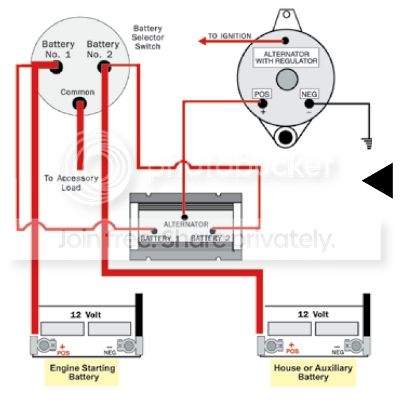
The "Accessory Load" off the switch would be the winch so I would have the option to use both batteries to run it. In addition to being able to select either battery individually.

The "Accessory Load" off the switch would be the winch so I would have the option to use both batteries to run it. In addition to being able to select either battery individually.

I think the sense line is made from a 3rd diode, selected to have similar voltage drop to the main power diodes. So the load current has no effect on the amount of drop to the sense diode. It basically just makes your alternator make up the difference from both the Alternator-isolator wire and also the isolator itself. In other words, charging voltage is the same as if there was no isolator.The .7 volts dropped across a silicon PN junction, is not a resistance, but the turn-on voltage, and is not a function of the load.
A diode would have some resistance, of course, everything not superconducting has some, but the wires would probably have more.
If the output of the alternator was 15.2 volts, 14.5 + .7, and was applied to the anodes of two identical diodes, then the output of each should be the same.
A heavy load on the sense side, would draw the voltage of the whole system down due to alternator capacity and wire resistance.
Thus the non-sense side would see the same voltage as the sense side.
A heavy load on the non-sense side would also draw down the voltage. The sense side would try to boost the voltage to compensate.
However, the only voltage difference between the two batteries would be due to the voltage drop in the wire from the non-sense diode to the battery to non-sense battery.
Any voltage drop in the main charging wire, or the alternator would be sensed and compensated for because it would be shared by both batteries.
Or so it seems right now. It may look different in the morning.......
As for the effect of high current, it reduces the overall charging voltage to the battery with no load, since the overall alternator voltage is reduced.
For isolators with no sense terminal, you DO lose that 0.3-0.8V, unless you do some other workaround. You also can under or overcharge one battery if you connect your sense line to one of the outputs.
I think running similar batteries in a setup like mine is more important in regards to age as much as anything. I wouldn't want to tie a 3yr old battery with a brand new one.
Although I also think you would want similar if not exact CCA. Just seems to me that would be a good idea but that's just a gut thing, not science.
I don't know how old the optima I plan on using is, but my die hard is about 2 years old. The die hard is 880cca and the red top is 800cca.
I may stick with the way you have yours setup for now, then later on add an isolator or ACR.
I figure the optima is good. I use it to jump off my lawn mower and I try to keep it on a trickle charge.

45acpJr
1/2 ton status
the best solution..
http://www.bluesea.com/products/762...rging_Relay_with_Manual_Control_-_12V_DC_500A
you wouldn't use his exact diagram for an ACR..basically his signal wire/toggle switch setup becomes the parallel switch that comes with the above ACR.. and like I have run in my switch layout... run on momentary switch to hold as needed to boost for starting, etc.. or add a DT switch, adding a perm "on" too for longer paralleling to the mix too..
Ryoken (or anyone else for that matter) I have a few questions about the acr you listed above. In regards to the pic below, are you saying that using the above acr takes the place of the "marine battery switch" and the included toggle takes the place of the "toggle switch" and the "heavy duty relay"?
Next question has to do with the wiring of this acr. Below is the wiring diagram from Blue Sea. I'm assuming for my purposes one battery would be normal operation (engine start, regular lights, etc...) and the other battery would be for winch, off road lighting, arb compressor for lockers. A few questions, first I assume the squiggly lines are inline fuses? Next the grey shaded circles that are labled battery switch, what are they referring to?
Last question, I swear!! How the hell does this work? I'm referring to the rocker, can you explain the differences in the switch settings? Assuming I wire this like I said above....one battery for normal operation and the other for winch and stuff. Will the componets hooked to the second battery always be hot or will I have to flip a switch to draw power off the second batter? Hopefully this doesn't sound too dumb.
texlurch
Old fart on a hill
Ryoken (or anyone else for that matter) I have a few questions about the acr you listed above. In regards to the pic below, are you saying that using the above acr takes the place of the "marine battery switch" and the included toggle takes the place of the "toggle switch" and the "heavy duty relay"?

Next question has to do with the wiring of this acr. Below is the wiring diagram from Blue Sea. I'm assuming for my purposes one battery would be normal operation (engine start, regular lights, etc...) and the other battery would be for winch, off road lighting, arb compressor for lockers. A few questions, first I assume the squiggly lines are inline fuses? Next the grey shaded circles that are labled battery switch, what are they referring to?

Last question, I swear!! How the hell does this work? I'm referring to the rocker, can you explain the differences in the switch settings? Assuming I wire this like I said above....one battery for normal operation and the other for winch and stuff. Will the componets hooked to the second battery always be hot or will I have to flip a switch to draw power off the second batter? Hopefully this doesn't sound too dumb.

I have the ACR with my duals in the Jeep. Mine is a newer model without the yellow manual switch on top. That serves the same purpose as the remote rocker on the dash.
The switch on the dash is three position.
top locks the batterys together
middle locks them together when running and voltage is equal. I can hear mine "clunk" a few seconds after starting or stopping the engine. It is the auto mode and where you usually leave it set.
bottom position seperated the two batteries completely, like if you plan to park it for long periods and don't want any chance of it drawing down the start battery
So far as wiring, all my stock "house" leads and charging lead from the alt go to the main battery
then a seperate lead with inline fues goes to one post on the ACR
from the second ACR post another lead with inline fuse goes to the start battery + post. The start battery is only connected to the starter + and engine ground, and the charging lead from the ACR.
I am running a pair of Odyssey PC1200 cells in my stock battery tray, with some minor trimming. ACR is mounted on frame rail below. I am not using the "start" wire to the ACR but may hook it up later.


I'm not clear on whether the ACR has the flexibility of my setup in terms of being able to start with either battery. Most of these systems seem to want a start battery and an accessory battery. This doesn't make that much sense to me for people without a winch. I like being able to select which is the primary (tied in when ignition off) and also having both batteries help with starting. And self jumping.
It's quite possible I don't understand how these things work though. If I could get the exact same functionality I have, with the switch and relay in one to cut down on wiring clutter, I'd be very interested.
It's quite possible I don't understand how these things work though. If I could get the exact same functionality I have, with the switch and relay in one to cut down on wiring clutter, I'd be very interested.
texlurch
Old fart on a hill
I'm not clear on whether the ACR has the flexibility of my setup in terms of being able to start with either battery. Most of these systems seem to want a start battery and an accessory battery. This doesn't make that much sense to me for people without a winch. I like being able to select which is the primary (tied in when ignition off) and also having both batteries help with starting. And self jumping.
It's quite possible I don't understand how these things work though. If I could get the exact same functionality I have, with the switch and relay in one to cut down on wiring clutter, I'd be very interested.
The dash switch does exactly what you are saying.
You can join the batteries and bypass the switch part; (top position)
You let the ACR decide to join or not (middle position)
You can seperate both batteries completely and make them "stand alone" (bottom position)
You can't switch how you have the batteries hard wired in to your circuit, but you can control whether they are connected in series or not.
Maybe it boils down to the current capacity of the ACR. Can it pump hundreds of amps like the big relay, or just enough for charging? In other words, if the starting battery is dead, can the other one start the truck?


