CK5
Register an account today to become a member! Once signed in, you'll be able to participate on this site by adding your own topics and posts, as well as connect with other members.

Dumb question: Why ball joints on straight axle?

Mastiff

1/2 ton status
 Premium
Joined
Jul 21, 2002
Posts
3,263
Reaction score
265
Location
Tucson, AZ
Title basically says it. I must be missing something, but on a straight axle, isn't there only one axis of rotation required? What extra motion is the ball allowing for?
 
Think of it like a door with two hinges, and the top one is really loose.
So the door doesn’t swing correctly or in a true arch, and doesn’t return to the exact same position
 
From http://www.rockstomper.com/catalog/axles/60knuckles.htm

What's different between a kingpin knuckle and a balljoint knuckle? Kingpin or balljoint refers to the pivoting parts between the inner and outer knuckles--kingpin knuckles rotate on machined bushings and bearings, while balljoint knuckles rotate on a ball-and-socket joint.
Why would I want kingpin knuckles? Kingpin knuckles are generally stronger, easier to maintain, and more durable than balljoint knuckles. Also, if you break an axle, the broken chunks can pop out the ball joints in a balljoint knuckle--kingpins can't be popped out like that. Kingpin knuckles also use a conventional spindle, wheel bearing, and hub assembly. Most balljoint knuckles are designed to use an expensive dealer-only "Unit Bearing" wheel hub assembly that isn't maintainable separately--you just wait till it wears out, throw it away, and buy a new one.
If kingpins are so good, why did Ford and Dodge change to balljoints? Balljoint knuckles have fewer machined surfaces, and use less material. For an application where the knuckles are being loaded properly (small tires, minimal offset, street use) and not side loaded, ball joints are strong enough. Being that they cost less to manufacture, the OEM's switched to save money--$5 a knuckle is a lot of money if you build a million trucks a year. Since OEM light trucks don't use large tires, and they're not intended to go rockcrawling, they don't have to worry about the side loads that 38" and bigger tires put on the front axle.
 
Think of it like a door with two hinges, and the top one is really loose.
So the door doesn’t swing correctly or in a true arch, and doesn’t return to the exact same position

But why? Would something bind if the wheel just steered on a single tight axis?
 
I don't think either joint truly works in a single axis. With the spacing between the balljoints, it's putting the knuckle-to-C rotation into (approximately) a single axis - that is the line intersecting the center of both balls. Obviously you can't just put one long pin all the way through because of the axleshaft. But with a balljoint, the machining of the knuckle and the C don't have to line up exactly - the joint can have a static angle in it and I think that's the biggest reason. The balljoint can have that angle and still rotate, where something simply "bent" would bind.

There is also the possibility of the balljoint angles changing slightly as the wheels turn - don't know how much that actually happens.
 
I don't think either joint truly works in a single axis. With the spacing between the balljoints, it's putting the knuckle-to-C rotation into (approximately) a single axis - that is the line intersecting the center of both balls. Obviously you can't just put one long pin all the way through because of the axleshaft. But with a balljoint, the machining of the knuckle and the C don't have to line up exactly - the joint can have a static angle in it and I think that's the biggest reason. The balljoint can have that angle and still rotate, where something simply "bent" would bind.

That's the best explanation I can think of too, just the fact that they can't make the tolerances good enough in the knuckle and C.
 
It's money. Ball joints are cheaper. That's it
 
I wasn't asking about "vs. kingpins", just why any flexibility is required outside of the rotation axis at all. Simplistically, it seems that in place of a ball join you could just have a solid piece of metal with the rod sticking up/down. On a solid axle (I think) you are just making it so you can steer around one axis of rotation, no lateral movement is required like on an IFS.
 
What would your alternative be? A pin and bushing like a lawn tractor? How do you get all the slop out of that and still let it rotate? By pressing the socket in and tightening the tapered stud, there is zero slop in those locations. If you compare straight-axle balljoints to IFS balljoints they're a lot different. The straight-axle joint pretty much just rotates. They hardly allow any angle - at least not until they go bad.
 
I think ball joints are a smarter design. Not a stronger one but a more user friendly and cost effective one. Modern vechicles are all about ride quality and longevity. A half warn ball joint isnt going to show issues like a new king pin will. They have less slop in them by design than the king pin bushing. They control side to side as well as up and down movement. A king pin is left free to move up and down. In the case of a dana 60 up and down is controlled by a spring holding a plastic cup in place.

I just put a dana 60 in the front of my truck and immediately experienced death wobble from the slop in the king pin design. The entire axle was brand new components. My tired old almost 40 year old 10 bolt never as much as had a shimmy with its ball joints.


The aam 9.25 in the front of Dodges still use a king pin. Not traditional like the dana 60 but a vertical pin that can move freely up and down in its cup, it handles side loads better. The lower joint is a ball joint that controls up and down movement.
SYN4120-3.jpg


We all know that dodges are known for their death wobble issues. mainly suspension and steering design but there is no doubt that the king pin is part of that.

Ball joints allow the axle to turn on its plane of rotation while keeping the joint solid and minimizing slop. If you just put a pin and bushing in there, they will wear out and start to get sloppy, plus how do you control up and down movement? a shim stack? every axle is different, or slightly bent, or worn out. They all would need to be individually shimmed. That cost time and man power. A ball joint has the weight of the vehicle pushing the ball into the cup so as they wear they take up their own slop to an extent.


A ball joint is also a wear item. If you put a solid rod in there. What would be your contact surface. The knuckle to the bottom of the C? Then you would wear out the entire axle rather than just a ball joint. Imagine replacing an axle housing or knuckle when you normally would do a balljoint..


Simplistically, it seems that in place of a ball join you could just have a solid piece of metal with the rod sticking up/down.
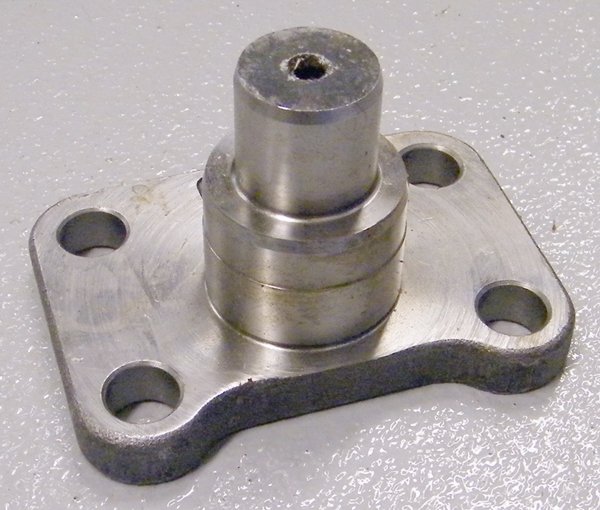
Thats what a king pin is if you break it down. look at the pic above or below

A vertical rod riding in a bearing or bushing. Here is a lower king pin cap. The shaft rides in a bearing to provide rotation. other than that its a solid rod. The upper is similar but is two coned pieces that interface with each other to keep them tight.

d60kngpncap.jpg


I think the biggest thing is. Can you think of an easier way to control up and down movement in your solid rod than just using a ball joint? You only seem to be thinking about rotational movement and not side or vertical loads
 
Last edited:
Okay. I didn't appreciate that the ball joint was also responsible for the rotation. I rebuilt my kingpin D60, but have never had a ball joint system apart. I'll be replacing ball joints on my Jeep shortly. My "solid rod" would have had a bearing of some kind for the C to ride on, so would have quickly become a kingpin over again. Thanks for clearing it up.
 

Latest Posts

Top Bottom