CK5
Register an account today to become a member! Once signed in, you'll be able to participate on this site by adding your own topics and posts, as well as connect with other members.

Electrical System Overhaul

brosblacknred

Registered Member
Joined
Jan 15, 2011
Posts
27
Reaction score
0
Location
Ft. Stewart
Hey all,

I'm thinking of overhaulin' my electrical system (battery(maybe 2), cables, lights, switches, gauges, etc.

I am not an electrical whiz and was curious if any of you had any experience with this kind of job.

Some of my main questions are:

-is there a quick reference guide to automotive wiring? (I need to understant the principles first)

-how do I know what gauge of wire to use? (ryoken used some massive cables for his dual batt. system)

-what is too much? can I go overboard?

-total cost ideas

-basically, how do I construct a more efficient and user friendly system?

P.S.-ryoken's setup is what I'm drawing inspiration from. I'm looking for bullet-proof.

Thanks
 
You are looking at a couple of different things there. Dual batteries with some kind of switchover or charging system and larger wires is one thing.

Different general wires is another.

If your wiring harness is just old and in bad shape generally, then you would be better off getting one of the prefabbed kits that they sell.

Everything is already cut, labeled, and has the right connectors.

Or, there are the higher current/relay mods. You can add relays to the headlights to either get them brighter or have more of them on at the same time if you have one of the multilight trucks.
And, you can add relays to the windows it get them faster if you need to.

But, all those mods are pretty much stand alone stuff. You can do any or all of them as you want.
 
the real question is, how much do you want to mod and re-engineer....

my K5 system is based on the premise of a complete custom DC system... with very, very little reused from the factory system... breaker glovebox in place of the factory fuse panel, etc, etc... this is an avenue I don't recommend for most unless VERY confident in the workings of a DC system, not for the faint of electrical heart... ;)

modding small portions of a factory system is generally the best approach for most as Fordum mentioned..... as long as the factory system is in decent shape.. upgrading different sub systems one at a time is usually the best route for beginners..

a beefed up battery system, multiple batteries, is often one of the first routes... and as mentioned in here before, there are many, many different approaches to that, diode isolators, straight parallel, charging relay's, marine switches, etc... most DC electrical isn't that flexible in it's design parameters..

than ya have headlight relay mods, power windows, power sub panels, etc, etc..

basic electrical rules need to be followed, proper wire sizing, circuit protection, etc.. always remember that your circuit protection is not only protecting the component, but more importantly, the wiring in that circuit of the system..

I would direct you to some literature or links that I've used, but all my knowledge comes from years of cars, than designing marine systems meeting ABYC and Coast Guard requirements, etc.... but if I can help, holla..
 
Im would like to start with the battery system and then the lighting next...

I did some research last night and I feel like I have a basic understanding of the parallel system, (which seems to be what most recommend for a two battery system), but I would like to be able to switch which battery I am using at the time. Is that possible using the Parallel?

I am also having trouble understanding the purpose of the solenoid...what does it do?

I started a diagram last night in order to get a grip on the concept, but came to a stand still after I had drawn up the batts in parallel...didnt know where to go from there...
 
Here is what I drew up...

I have a couple of questions though...

mybattdiagram1.png

1. would the "BATTERY SELECTOR SWITCH" be the solenoid?

2. what is the "slave" that ryoken talks about/uses?

3. where in the circuit would I put a master batt. power switch?

4. where in the circuit would the bus fall?

Im gettn there...just need some more help

Thanks

mybattdiagram1.png
 
well, the issue is that technically, all the different dual battery systems parallel in way or another... all it means is the 2 batteries get combined at some point... that can vary from being as simple as being paralleled all the time (the downside being, when it dies, it's dead), diode idolators such as hellroaring and 12voltguy type systems that have a parallel switch to combine the 2 when needed, a marine switch which can be all the time paralleled, or either battery.. a charging relay has a parallel switch similar to a diode style, charges both batteries but has no voltage loss..

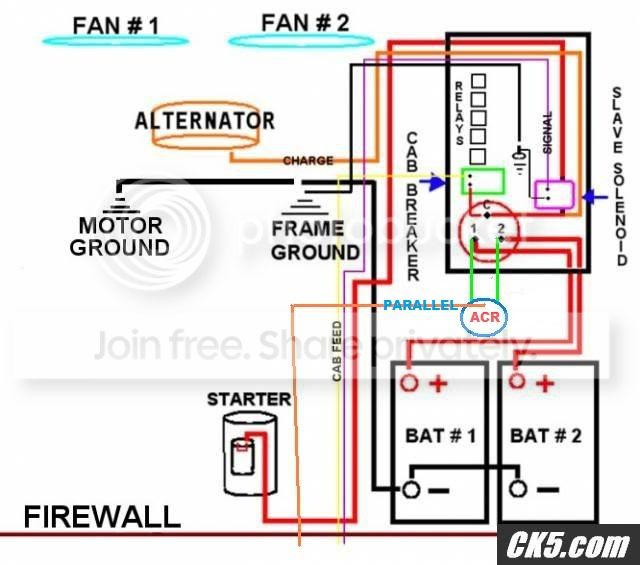
my system is based on a marine switch and ACR... this is by far the most flexable of systems imo...

a diode isolator is probably the most common used.. and diodes have improved greatly in recent yrs.. many in here run them with success..

marine switches give you complete flexability in which bat your using, or both.. the downside being if your just using one of the 2 bats, and not in the "all" position, only the bat selected is charging.. BUT, that combined with an ACR charges both bats all the time, and allows you to use either battery for whatever you want, and select either battery...

a marine switch system such as mine will require some redesigning of the system, tho it can be kept pretty minimal and simple, or you can get quite involved with slave solenoids, ACR's, etc like mine.. whereas a hellroaring diode kit will pretty much walk you thru the whole install...

have you seen my diagram? it's incomplete, but the main battery stuff is there... if not I'll go dig it up and try to walk thru some of the basic theories for you...

solenoids can be used in various ways... they can be used as THE form of paralleling the bats temporarily for your back up power... like i said, there truly are dozens of ways to do this, and wire a system... some better than others..

or than can also be used as a slave solenoid like in my system, often reffered to as the ford solenoid mod... this is a totally different purpose and is designed to eliminate starter heatsoak issues and get power off the starter lug...


one of the most important things I'll say is the quality of materials you use, and the attention to detail you take in doing the wiring.. crappy connectors and rushed work lead to lousy electrical systems..
 
ryoken,
yes I have seen your diagram...I've referenced it countless times, HOWEVER
due to the fact that I have a limited understanding of electrical systems, I have trouble understanding it...BUT I look at this as a personal challenge that would reap incredible benefits...SO, if you wouldn't mind running me through some of the basic theories, I would be extrememly appreciative:bow:

Also...I like to pride myself on my attention to detail and quality of work (which is why I have been so inquisitive recently), so I don't ever plan on running a prefab system...just personal preference. Once again, I like challenging myself.

Props to you and your knowledge/abilities/innovative mindset...its INSPIRING...no homo:whistle:

Like I said earlier, If you would be ever so kind to invite me to "Join the Dark Side, so that we as mentor and pupil can rule the galaxy", I would be eternally grateful.
 
i'll have to do the explaining tomorrow, but here's the most revised version, so it's up in the thread...


diagram_zps2bbc7e9b.jpg


the basic principles are the 2 bats feeding the #1 and #2 post of the marine switch.... the ACR jumpers those 2 posts for full time charging and paralleling when the switch is in the 1 or 2 position... it can also be paralleled by running in the "all" position..


the "common" ouput of the switch can feed anything, your starter, a slave solenoid like mine, a bus bar than the starter, etc, etc... but it gives you the basic idea..

i'll go into more tomorrow...
 
alrighty... I'm not actually sure where to go with this...


you can see in the diagram that the ACR connects the 2 switch posts... this keeps them seperate, but allows both to charge when needed... this allows you to run the marine switch off either battery, and they both charge.. the marine switch are usually "off", "1", "2" or "all"....

there are a few other ways to obviously wire this... everything doesn't always have to get powered off the "common" out of the marine switch.. you can have the main truck function off that, but have your winch, or maybe offroad lights hooked directly to the A (1) or B (2) post..

the slave solenoid that you see next in line is often reffered to as the ford mod cuz ford often ran slave solenoids... basically the common (bat) feeds the one post, than when you hit the key, the trigger wire allows power thru down to the starter.. this keeps power off the starter lug... helps with heat soak, wire corrosion issues, etc.. you only have the one big wire running down to the starter, than just a little jumper wire from that post to the "s" pst" which is where the trigger wire used to go.. but now that will go to the solenoid instead...

any particular questions, feel free... :D
 
Kinda off topic but here is goes...
Can you explain the purpose of the ground from the switch in this diagram?

And what kind of switch would this be?.....spst, spdt, dpst, or dpdt?

Thanks again...

relay-diagram.gif
 
it's for a lighted switch.. just a grd for the light...

that'd be a simple spst illuminated switch...
 
Ok. SO...
In order to prevent the switch from constantly drawing power, it should be hooked up to a hot in run or the common from the marine battery switch?...just tryin to wrap my head around this...

...or does it light only when "ON"?...

Im assuming eliminating the lighted switch would forgo this potential issue...right?
 
it wont draw power unless on... the grd only functions to complete the bulb circuit and turn it on when the switch is on and feeding the load...
 
Seems like it would be a pain to run lit switches when it comes to hooking up grnds...

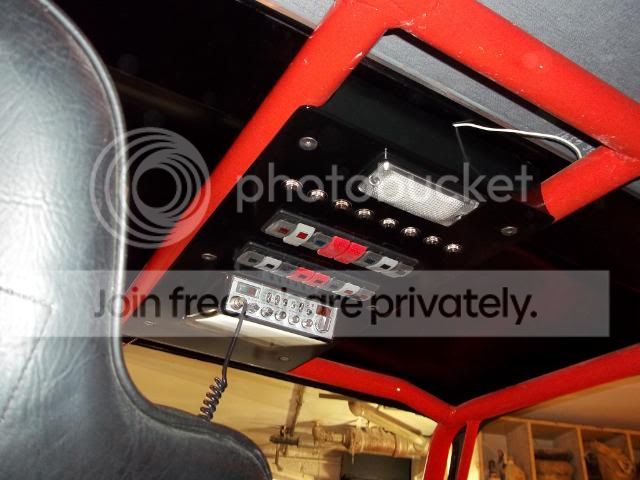
Are the switches in your overhead switch panel lit?
 
yup, all of em... keep in mind, that's all low voltage and you can just piggyback one grd to the next on the switches, than run the last grd to a common grd..

that overhead console is designed to basically be run by a 10 gauge red hot and a 10 gauge black grd up thru the cage (plus all the signal wires).. with a dual bus bar, hot on one side, grd on the other, mounted right near the switches... a blueseas one like this


186.png


000_0003-10.jpg
 
Cool...

And I thought that deciding on 14g was big...

BTW...you got sixteen switches, one side of the bus bar has only five connections...how did you get that to work?

cant piggy back positive...or can you?
 

Latest Posts

Top Bottom