CK5
Register an account today to become a member! Once signed in, you'll be able to participate on this site by adding your own topics and posts, as well as connect with other members.

Electronic Advance Curves and "Locked Out" Distributors...????

Greg72

@MIGHTASWELLK5
Staff member
Super Moderator
Joined
Mar 5, 2001
Posts
17,071
Reaction score
5,716
Location
Austin, TX
I've been reading up on a few products that claim to allow fully programmable advance curves for the distributor... The new MSD Programmable 6AL-2 for example, claims to do it with a laptop interface. Just program in the advance curve you want, and the box takes care of the rest.

Here's where I'm having trouble wrapping my head around this concept: If you "lock out" the distributor weights so that there is no centrifugal advance (or vacuum advance for that matter) how is it possible that the rotor can line-up correctly underneath the proper output stud for the spark plug it needs to fire??? :dunno:

It seems like with the centrifugal advance, the spark "advances" beacuse the spring is allowing the rotor to get a few degrees ahead of it's normal position to fire the plug earlier. If the dizzy is "locked out" so it can't advance....wouldn't the rotor be out-of-position under the cap....(ie. not quite lined up under the plugwire stud that it needs to fire)???

Maybe 36* of total advance is "close enough" to the proper location to still get current from the rotor to the cap properly....and I'm just overthinking all this...


I can easily understand how the electronic part works to delay the firing of the spark, I'm just having trouble understanding the mechanical aspect of how the rotor can still be in the proper position under the cap once it's locked-out.


:usaflag:
 
Just kinda thinkin' about the guts of the dizzy right now,

The contact on both the rotor and the bottom of the terminal are wide enough to cover a good deal of retard or advance in the spark.

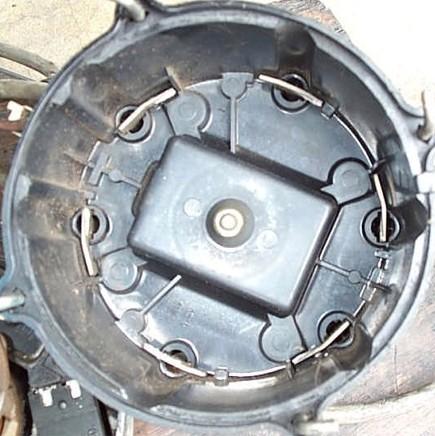
I'll have to pull the cap off the MSD that dizzy I got for the cad fuel injection build. It's fully locked out.
 
Kert,

That's kind of what I was thinking too.... Here are some measurements taken directly off an MSD rotor (Pro-Billet #8361):

Cap Circumference @ conductor = 2.892"
Conductor width = .315"

So with a little math:

Circumference = Diameter x Pi
Circumference = 2.892 x 3.141
Circumference = 9.085"

For each degree of rotation at that circumference the amount of distance is:

9.085 / 360 = .02524" per degree of rotation


Or solved another way....given the width of the rotor contact (.315") would represent about 12.5 degrees of rotation. :thinking:

It doesn't seem like it would work, unless there is a different rotor with a much wider conductor (like almost 1" wide!) for the locked-out dizzy.


I'm still confused.


:usaflag:
 
OK, I think I have it figured out.

Under the rotor, not the cap, the rotor. There are 8 what look to be pickups. They spin past an electronic piece that is almost .625" wide. Much closer to the center axis. So, just going by the way it looks spark timing is controlled by the computer and charges each of these eight terminals as they pass by the electronic device.

The phase of the rotor is adjustable on the top outside of the rotor.

Pics to come.
 
Thanks! :thumb:

I just downloaded a 130+ page document from the MSD website to try to answer my own questions but it doesn't seem to directly address this one.


:usaflag:
 
I've been reading up on a few products that claim to allow fully programmable advance curves for the distributor... The new MSD Programmable 6AL-2 for example, claims to do it with a laptop interface. Just program in the advance curve you want, and the box takes care of the rest.

Here's where I'm having trouble wrapping my head around this concept: If you "lock out" the distributor weights so that there is no centrifugal advance (or vacuum advance for that matter) how is it possible that the rotor can line-up correctly underneath the proper output stud for the spark plug it needs to fire??? :dunno:

It seems like with the centrifugal advance, the spark "advances" beacuse the spring is allowing the rotor to get a few degrees ahead of it's normal position to fire the plug earlier. If the dizzy is "locked out" so it can't advance....wouldn't the rotor be out-of-position under the cap....(ie. not quite lined up under the plugwire stud that it needs to fire)???


Maybe 36* of total advance is "close enough" to the proper location to still get current from the rotor to the cap properly....and I'm just overthinking all this...


I can easily understand how the electronic part works to delay the firing of the spark, I'm just having trouble understanding the mechanical aspect of how the rotor can still be in the proper position under the cap once it's locked-out.


:usaflag:

Don't forget the width of the contact terminal as well as the rotor. The advance does create a gap between rotor and cap terminal that the spark has to jump. That gap is why distributerless ignitions were brought about, less energy loss and more control over exactly when the plug would fire.

I think MSD has a faq about phasing the rotor, well I remember reading it somewhere....

Here's a link on a how to: http://forums.off-road.com/jeep-short-wheelbase/122916-rotor-phasing-basic-how-explained.html
 
I'm confused right along with you on the mechanical alignment as well.

The rotor terminal is .3" ish wide like you had said, the bottoms of each spark plug wire terminal are pretty small. .125" est. Don't have a decent way to measure up inside the cap. They're small though.

Here's some pics.

dizzy1.JPG


dizzy2.JPG


dizzy3.JPG
 
It would seem with all the room to electronically change the timing, the physical alignment could easily be missed. I thought I had it in my head right until your last post.
 
I had a vacuum + mechanical HEI and I locked out both the vacuum and mechanical advance portions. Then I used my ECU to control the timing. I used a fairly standard advance curve and the spark table covered 3 to 50 degrees BTC. Now the extremes of those are in regions that basically never happen (like WOT @ 600 rpm or maximum vacuum @ 6000 rpm, stuff like that) so I can't be certain that they would have worked. But I can vouch that the standard HEI hardware did work for the normal 10-40 degrees BTDC range.

Now when I first started running it that way, I had rotor alignment issues and got severe misfire for any advance over 25 degrees. Once I moved the distributor one tooth, it could be adjusted within range.


I think the key to understanding this is to think in terms of crank degrees and not distributor degrees.

Img_0626.jpg


The terminal covers about 10 degrees of the cap, but that is 20 degrees of crank rotation. There is also a width to the rotor tip, which is at least half the terminal width. With that overlap at least 30 degrees is covered and you can add to that the useable range where the rotor and terminal are not quite lined up, but are still close enough to arc.

So you must have the ability to offset the trigger timing in your spark box if you are triggering from the dizzy pickup coil. After you line it all up for rotor to terminal alignment, you tell the electronics how far off the trigger point is from TDC, which is usually just a matter of matching your electronic reading to a timing light.

If you are worried about it, you could always try to get some of the centered terminals out of old caps like this:

hei5a.jpg


I have heard of leaving the advance mechanisms operational to aid in rotor alignment, but this requires you to trigger from something other than the distributor pickup. You could use a crank trigger, for example. Personally, I wouldn't want to rely on the mechanical advance for it to work because those tend to get stuck, costing you part of the reliability advantage of electronic timing.
 
I Believe the contact area advance your talking about would be similar to the standard vacuum advance on an HEI distributor. If you lock out the mechanical advance I cant figure out how you would go beyond that 12* or whatever you measured it to be.

Its all fine and dandy to say the computer does it but even if the computer times it to fire say 36* advance at full blown throttle way up there in RPM's how can it manage that with out the physical connection being there???
 
I think the key to understanding this is to think in terms of crank degrees and not distributor degrees.

Img_0626.jpg


.


Too bad that link is broken, I'd really like to see what it is... :doah:

You're right that I'd forgotten that the distributor rotates at a slower speed than the crank. Two complete rotations of the engine for each combustion cycle right?....


:usaflag:
 
Yes, 2 engine revs to one distributor rev. Don't worry about the picture. It's just the inside of an HEI cap. It's just a picture I found on another site and it must be having problems.
 
Its all fine and dandy to say the computer does it but even if the computer times it to fire say 36* advance at full blown throttle way up there in RPM's how can it manage that with out the physical connection being there???

:confused: I thought I was explaining this.

Blue85 said:
The terminal covers about 10 degrees of the cap, but that is 20 degrees of crank rotation. There is also a width to the rotor tip, which is at least half the terminal width. With that overlap at least 30 degrees is covered and you can add to that the useable range where the rotor and terminal are not quite lined up, but are still close enough to arc.
So you have a range of 40 (crank) degrees or so before the physical connection becomes an issue, assuming you have phased things optimally. For example, you would set the rotor tip to be just in range of the leading edge of the terminal at your minimum advance (10 degrees BTDC, for example). Then you are at 40-some degrees BTDC before the rotor tip is leaving the range of the trailing terminal edge.

Keep in mind that this phasing is probably not optimal in a mechanical distributor because you align it for timing, not rotor phasing (they move together as you turn the distributor body). Take a look at old distributor caps. Many of them have the terminal wear really harsh on one edge, meaning that a lot of the time the spark was happening before (or after) the rotor was in the ideal location. As long as it still arcs and it doesn't go to a different cylinder, you are OK. It takes inches of free air to match the resistance of a fully charged, fully compressed combustion chamber.
 
Blue85 is right; the distributor spins 1/2 the speed of the crank. This is easier to explain in person but here it goes.

There are 8 terminals on a distributor cap equally spaced over a 360 degree circle. Divide 360 degrees by 8 and you are left with 8 equal divisions of 45 degrees each. Thus there are 45 degrees between each terminal on the cap...

If total timing on the crankshaft/balancer is at 36 degrees and the distributor spins at half speed of the crank then divide the 36 by 2 and you are left with 18 degrees. This means the rotor is firing 18 degrees before the determined terminal on the cap giving you timing "advance".

Remember that electricity is like water and takes the path of least resistance. It is easier for the spark to jump to the closer terminal in the cap therefore it will jump to the terminal 18 degrees away as opposed to the further terminal.

If you run a small diameter distributor cap as opposed to a large HEI style cap the space between the terminals is tighter and can cause a problem with the spark jumping or arcing to the wrong terminal. For this reason we offer the adjustable rotor like the one Kert has on his MSD distributor. This will allow you to fully advance the distributor as needed then phase the rotor by adjusting the upper portion.

Timing is determined by the paddles on the reluctor (paddle wheel) and when they pass the center point on the magnetic pickup. Timing doesn't change because the reluctor (paddle wheel) that passes the magnetic pickup in the bottom of the distributor doesn't move; only the tip of the rotor changes position to get it as close to the necessary terminal on the cap as possible.

I hope this makes sense and I didn't confuse anyone more.

Phil
MSD Ignition
 
Philly87, since your here, you could answer my question(s).
I have the ignition locked out in my blazer and the timing is set at 36°.
I have a MSD Multi-Function Ignition Controller PN 8979 and is it possible to adjust the timing with Multi-function without adjusting the distributor. For example, if I want to retard the timing to 30°to run pump gas.

Also, when we had the laptop hooked up (which no longer works because it crashed, need to buy a new one). The pull down menu said it wasn’t getting a CamSync signal even though I have the Inductive sync kit (PN 7555). Do I need to change a parameter if I using the Inductive sync kit instead of Cam Sync pickup (PN 2346)?

There is more but till I get another laptop, I won’t be to access the Multi-Function Controller to play with it.
 
JDnobodi;

If you are familiar with the timing graph when you open the software you are aware that the graph starts at zero at the top where the zero position is actually your total timing of 36 degrees. If you wanted to start your initial timing at say 15 degrees your initial point would be placed at the 21 degree mark on the graph and plotted back up to zero according to how aggressive you desire your advance curve to be.

Now; if you choose only to run 30 degrees for pump gas to prevent detonation then when you ramp your timing back up toward zero you would stop it at the 6 degree mark before zero so that it goes no further than 30 degrees. Your timing ramp would only run from your beginning point to the 6 degree point and flat line at the 6 degrees as this would simulate your zero point and that would be total timing.

Make sense? Also keep in mind that you can save several different files in the program so you can program the pump gas file and save it as “PUMP GAS” and have the second file saved as “RACE GAS” for play time. This way all you have to do when its time to take the puppy off the leash is hook up to the laptop, quickly download the desired file and play hard.

As far as the cam sync signal goes keep in mind the motor must be running for the ignition box and the laptop to see the signal. If you had the computer hooked up and the engine not running then no signal is pulsing the box.

Hope this helps.

Phil
MSD Ignition
 
Top Bottom