CK5
Register an account today to become a member! Once signed in, you'll be able to participate on this site by adding your own topics and posts, as well as connect with other members.

Exhaust size for stock motor with fuel economy paramount

Kenny78

1/2 ton status
Joined
Nov 7, 2007
Posts
496
Reaction score
2
Location
Around Tulsa, Oklahoma
1982 K20 350 with no known modifications. Could have a truck cam, but unknown. Factory air cleaner, quadrajet, 4l80e, 4.10's and 235/85/16 just for background. This truck has been pressed into a contractor service truck while I start my business. The truck came with a bubba job straight dual with ~2" pipes and some kind of thrush etc. mufflers. I want to put a stock single exhaust on it so that I can put my spare where it belongs rather than in the shell.

My question is: Walker has enough of the pieces to put it together but the pipe downstream of the wye is 2.5". I have tried to educate myself but am in a Google rabbit hole and hope you can set me straight. Some on here say 3" single for best performance, but is that for max performance with headers etc.? I am and will be running manifolds. I am putting most of the emissions stuff on except for the heat riser and will put an eliminator for spacing. After exhaust, the EGR Is next.
 
Last edited:
Another question, if I were to install a cat, do modern cats operate well enough without a smog pump? I won't be putting a pump back on. I'm not well versed in emissions as Oklahoma is non existent.
 
IMO, a lot of people size exhaust by maximum engine potential...even on a street truck that might only see 4500rpm a couple times a year. I suggest tuning your engine cam/intake/exhaust/gearing for the operating range you will see most (probably 22-2500 rpm?). With a typical early 80's 350 engine and stock manifolds, and your drivetrain setup, I would go 2" primary pipes and if your hellbent on a single, no bigger than one 3" pipe, if possible one 2.75 i.d. pipe (not common though) Maybe get more air into the engine as well, with a dual snorkle type air cleaner drawing air from the core support or front fender areas. When you get it all put together, make sure your ignition system is in top shape, then check your plugs for proper jetting.
 
I will start a carb thread fishing for opinions on my last carb issue later. Newac delco plugs are in the mail as these probably have 20,000 or so. I honestly can't remember if I've even had them out in the 7 years I've owned the truck. Too many square bodies around and this truck was and still ismstone reliable other than my own errors in judgement.
 
Single 2.5" is probably enough. Here is a chart with rough numbers: http://www.exhaustvideos.com/faq/how-to-calculate-muffler-size-pipe-diameter/

With manifolds, the efficiency that comes from scavenging/proper pipe diameter is probably inconsequential. At least in terms of a work truck. Prior to the last couple years of the TBI R/V series, GM was running 2.5" (IIRC), and went to 3" at the very tail end of production. I'd look for whatever is cheapest, whether 2.5" or 3". You might find that mufflers and converters are cheaper in 3" than 2.5", but that's all I'd base your decision on...cost.

You'll want to look at the aftermarket converter manufacturers comments on their products...I don't know as you'd hurt it by not applying AIR, but probably won't be as efficient if the converter is designed to utilize it. At least some of the aftermarket converters appear to be marketed as "universal" in that regard.
 
Dyeager and all, did the tbi's in r/v series have different manifolds or would/should a wye from a tbi's bolt up to a car bed engine with stock manifolds? If so, I'll order the associated stuff and try it. I was tempted to do this before but didn't want to necessitate returns as no one stocks this exhaust locally
 
My buddy has an R/V Suburban (can't remember year) that had a cracked manifold, and he couldn't find them anywhere. It sounded like they could be different even within R/V series.

Someone here may have the answer directly, but you can do what I'd do...see if you can find the parts manual in the link in my signature that covers the year you are dealing with, and see if the manifold part numbers are the same.

Obviously O2 sensor bung is going to be a difference, but where they actually dump, I can't answer.
 
Mine on my 95 tbi is 2.75 diameter. It seems to flow good and has a universal cat i put on. I've had two of these trucks with pretty much the same cars and flowmadter type mufflers on them. The way cats are made now it doesn't need the air system but in the 80s to pass emissions it was easier to add clean air to the exhaust by having the smog pump pushing the gasses out from the manifolds. A single 2.5 should be sufficient to get the job done on a stock or mildly built engine. 3 inch would probably flow better in the end but has less backpressure. If you throw headers into the mix you will
Get better even flow and pick up a little power over stock manifolds. Depending on what you have on now, it only cost me 300 to get my exhaust done at Midas when my old 94 had rotted away. But that was about ten years ago. That was with uni cat and turbo muffler.
 
I have a 90 Sub. It has, about, a 2" wye and it has a 3" tail.pipe. I wouldn't get any bigger than that. Those pieces are available over the counter.
 
I'd be willing to bet the factory size exhaust and design, is probably best for economy for an all stock engine with all the pollution stuff in place.

I gotta believe the GM engineers didn't just throw some exhaust tubing on and call it a day. With some balance between flow numbers, scavenging, mph, performance, packaging and all the other considerations they arrived at a size that best suited those requirements.
 
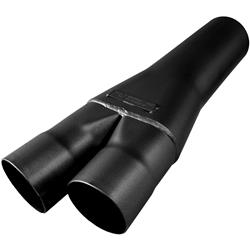
One of the biggest improvements you can make to a stock exhaust configuration is a scavenger type Y-pipe in place of the factory Y-pipe.

FLO-Y250300_ml.jpg
 
I'd be willing to bet the factory size exhaust and design, is probably best for economy for an all stock engine with all the pollution stuff in place.

I gotta believe the GM engineers didn't just throw some exhaust tubing on and call it a day. With some balance between flow numbers, scavenging, mph, performance, packaging and all the other considerations they arrived at a size that best suited those requirements.

I really tend to believe in the above. Max HP numbers are probably w/bigger pipes (especially w/engine mods), but cruising down the road at 1/4-1/2 throttle, I think that the stock 3" is hard to beat & dual 2" are hard to beat, FOR STOCK.

BTW, you do not need back-pressure...that is a term that Goobers came up with. What you need is suction, like when syphoning gas...the exhaust flow pulls the exhaust out of the chambers, heads, and manifolds. The smaller the pipe, the better the suction at lower rpms, the larger the pipe the better at higher rpms.
 
I'd be willing to bet the factory size exhaust and design, is probably best for economy for an all stock engine with all the pollution stuff in place.

I gotta believe the GM engineers didn't just throw some exhaust tubing on and call it a day. With some balance between flow numbers, scavenging, mph, performance, packaging and all the other considerations they arrived at a size that best suited those requirements.

I personally don't trust the OEMs to get this kind of detail right until around the late 90s / 2000s era. Ive owned 4 GM V8 vehicles from the 80s/90s and i gained noticeable power and mileage from changing the exhaust on all of them with no other changes to the engine. A couple of them had some really bad designs right from the factory, most commonly the "y-merge" which crashed together more like a t-pipe....certainly not an efficiency focused design.

As for choosing an exhaust size: it seems counter-intuitive, but going too big can actually create a restriction in the sense that a percentage of the air volume will be at standstill and blocking the moving air from reaching the end of the tailpipe. Whenever I hear someone say their engine "needs backpressure" I assume they probably don't realize their oversized exhaust actually ADDED backpressure. Backpressure is never a good thing in my experience... engines are designed to pump air, so hindering that process is unlikely to yield any benefit unless perhaps that back pressure is driving a turbocharger.

I personally prefer going slightly too big than slightly too small, as on more than one occasion Ive been told "Im not making enough power to see any gains from increasing diameter... and low and behold the engine ran better anyway.

As an example I recently removed a single catted 2.25" exhaust on my 305 and replaced it with a catless dual 2.25" and it runs a LOT better even though I am sure the 305 isn't using the full capacity of that exhaust system. It definitely breathes easier even if I did overkill it slightly and as far as I can tell the cat was in perfect operating condition (not clogged). I used the same 2.25" setup on a previous vortec 350 I have owned and it also ran very well. Dual 2.25 tends to be my default choice until north of 400hp. A stock 350 would also be very happy with a single 3". I wouldn't use any more or less than that even if you can get away with 2.75" it doesnt give you room to grow and IMO its riskier to go too small than too big ).

Dual 2.5" or single 3.5" would probably be about the point where you might start seeing a power loss when compared to a smaller size.
 
Last edited:

Latest Posts

Top Bottom