CK5
Register an account today to become a member! Once signed in, you'll be able to participate on this site by adding your own topics and posts, as well as connect with other members.

Frame Crack Question

Mudmanmaniac

Registered Member
Joined
Feb 11, 2009
Posts
26
Reaction score
0
Location
Kansas
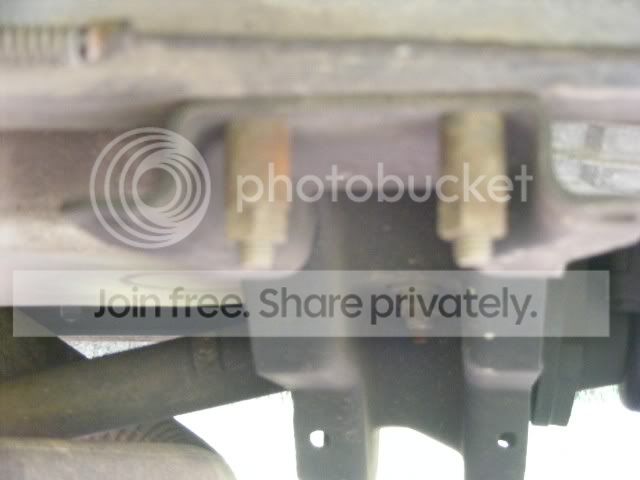
So I Discovered this crack located on the drivers side of my transmission mount. the PO bolted a piece of steel over the crack and drilled new holes.... What I would like to know is how bad is this crack? Would it be easy to weld up and be strong? What do you guys think?

Crack 1.jpg

Crack 2.jpg

Crack 3.jpg
 
#1 you need to get rid of those spacers, they are the reason that your frame is cracking there. Whether you buy a real t-case drop kit or put the t-case back where it should be is up to you.

After that, yes you need to fix that crack ASAP. Drill a hole at the end of the crack and then weld it up.
 
nope, on a stock truck it has frame, x-member, then those spacers, nuts..

thats a poor man's bandaid fix to help the back driveshaft angle after the lift... at least replace em with some solid stock with 2 holes drilled as a spacer.. or ditch em and fix the driveshaft angle prob..

as for the cracks, yeah, stopdrill the cracks, V em out a little and weld em up....
 
I thought the spacers were there to accomodate the lift?

Those spacers were actually inside and above the frame from the factory, the crossmember sat flush with the frame.

The problem with your setup, as it sits, is that those "spacers" have very little surface area on the frame and hence create high stress concentrations and create the cracks that you are seeing.

Dropping the transfer case crossmember is a half assed way of fixing driveshaft problems with a lift (though it actually makes the front driveshaft angle worse)
 
I'm glad to know this. I've found a few other cheap fixes with this thing too. So is there a kit or what is the "correct" way to fix my problem with the spacers? Should I get rid of them completely or put them back in the stock location? I want to do everything the right way the first time.
Thanks
 
it's best to put it back by the frame, get a decent cv shaft for the back and redo the spring perchs, rotating the pumpkin up to point at the trans for the cv shaft...
 
I'm glad to know this. I've found a few other cheap fixes with this thing too. So is there a kit or what is the "correct" way to fix my problem with the spacers? Should I get rid of them completely or put them back in the stock location? I want to do everything the right way the first time.
Thanks

Theres a few ways to do it.

First one that comes to mind is find some heavy flatbar (thickness of the spacers if thats where you want it to sit) and drill 2 holes in it. Don't know what your driveline angles are like but depending on where you want your t case to sit you can adjust the thickness of said flatbar accordingly. That'll give you basically the same thing putting the crossmember back on the frame would strengthwise because of the large contact area. Use some large flat washers on the nut side and your good.

As for the crack the best way to do it is to stop drill the hole, grind a V in it, and weld it up. Then grind down your welds so they are flush or almost flush and weld some 3/16 plate all the way around/solid over the area the cracks were. You should only have to plate it on one side but you'll need to drill holes in the plate. Make SURE you weld the crack all the way into the bolt holes with good penetration nice and hot. I gaurantee it'll crack again if you leave some of the crack by the hole. You may have to to some die grinding to clean up the hole but that's the right way to do it.

Looking at how the crack goes up the bend in the frame you might have to heat up the fish plate and bend it to fit the frame so you cover the whole crack with the plate. You could either have a shop put a bend in it for you (most will do a piece like that for free) or if you have a torch just weld the plate on one side heat it up where it needs to bend and smack away. Just be careful to not get the frame too hot. STRONGEST WAY: You can also take a cut off wheel, plasma, or torch and cut the cracks out, then put the plate on and weld up the "cuts/hole's" with the plate as a backer. It'll make the uphill welds alot easier and will be much stronger then welding the cracks and putting the plate over it.

Also make sure you run an uphill bead on the vertical part of the frame. A downhill weld isn't near as strong.

You might be ok with just welding it but I've seen rewelds crack ALOT on frames. Everytime I'd have to air arc out the old weld, re stick it, and fish plate it and I never saw a comeback.
 
Last edited:
When you say uphill not down hill are you meaning just run the bead from the bottom up instead of from the top down?
 
yup... uphill=bottom up... downhill=top down.

There are some fabbing situations where uphill actually is a bad idea but that frame isn't one of them. Uphill is THE strongest weld you can make. Downhill is the weakest, however sometimes uphill can cause breakage and cracks near the weld or on other areas. It just depends on what your working on.

Doesn't sound like it makes sense but having done a lot of structural and heavy repair and fabbing, it is the truth.

Uphill is not easy to do with hardwire but it's very do-able. You may have to stop in the middle of the weld to avoid undercutting, but it will still be alot stronger then downhill. If you heat is set right you shouldn't have to worry about undercut or burning through.

Just a tip- when welding uphill you want your machine set slow and a little colder then normal welding. Try to "stack" your weld. There's a few techniques to it... you can either do a "Z" pattern or ocelate like you would on a horizontal weld(circles). Circles are a bit trickyer but it looks alot better then the z pattern. You just need to make your ocelations far enough apart that the metal has a little time to cool between ocelations to prevent undercut and burn through.
 
That is a classic example of how not to correct for bad driveline angles.. IMHO even using a spacer to space the case down is borderline retarded, but at least it won't crack the frame like that abomination did.

When you space the case down, it worsens your front drive shaft angle since the t-case mount rotates down on the motor mounts, the front out put ends up pointing upwards. You really can't afford that in these trucks, and fixing the front angle is harder than the rear, if you are concerned about your caster..

Best solution, put the crossmember back to stock, fix your pinion angle and get a proper shaft made.

Here's a pic showing how those spacers are supposed to be used, at least in regards to both my rigs(the 89 with a 700r4/241 and the 91 with a 4l80e/241). I would think for the NP208 it would be the same or similar. My 91 has a 4" lift on it, but with a Suburban I've got wheel base on my side :)

crossmemberspacers.jpg


Sorry for the sh!t quality, but it gets the job done :wink1:
 
I've actually seen those spacers on top inside the frame also. Guess it makes no difference

Ok stupid question of the day. I'm not a welder by no means so bare with me :D

Why do you drill the hole in the end of the crack?? Does this help it to not crack later??
 
I've actually seen those spacers on top inside the frame also. Guess it makes no difference

Ok stupid question of the day. I'm not a welder by no means so bare with me :D

Why do you drill the hole in the end of the crack?? Does this help it to not crack later??

Yeah I installed mine with the tubes on the inside of the frame when I undid the drop from the previous owner.

I would think that drilling the end would clear away any material that may be cracked but not shown through yet.
 
That is a classic example of how not to correct for bad driveline angles.. IMHO even using a spacer to space the case down is borderline retarded, but at least it won't crack the frame like that abomination did.

When you space the case down, it worsens your front drive shaft angle since the t-case mount rotates down on the motor mounts, the front out put ends up pointing upwards. You really can't afford that in these trucks, and fixing the front angle is harder than the rear, if you are concerned about your caster..

Best solution, put the crossmember back to stock, fix your pinion angle and get a proper shaft made.

Here's a pic showing how those spacers are supposed to be used, at least in regards to both my rigs(the 89 with a 700r4/241 and the 91 with a 4l80e/241). I would think for the NP208 it would be the same or similar. My 91 has a 4" lift on it, but with a Suburban I've got wheel base on my side :)

crossmemberspacers.jpg


Sorry for the sh!t quality, but it gets the job done :wink1:


By the way since no one mentionned it I figured I might as well:
Those tubular spacers come stock on a couple of places in our trucks, they have them here at the crossmember and at the steering box.
It's to give a longer bolt a chance to work in tention.
The longer the bolt, the better clamping without stretching the bolt beyond it's elasticity, and since both locations are across less than 1/4" thickness, they add 1" or more of length to the bolt with these spacers.
I did eliminate them on my truck and after running less than a year my bolts loosened up.
 
By the way since no one mentionned it I figured I might as well:
Those tubular spacers come stock on a couple of places in our trucks, they have them here at the crossmember and at the steering box.
It's to give a longer bolt a chance to work in tention.
The longer the bolt, the better clamping without stretching the bolt beyond it's elasticity, and since both locations are across less than 1/4" thickness, they add 1" or more of length to the bolt with these spacers.
I did eliminate them on my truck and after running less than a year my bolts loosened up.

About time somebody told us why those spacers are on our trucks. The spacers are there for a reason and if GM could save a few cents by not putting the spacers on, they would have.

I wonder why GM put the spacers for the cross member on the later blazers? I don't think there is much stress by the cross member as compare the steering box.
I think the later blazers have thinner frames than the early blazers.
I need to check this out.
Edit--the early model blazer have the cross member mounted on the top and bottom of the frame rails. Therefore, more mounting points and more load carrying capacity.
 
About time somebody told us why those spacers are on our trucks. The spacers are there for a reason and if GM could save a few cents by not putting the spacers on, they would have.

I wonder why GM put the spacers for the cross member on the later blazers? I don't think there is much stress by the cross member as compare the steering box.
I think the later blazers have thinner frames than the early blazers.
I need to check this out.
Edit--the early model blazer have the cross member mounted on the top and bottom of the frame rails. Therefore, more mounting points and more load carrying capacity.

As I said, I tried with my blazer to eliminate those spacers, and within a few months, I lost a couple of the bolts, and finally I ended up on a trail with a tranny tcase on the ground. Good thing I carried spare bolts and nuts.
It didn't help I had a big 5.9 l Turbo diesel vibrating the bolts lose, but still the clamping force of a stretched bolt can only be replaced by a good thread locking compound or safety wire, and I didn't want to do either.
By the way, not all the trucks came with the double cross memeber, some just got the same as the newer one, just one layer, I am guessing it was more for the 203 equiped trucks, dunno...

Santa Maria... what is there I can see there, I will be there on Tuesday waiting for a load to be loaded, is there anything interesting I can do for a couple of hours?
 
As I said, I tried with my blazer to eliminate those spacers, and within a few months, I lost a couple of the bolts, and finally I ended up on a trail with a tranny tcase on the ground. Good thing I carried spare bolts and nuts.
It didn't help I had a big 5.9 l Turbo diesel vibrating the bolts lose, but still the clamping force of a stretched bolt can only be replaced by a good thread locking compound or safety wire, and I didn't want to do either.
By the way, not all the trucks came with the double cross memeber, some just got the same as the newer one, just one layer, I am guessing it was more for the 203 equiped trucks, dunno...

Santa Maria... what is there I can see there, I will be there on Tuesday waiting for a load to be loaded, is there anything interesting I can do for a couple of hours?
Edit--Opps wrong thread and about something else.
As on Tuesday, I work in Buellton and I won't be back in Santa Maria till 5:00pm.
When do you think you are going to be here. As for what to see in Santa Maria-- Nothing.
 
edit - brainfart...... :haha:
 
Last edited:

Latest Posts

Top Bottom