CK5
Register an account today to become a member! Once signed in, you'll be able to participate on this site by adding your own topics and posts, as well as connect with other members.

Front vs Rear shocks

solace22

1/2 ton status
Joined
Apr 26, 2014
Posts
245
Reaction score
11
Location
kentucky
I bought 2 rear shocks for the blazer some time back and even though they were nothing special they were a great improvement over what I had. I decided to order shocks for the front and noticed that the ones I bought for the back supposedly arent for the front. So I bought shocks supposedly for the front of the truck and of course they seem to be totally incorrect. (about 4" shorter than what I took off).
Anyhow, is there a length difference between front and rear shocks (generally)? This truck had a total of 6 shocks on it and I could not tell you the difference between any of them, they all seem to be the same shock. Are fronts "tuned" differently than "rear" shocks or something?
I guess ideally id just like to buy two more of the "rear" shocks and stick them on the front., is that stupid? lol
(yes I know they arent anything special, its what I could afford right now though)
Rear shocks I bought
Front Shocks I bought
 
In and of themselves, the shocks don't care about position, no. There is the issue of valving (more or less mow much shock they absorb and how much they rebound, i.e. how "soft" or "hard" they are, what you call "tuning.") If you had four shocks up front, originally GM had one fairly stiff shock and one soft one on each side. Without custom tuning for your particular truck's weight distribution and springs, having the same valving front and rear is probably just fine, so if they fit, you could use "front" shocks in the back or vice versa.

The other issue is of course length, compressed and extended, which is tied to the shock mounts and your lift, if any. If the truck has stock mounts, the fronts should be a bit shorter than the rears. For my ~4-5" lift, the fronts are 26" / 16", and the rears 30" / 18". (My truck didn't have the quad shock option.)

That make sense?

-- A
 
In and of themselves, the shocks don't care about position, no. There is the issue of valving (more or less mow much shock they absorb and how much they rebound, i.e. how "soft" or "hard" they are, what you call "tuning.") If you had four shocks up front, originally GM had one fairly stiff shock and one soft one on each side. Without custom tuning for your particular truck's weight distribution and springs, having the same valving front and rear is probably just fine, so if they fit, you could use "front" shocks in the back or vice versa.

The other issue is of course length, compressed and extended, which is tied to the shock mounts and your lift, if any. If the truck has stock mounts, the fronts should be a bit shorter than the rears. For my ~4-5" lift, the fronts are 26" / 16", and the rears 30" / 18". (My truck didn't have the quad shock option.)

That make sense?

-- A
yep sure does. The only thing that sucks is I bought the truck the way it is, that leaves me trying to learn what is supposed to be and what was added later. I am thinking the dual shock thing was added because the hardware for the upper mount has new-ish looking nuts on it. Was the front single shock setup shock straight up and down or at an angle?
As far as I can tell this truck used the stock mounting options in the rear, it has 6" lift.
 
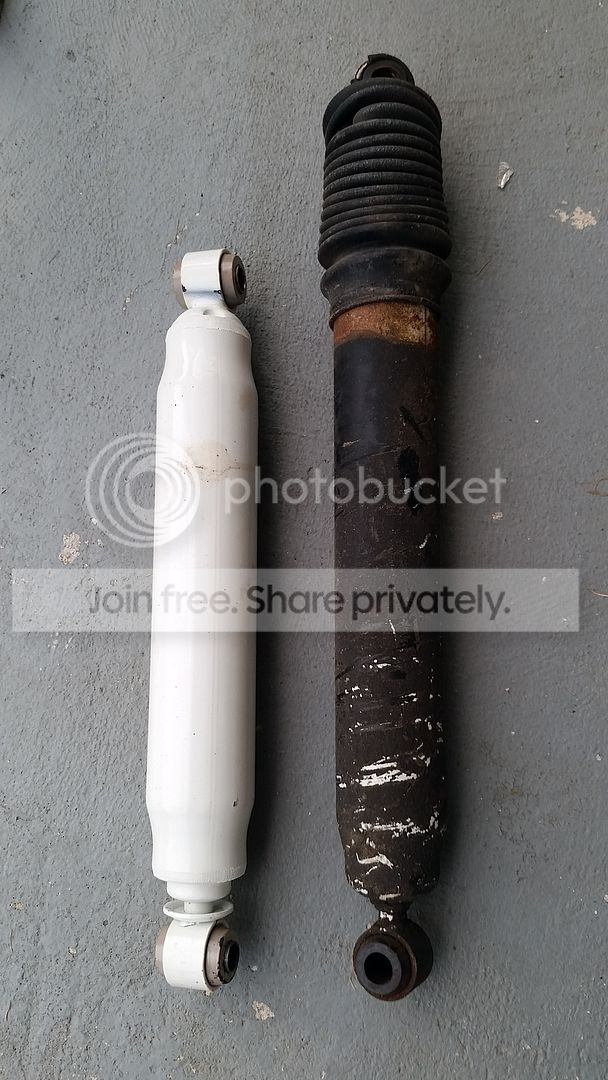
for reference here is a comparison of the two front shocks. Seems like a hell of a difference.
20160602_194533_zpsx7h7r1tv.jpg
 
A random internet pic which I believe is the factory quad shock (not my truck, random Google search)

177027P1040494.jpg


And yes, there were also aftermarket kits to do this, especially during the 80's when "Moar Shox!! Moar Bettah!!" was the mantra.

General consensus these days is one good shock on each corner is appropriate. For the most effect from your shock, mount it as close to vertical as possible. (As it tilts, the shock loses effectiveness, up to something like half if at a 45* angle.)

-- A
 
Last edited:
A random internet pic which I believe is the factory quad shock (not my truck, random Google search)

177027P1040494.jpg


And yes, there were also aftermarket kits to do this, especially during the 80's when "Moar Shox!! Moar Bettah!!" was the mantra.

General consensus these days is one good shock on each corner is appropriate. For the most effect from your shock, mount is as close to vertical as possible. (As it tilts, the shock loses effectiveness, up to something like half if at a 45* angle.)

-- A

well thats exactly what mine looks like. must have had factory quad shocks.
 
for reference here is a comparison of the two front shocks. Seems like a hell of a difference.

Umm, another issue is that neither of them want to extend. When not bolted in place or strapped down, shocks should want to go to their full length, unless they're dead (or if they're in fact steering stabilizers, which look like, but are not exactly, shocks.)

Is the white one one of the ones you bought new?

-- A
 
Umm, another issue is that neither of them want to extend. When not bolted in place or strapped down, shocks should want to go to their full length, unless they're dead (or if they're in fact steering stabilizers, which look like, but are not exactly, shocks.)

Is the white one one of the ones you bought new?

-- A
the white one is a brand new shock i just took out of the box. the ones on the rear did not want to extend either. you bring up a good point though. I didnt even think about that.
 
the white one is a brand new shock i just took out of the box. the ones on the rear did not want to extend either. you bring up a good point though. I didnt even think about that.

Hmm. That may be a difference between dual-tube and mono-tube types, but my memory is all the shocks I've installed I had to put a strap around to hold them in place or they'd stretch out to full length.

Anyway, measure it eye-to-eye as is, stretch it out, and measure it again. That gives you compressed and extended lengths. You can then see if it'll fit either of the two mounting locations you have.

At rest you want the shock to be between compressed and extended, with enough room for the spring to move all the way up without squishing the shock, and with enough room for the spring to move all the way down without yanking it.

-- A
 
Hmm. That may be a difference between dual-tube and mono-tube types, but my memory is all the shocks I've installed I had to put a strap around to hold them in place or they'd stretch out to full length.

Anyway, measure it eye-to-eye as is, stretch it out, and measure it again. That gives you compressed and extended lengths. You can then see if it'll fit either of the two mounting locations you have.

At rest you want the shock to be between compressed and extended, with enough room for the spring to move all the way up without squishing the shock, and with enough room for the spring to move all the way down without yanking it.

-- A

maybe. I checked youtube real quick, a guy had 4 of these and the one he opened was extended already. hhhmmm,.. I dunno.
Ill have to try and check it tomorrow and see if anything would work or if it looks like it would fit. I am all open to shock suggestions, especially by part number. =D
 
I'm partial to the Bilsteins, though again, it's dependent on your springs and lift and personal taste. Some folks prefer the adjustable variety (Ranch 9000, Procmp MX6) to tune; others get fancy and get the really nice ones that are user-rebuildable for adjustment.

Anyway, the ones I got are Bilstein 33-185552 front and 33-185569 rear. Bit spendier than the ones you linked, but not catastrophically so, direct drop in for 4-6" lifts, and IMO a decent shock.

-- A
 
I'm partial to the Bilsteins, though again, it's dependent on your springs and lift and personal taste. Some folks prefer the adjustable variety (Ranch 9000, Procmp MX6) to tune; others get fancy and get the really nice ones that are user-rebuildable for adjustment.

Anyway, the ones I got are Bilstein 33-185552 front and 33-185569 rear. Bit spendier than the ones you linked, but not catastrophically so, direct drop in for 4-6" lifts, and IMO a decent shock.

-- A
youre the man, ill check those out. Not sure if thats "too much" shock for my needs or not. think daily driver maybe occasional offroader one day. Im just trying to get it reliable right now and old worn out parts replaced.
 
Only gas charged shocks will come with "tie downs" in the box to hold them fully compressed--they probably still sell "regular" non gas charged shocks and that may be what you have,if you went with a lowest priced one..those have to be manually extended to be installed..

I used to like Monroe Magnum 60's ,with no gas charge..I ran those for 10+ years,never had one fail or leak,and they stiffened the ride up a lot...back then gas shocks were just getting popular,but many had a short life,they leaked at the piston seals and failed early quite often..

Also ,it's been years since I looked up shocks ,but I think the quad shocks have one part number for the most "foreward" shock,and another for the rearmost facing one,they are are mounted further back,so they may need a longer shock in that position..at least thats how I recall it used to be listed--perhaps now they have one number that'll work in either position..
 
I had a minute, grabbed the new shock and threw it on. It does not fit in the forward most position. It does fit in the other spot, the one closest to the rear bumper. it was not maxed in this position and had a moderate amount of distance to travel still before maxed out.
should I keep it or return it for one that fits the forward position?
 
Given that you have it, I'd say use it -- at least, assuming it's working properly. The slightly larger angle off vertical compared to the other position isn't enough to fuss over.

But why go through any more hassle and cost if you can make work what you have, right?

And YMMV, caveat emptor, offer expires while you wait, all the usual disclaimers apply. My opinion, as with all on the web, is free, and worth at least what you paid for it if not less. :D

-- A
 
Given that you have it, I'd say use it -- at least, assuming it's working properly. The slightly larger angle off vertical compared to the other position isn't enough to fuss over.

But why go through any more hassle and cost if you can make work what you have, right?

And YMMV, caveat emptor, offer expires while you wait, all the usual disclaimers apply. My opinion, as with all on the web, is free, and worth at least what you paid for it if not less. :D

-- A

Thats true. The only benefit is the other shock I have to buy is 45$ and I paid that for the two in the back lol so 45$ for rear 90$ for front. If I sent it back i could buy two of the rear and save 45$ but then I dunno if they would fit since its the wrong spot for the longer shock. Ill just keep it I guess. ugh.
 
"Regular" shocks do not extend when released. For most of the history of shocks, none of them extended. However, when you work a shock hard, the fluid inside can absorb air and get foamy.
Since the shock action depends on the fluid flowing smoothly through the valves, foam causes it to not do much of anything until the foam goes away.
Think of a power steering system with air in it.

One day, some engineer realized a couple of things:
First, Nitrogen does not mix with the fluid as bad as air does, and second, the more pressure the system is under, the less foam.

Think about a hot Coke in a glass bottle. There is a ton of carbon dioxide in the fluid, but it will not foam when you shake it up because the pressure keeps it dissolved.
When you release the pressure, all bets are off.
Remember, the amount of gas dissolved in the shock fluid does not matter, as long as there is no foam.

So, most shocks these days are Nitrogen pressurized. But, that costs money. So, if you have a shock that does not get worked hard, like one mounted at a steep angle, many shock makers will not add the extra seals and things necessary to have them pressurized.

And, the pressure is not necessary until the shock gets worked hard. Under normal street driving, there is not going to be much of a foaming problem.
Just like a hot Coke will not foam much unless it is shaken.
So, a lot of the shocks for cars and things that get driven on the street may not be pressurized.
 

Latest Posts

Top Bottom