CK5
Register an account today to become a member! Once signed in, you'll be able to participate on this site by adding your own topics and posts, as well as connect with other members.

Fuel guage problems

readymix said:
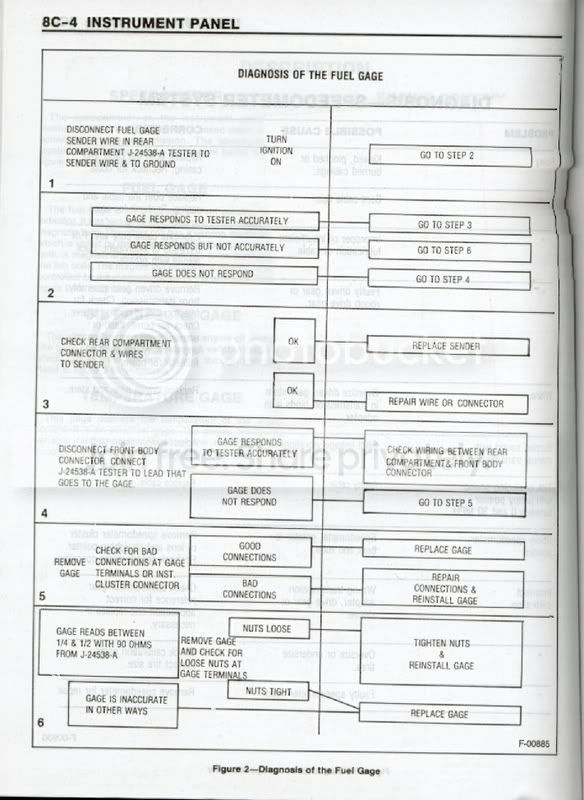
Care to tell us all what the correct gauge response would be in step #1?

I am on my way to scan the GM book hold your all horses. I will be posting from a remote location (dial up only). :rolleyes:
 
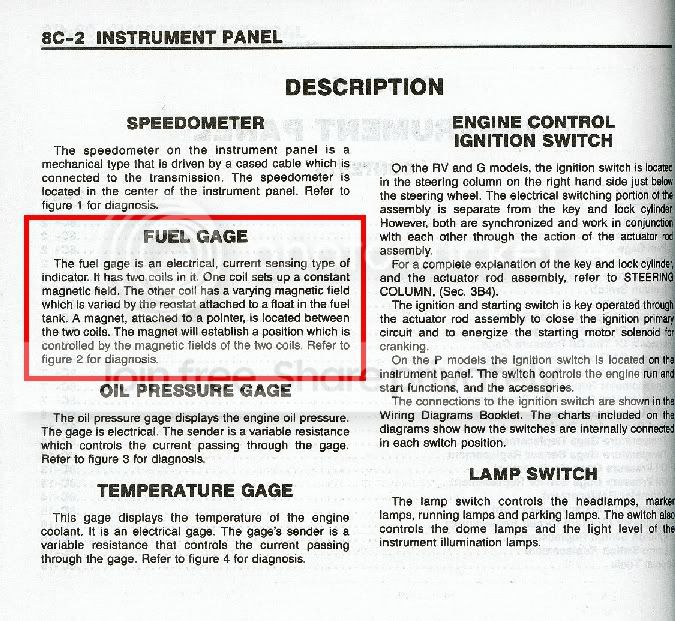
f1.jpg


f2.jpg

*be sure to check your nuts!
LOL it took 25 mins to upload these to photobucket.....luv ma Bell
 
Isn't this fairly simple? The gauge reads the resistance via the tank sender. At the extreme ends of the spectrum, you either have infinite resistance, or no resistance, correct? (sending wire disconnected, or sending wire grounded, or 90 ohms and 0 ohms, realizing that an open wire is infinite)

With the tank sender wire disconnected, key in run, the gauge reads past full. I just verified this, and even though my gauge isn't dead accurate (to 1/8 of a tank) it's close enough. To me that says 90ohms (in my test case infinite) is full. 0 ohms (no resistance) means empty.
 
That is how I remember it. If you shorted it it would read empty.
That said, Ryoken remembers it the other way. Now I'm not sure. Maybey the tester does something different.
Do you have to completely disconnect the gauge from the wiring when using the tester? That could account for our difference in opinion in the test procedure and outcomes....

I really want to see the real schematic, not sure if it exists though. I am sure my schematic is close though.
 
I'll have to take a look at my manual later, but as I understood the tester (I glanced at this section a few months back) it's just a tool that allows you to vary resistance to the gauge on the sending unit wire. It is *probably* calibrated to show the various tank positions in relation to where you turn a knob or something. (IE, 45 ohms should show half tank, etc) You can do the same thing with a spare sending unit, I have. As a matter of fact, I can probably measure the resistance on one of the senders in full/empty, can't I? :)

I can guarantee you that an open sender wire reads past full, I just crawled under my truck to verify.
 
If someone wants to walk me through resistance testing, PM me. This meter has a bunch of settings, I can't see how I'm possibly setting it wrong, but the resistance numbers come nowhere near close to the 0-90 it "should" be, and that's on two senders. The variance I *am* seeing indicates resistance increases the more the float moves to the "full" point.
 
Testing the OHMS of the sender is easy. All you need to do is make sure your meter is set in the proper range (0-90) then put the black clamp on the sender somewhere and the red clamp on the sender terminal wire and move the float, it should be 0 ohms at one end of movement and 90 ohms at the opposite end of movement.
 
In the schematics I have for 1987 year vehicles, the ignition feeds in on the E terminal, the fuel sender feeds in on the center post and Full is grounded.

fuel_tank_sender.jpg

In this image swap leads 1 and 2. That is how it shows it in the factory GM wiring diagrams. If my electrical is up to snuff that would mean that 0 would be full and 90 would be empty.

Dik

fuel_tank_sender.jpg
 
Yep...one lead clamped to the sending unit ground wire, the other in the connector for the gauge sending wire. One dial set to ohm, the upper one set to any range never results in a range of 0-90, it's up in the 100's. (or .100's, depending on which range I select...3, 30, 300. :confused:
 
sandawgk5 said:
In the schematics I have for 1987 year vehicles, the ignition feeds in on the E terminal, the fuel sender feeds in on the center post and Full is grounded.

View attachment 55097

In this image swap leads 1 and 2. That is how it shows it in the factory GM wiring diagrams. If my electrical is up to snuff that would mean that 0 would be full and 90 would be empty.

Dik

I am backwards on this. If both the center and full have zero resistance (GROUNDED) then the flow will go to the first ground as electricity is lazy. If there is 90 Ohms of resistance on the center post then the flow will travel through both coils energizing them equally causing a full signal. so 0 ohms will be full and 90 ohms will be empty.

Dik
 
Two in a row? I agree, it seems bad sender, but I wish I had a resistor handy to test. One of these is a new (out of the box now!) TBI sender. Doesn't mean it's good, but there isn't much to these things! And since resistance DOES change when the float is moved...?
 
sandawgk5 said:
In the schematics I have for 1987 year vehicles, the ignition feeds in on the E terminal, the fuel sender feeds in on the center post and Full is grounded.

View attachment 55097

In this image swap leads 1 and 2. That is how it shows it in the factory GM wiring diagrams. If my electrical is up to snuff that would mean that 0 would be full and 90 would be empty.

Dik

Dude read the GM service manual for the truck! This page is right out of it.
Metrodps said:
 
Can Can make sticky!

I did not read all of this but here is a link.
http://members.cox.net/vipir14/gmgauges.html

General Motors 0-90 Ohm Gauge Diagnosis Procedure

Especially as cars age, it is often somewhat difficult to pinpoint the root cause of instrument cluster gauge failure, thanks to questionable wiring, normal wear and tear, and sometimes even incorrect diagnosis procedures. The following diagnosis procedure is the method that GM publishes in it's shop manuals, will work on oil pressure, temperature, and fuel gauges, and should apply to all but the most recent GM-made vehicles with computerized gauges.
Before You Begin

You will need either Kent-Moore tool J-24538-A, if available, or tool JG-GM-1, a homemade GM gauge testing jumper. To build tool JG-GM-1, you will need the following materials:
  • 1 Jumper wire with alligator clips (about $2 US from Wal-Mart)
  • 1 220 ohm, 1/2W resistor (Radio Shack #271-1109, pack of 5, $0.99)
  • 1 150 ohm, 1/2W resistor (Radio Shack #271-1111, pack of 5, $0.99)
  • about 1" of 1/4" heat-shrink tubing, or vinyl electrical tape
Construct the jumper as follows:
  1. Cut the jumper wire in half, and strip about 1/8" of the insulation off of the cut end of each wire. Tin the bare wires using a soldering iron.
  2. Take both resistors and twist their leads together on each end, so that the resistors are joined in parallel. Twist the leads tightly, cut off the excess, and tin the twisted leads. If using heat-shrink tubing, make sure that the resistor assembly is about half the length of the tubing, or less.
  3. If using heat-shrink tubing, slip the tubing over one of the jumper wire halves.
  4. Solder each half of the jumper wire onto the opposite ends of the resistor assembly.
  5. If using heat-shrink tubing, slide the tubing over the resistors and solder joints and shrink using a low-temperature flame or hair dryer. If using electrical tape, tightly wrap the tape around the resistors and solder joints, ensuring that the solder joints are completely covered.
Diagnosis Procedure
  1. Disconnect wire from sending unit, and connect tool JG-GM-1 from the wire connector to ground.
  2. Turn ignition ON.
  3. If the gauge being tested reads at the high end of the scale (i.e. full for gas, 60psi for oil, etc.), the sending unit is at fault and must be replaced. Retest after sending unit replacement.
    Else, go to step 4.
  4. If the gauge responds, but not accurately, go to step 5.
    If the gauge does not respond at all, go to step 7.
  5. Disconnect engine harness connector at firewall bulkhead. Connect tool JG-GM-1 from ground to bulkhead connector lead that goes to gauge. If the gauge now responds accurately, check the wiring between the sending unit connector and the engine harness connector, repair any faults, and retest.
    Else, reconnect the engine harness connector, and go to step 6.
  6. Remove the gauge from the instrument cluster and check the speed nuts holding the ceramic shunt across two terminals on the back. If they are loose, tighten them and retest gauge; if tight, the gauge is at fault and must be repaired or replaced.
    NOTE:You might be able to repair the gauge with a kit from Fix-A-Gauge, and/or you might be able to manually reposition the needle where applicable. Retest after repair.
  7. Remove the instrument cluster and check for bad connections at the gauge terminal clips, instrument cluster connector, and both the instrument cluster and sending unit ground. If the connections are good, inspect the wiring from instrument panel to firewall harness connector, and repair any faults if found; if bad, repair the connections, reinstall gauge, and retest. If the connections and wiring are both good, the gauge is at fault and must be replaced.
    NOTE:A gauge diagnosed as bad through this step most likely can not be repaired.
 
Metrodps said:
Dude read the GM service manual for the truck! This page is right out of it.

Dude I have that manual as well as all of the other manuals for my year of truck including the wiring diagrams.

The diagrams shows the reostat coming in the fuel gauge in the middle with ground on the full side and 12V on the E side.

The paragraph you have encircled in red only tells how the gauge operates it does not tell where the various connections on the gauge go.

The GM wiring diagrams show it just like Readymix has other than his leads of 1 and 2 are swapped.

Dik
 
Just a heads up....

I made that schematic just form "my" understanding of how hte crap works.
Ira, Scan or take a picture of the one you have. I am determined to figure this out once and for all.....

Now I can read everything that has been posted in the last few hours. I am late for my beer appt in the garage.

L8R
 
readymix said:
Just a heads up....

I made that schematic just form "my" understanding of how hte crap works.
Ira, Scan or take a picture of the one you have. I am determined to figure this out once and for all.....

Now I can read everything that has been posted in the last few hours. I am late for my beer appt in the garage.

L8R

It will take me a few hours as it jumps from page to page and is all on 11X14 sheets. My scanner only goes 8.5X11:( .

I did find this on autometers webiste though.

http://www.autometer.com/productPDF/1079A.pdf

Page 2 show the resistance reading for fuel gauges. Most GM upto 97 0=empty 90=full.

Dik
 

Latest Posts

Top Bottom