


I need some input on fuel system design for my IronMaiden project.
I will be running a 461 BBC, mechanical pump, and 750 carb. I will be using the stock tank and sending unit, but a different fuel pickup from the tank. The fuel supply line is .430 i.d. stainless tubing. My filler neck will be a unit which will seal tightly to the tank top, as well as the cap to the filler neck.
I plan on running a single supply line with no return line from the pump. I will vent the tank with a rollover valve from the tank to a hose that will meet the roll over loop (FATS) as described here:
Copied from Pirate 4x4 tech article on Fuel cells;
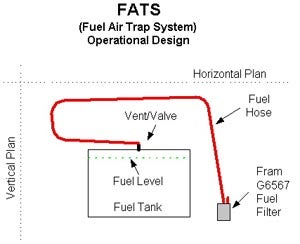
Fuel Hose Routing
The fuel hose must be routed in an easy to do, yet specific way.
From the vent/valve the hose extends to the left past the left side of the fuel tank on a slight angle past horizontal (See reference to horizontal and vertical reference lines.).
Once past the end of the tank, the fuel line is routed upward, again not quite vertical, but angled slightly.
Again the hose is routed to the right, completely over and past the right end of the fuel tank (Not quite horizontally).
And then lastly the hose is routed downward to a level close to (or below) the bottom of the fuel tank.
Hose routing is vital, for this routing is what makes the FATS design work.
Again, hose routing attributes are:
· Left-to-Right or Right-to-Left hose routing must always extend Past the Sides of the Fuel Tank.
· Vertical and Horizontal hose routing must not be square, but rather sloped so as to allow any fuel in the lines to drain back to the tank.
· Hose should terminate as close to the bottom of (or below) the fuel tank.
Now my concerns are:
1) Water and other undesirables getting in that filter, as it needs to be mounted lower than the stock tank position to be effective in the FATS design. So would it make sense to run a hose from that filter to a higher point on the vehicle, to avoid water and the like, or just move that filter to a higher location?
2) From past experience a vehicle doesn't need to run a return fuel line, but should I, would that help prevent vapor lock?
3) I'm thinking the FATS system will provide an adequate vent to prevent a vacuum condition on the tank while fuel is being drawn out to feed the engine....as long as the filter in the FATS system is clear.
I will be running a 461 BBC, mechanical pump, and 750 carb. I will be using the stock tank and sending unit, but a different fuel pickup from the tank. The fuel supply line is .430 i.d. stainless tubing. My filler neck will be a unit which will seal tightly to the tank top, as well as the cap to the filler neck.
I plan on running a single supply line with no return line from the pump. I will vent the tank with a rollover valve from the tank to a hose that will meet the roll over loop (FATS) as described here:
Copied from Pirate 4x4 tech article on Fuel cells;

Fuel Hose Routing
The fuel hose must be routed in an easy to do, yet specific way.
From the vent/valve the hose extends to the left past the left side of the fuel tank on a slight angle past horizontal (See reference to horizontal and vertical reference lines.).
Once past the end of the tank, the fuel line is routed upward, again not quite vertical, but angled slightly.
Again the hose is routed to the right, completely over and past the right end of the fuel tank (Not quite horizontally).
And then lastly the hose is routed downward to a level close to (or below) the bottom of the fuel tank.
Hose routing is vital, for this routing is what makes the FATS design work.
Again, hose routing attributes are:
· Left-to-Right or Right-to-Left hose routing must always extend Past the Sides of the Fuel Tank.
· Vertical and Horizontal hose routing must not be square, but rather sloped so as to allow any fuel in the lines to drain back to the tank.
· Hose should terminate as close to the bottom of (or below) the fuel tank.
Now my concerns are:
1) Water and other undesirables getting in that filter, as it needs to be mounted lower than the stock tank position to be effective in the FATS design. So would it make sense to run a hose from that filter to a higher point on the vehicle, to avoid water and the like, or just move that filter to a higher location?
2) From past experience a vehicle doesn't need to run a return fuel line, but should I, would that help prevent vapor lock?
3) I'm thinking the FATS system will provide an adequate vent to prevent a vacuum condition on the tank while fuel is being drawn out to feed the engine....as long as the filter in the FATS system is clear.


