CK5
Register an account today to become a member! Once signed in, you'll be able to participate on this site by adding your own topics and posts, as well as connect with other members.

Fuse block wiring questions?

robert97dodge

1/2 ton status
Joined
Mar 7, 2007
Posts
706
Reaction score
0
Location
Lufkin, Tx
I bought a couple Blue sea fuse blocks that I had some questions about wiring. One is a 6 circuit with negative bus and the other is a 12 circuit with negative bus.

Here is a pic of the 12 circuit one. The 6 circuit looks the same but is shorter with only 6 circuits.

5026_182x360.jpg


The ground wire goes in at the top I have grounded to the frame and the bottom is for the power I have coming from the battery. How I think it works is you use each of the 12 circuits to hook up 12 different products. According to the wiring diagram the left side of the positive section is positive feed and the right side is to device positive. The left side of the negative section is negative feed and the right side is from device negative.
Here is a link to some specs about the blocks. I have part number 5025 and 5026.

http://bluesea.com/products/5026
 
I am guessing (since you didn't post any questions) that you are correct. It shouldn't be necessary to carry the ground back to the fuse panel, unless this is for a marine application. On nearly all vehicle applications, you can ground directly to a metal surface, as long as the proper ground straps are on the engine and radiator support. Running grounds back in a vehicle is just extra wiring that can fail later on. Pretty hard for the entire body to rust away. I may have to get one of the 6 circuit boxes for my overhead console. Sure would make wiring the stereo, CB, and Sirius radios simple.
 
THese are designed for boat applications so that does make sense that you would have to run the grounds back to the block. I guess I am hooking it up right then. I got both of mine off of ebay.
 
Those are slick little fuse blocks, I've used them at work (you can get them at McMaster too). Once you have them in your hand with the cover off, it should be obvious how to wire them up. The main positive connection is on the bottom in your picture. The twelve fused positive connections are numbered and go out both sides in the lower 2/3s of the box (even numbers out the left and odd out the right - or vice versa, I don't remember). The upper 1/3 is for the ground side of the circuits (you won't need those).
 
I've installed hundreds, literally, and recommended them in here quite often..

yes, you do need to supply the grd for the grd bar... or you can not use it at all...
 
Hmmm, I have always used them with the grounds connected for ease of hooking up the stuff I was working on (not in a vehicle application). But why do the grounds have to be connected? If you ground everything through the chassis, why do you need to run ground to that fuse box?
 
you don't. but you do if you want to use the neg buss for any reason.... just another option when using in an auto as opposed to it's intended purpose.....
 
I don't know how many watts a marine VHF radio put out , but I wouldn't want to run more than a 4 watt CB off that fuse block , regardless how nice it looks .

My VHF radio ( 2 meter ham ) puts out 50 watts on high , so its straight to battery .
 
you don't. but you do if you want to use the neg buss for any reason.... just another option when using in an auto as opposed to it's intended purpose.....

Gotcha :waytogo:

Pauly, It does look like a wimpy little plastic thing, but x2 on the rating, 100 Amps total, and I think 20 Amps per circuit (~240 watt).
 
Gotcha :waytogo:

Pauly, It does look like a wimpy little plastic thing, but x2 on the rating, 100 Amps total, and I think 20 Amps per circuit (~240 watt).


100AMP total 30AMP per cercuit max.

I guess that I am wiring it right. Do you know what it means when it says positive feed? I always that meant you send power to that spot and then to device positive is where you get your 12V from. On the bottom section that is a 12V the left side on the diagram is called positive feed and the right side is to device positive and it just sounds like you have to send 12V to the left side and then it comes out on the right side. BUt that just wouldnt make sense that you do it that way since you have the big wire that goes on the bottom for the positive.
 
I don't know how many watts a marine VHF radio put out , but I wouldn't want to run more than a 4 watt CB off that fuse block , regardless how nice it looks .

My VHF radio ( 2 meter ham ) puts out 50 watts on high , so its straight to battery .

Most everything will be pulling straight from the battery. It is just that my batteries are mounted in the bed so it is easier to use these.

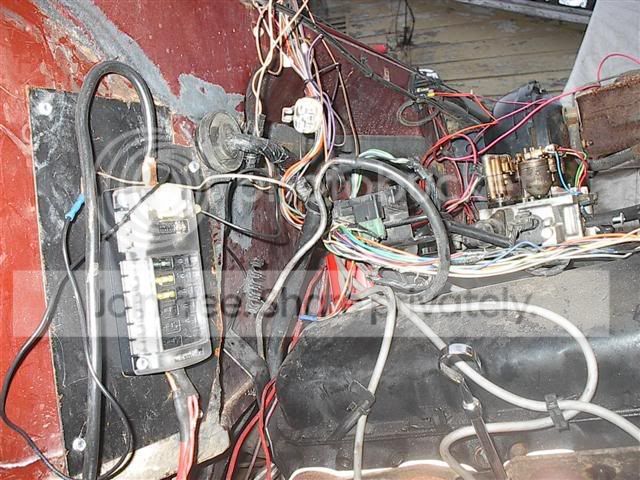
Here is a pic of the big one mounted up.


IM004624.jpg


You can see at the bottom the big 4 gauge wire that runs from the battery. The other small wires there are the factory wires that went to the battery. I will be running the small fuse block on a 50AMP relay. The small one will only get power when the key is on. I will have the PCM, coil, fuel pump, and one other wire on the motor that needs power when the key is on all on that small fuse block and it will also all be on it own relay. So it really wont be pulling power from the fuse block either. I am just using the block to activate the relay. It will all be pulling its power from the 4 gauge wire coming from the battery. As well as about 8 different lights, e-fans, and anything else that I end up wiring up.
 
you've confused me... power comes in the bottom, thru each fuse and to the corresponding #8 screw next to that fuse for each circuit..
 
you've confused me... power comes in the bottom, thru each fuse and to the corresponding #8 screw next to that fuse for each circuit..


That is what I think it should be too. I guess I will find out for sure when I hook it up.
 
Yup, that is what it is. You shouldn't need the big negative wire on top, unless you are going to run all the grounds back to the box.
 
Top Bottom