CK5
Register an account today to become a member! Once signed in, you'll be able to participate on this site by adding your own topics and posts, as well as connect with other members.

Getting more coolant flow on a 6.0 ls

Deuling

“I like to make things”
 Premium
GMOTM Winner
Joined
Dec 8, 2010
Posts
25,038
Reaction score
6,239
Location
Muskegon Michigan
In the buggy, the upper frame rail tubes are the supply and return for the coolant, to the radiator in the rear. Thats ALOT of distance.

Having heating issues when on it for a little bit, and wondered if there are better pumps, impellers, smaller pullys etc to get more flow.

 
You could put an inline pump at the other end to help the fluid from both ends. Basically two water pumps in series...one mech at the engine and one electric near the radiator.

However, if the radiator is really hot, its not the water flow thats the issue, it's the airflow to the radiator(which is probably more likely if there is a full 1.5" ID all the way to the radiator and back). If the radiator is cool enough but the engine is hot, then it's the water flow.

One more thing, put the shocks back on it! :haha:

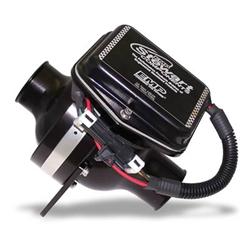
http://www.summitracing.com/parts/emp-e558abk

emp-e558a-bk_w_ml.jpg
 
Wonder if Stewart or anyone make pumps?

I don't know what the radiator hose diameters are stock, but by increasing distance you are increasing resistance to flow (due to pipe wall) but I bet there are flow calculators online that would prove helpful.
 
Lol that's an old pic Heath. Before the shocks went on.

It's a flow issue. It's got a good rad with good fan and probably 30' of tube open to the air to help cooling. Plus open engine.

That's just a long way to push fluid on a stock pump. Most likely original from 2002.
 
Wonder if Stewart or anyone make pumps?

I don't know what the radiator hose diameters are stock, but by increasing distance you are increasing resistance to flow (due to pipe wall) but I bet there are flow calculators online that would prove helpful.

You mean like in the link above? :D


It's a flow issue. It's got a good rad with good fan and probably 30' of tube open to the air to help cooling. Plus open engine.

That is all irrelevant if the radiator is too hot. If the radiator is is too hot then that means the heat is getting to the radiator, it's just not getting enough airflow to remove it from the coolant. However, if the radiator is indeed much cooler than the engine, then you are correct, it is a water flow issue.

I'm not saying it is not a water flow issue, I'm just saying you better check the radiator temp itself before you assume. We went through the same thing on a family members vehicle that has the radiator in the bed with dual fans and engine in the front. It already had dual fans and the engine kept getting hot. I made the mistake of assuming it was water flow do to the long travel of water hose and dual fans, so we upped the water flow and added an inline water pump and increased the radiator size, all of this helped a little, but it still got too hot. It wasn't until a big hole was cut in the bed to let air in from under the vehicle and larger dual fans installed that the overheating issue was solved, and there was already a lot of air flowing through the radiator, it takes way more than you think when the radiator isn't in the front. So I will still warn you before you spend money on water pumps, check the radiator temp first when it is overheating, if the radiator is too hot, the airflow is your problem, not the water flow. If water flow really is the problem, the engine will be too hot and the radiator will be cooler.
 
Something is definitely wrong. The length between the radiator and motor usually aids in cooling. Which is why when guys switch to AN its usually smaller in size than radiator hoses.
 
Something is definitely wrong. The length between the radiator and motor usually aids in cooling. Which is why when guys switch to AN its usually smaller in size than radiator hoses.

You can drive it around all day just fine. It's just the runs in the dunes after. 20 mins it gets up to around 230 and gotta let it sit for a bit.

Unless that's nothing to worry about. Itd be nice to be able to run around more.
 
I meant a more robust mechanical pump, just now noticed that's an electric stewart. :)

I'm *assuming* that you can calc (roughly) the flow figures for X length of tubing, but as mentioned, if it's a fan issue then fluid flow won't be a concern.

If the fans can't remove enough heat, the coolant temp increases. If not enough coolant moves fast enough, coolant temp increases. Verifying fan effectiveness is probably easier than trying to figure out if you are moving enough coolant.

I'm assuming 1.5" is pretty near what the radiator hoses are in the first place, so you wouldn't be dealing with slowing the flow of coolant down.
 
He should be able to cruise around on the sand all day in that thing, it's a stock engine. The sand does increase temps a lot because it sucks so much energy with all that friction, engine temps and trans temps rise in the sand for me. When half my fans went out on the way out last month my engine was at 220 in only a few minutes. But once I got out of the sand and aired up and put it in 2WD I drove all the way home without it going over 180 with only one fan all the way home. Fixed the fan relay to get both fans working again and I was good.

Next time it gets to 230, check the radiator tank temps, if it's about the same temp, you need more airflow. If the radiator is well below 200, then you need more water flow.

He could swap the water pump for a new one or higher flow edlebrock or stewart mechanical for piece of mind of he wants to see if it helps, won't hurt(except the wallet). Just don't get a parts store made in china one. I was stuck with that once on the tblazer, had 90k on it and I replaced the water pump thinking it was making a noise, turned out it was just the idler puller next to it. Anyway, 10k miles later the new water pump started leaking out the bearing vent. :doah: Second time I put a delco in it, probably would of lasted longer if it was still original.
 
Is there any chart or calculator out there that will give you an idea of what your inlet/outlet temps should be from the radiator?

There are a fair number of variables, but I can't believe there isn't something out there that has been developed to give some guidelines about cooling efficiency.

Obviously it takes little effort with an IR temp gun to get the inlet/outlet temps, but what out there says X degree drop across the radiator in Y ambient temp is "good"?
 
We will get some engine and radiator checks this weekend in the dunes
 
Top Bottom