


During my build I wanted to create redundancy and backup in as many of the systems as I could. I don't understand electrical as much as many on here so I wanted to keep it simple and the hell roaring unit was what I was looking for. I researched exactly what I was looking for and the Hellroaring unit fit the bill, but the info on them was kinda sparse.
Keep in mind, this is not the solution for everyone. It does cost more than an ACR or diode isolator but has many advantages that I liked.
- no voltage drop
- solid state, no moving parts
- small compact
- diagnostic capability
- excellent customer support
In short, I am building my Jimmy to be a go anywhere do anything type vehicle. I want to be able to drive out to Moab from Cali, camp out and drive back with my family of 5 with me. Safely and comfortably.
On the electrical front I wanted total redundancy with my batteries. I always used to stress about killing a battery when I was out boon docking by myself and see no reason to have that stress again. Running dual batteries, that can do the following was all I was looking for:
- be totally independent of each other or
- be connected as one large pool of juice
- enable the secondary to start the truck should the main battery die or discharge
- enable charging and conditioning of the second battery
- do all this easily and smoothly, with limited equipment and ancillaries.
In short, I wanted the security of a backup battery without crazy solenoids, resistors, kill switches, isolators etc etc. I wanted something fool proof as I would be installing and using it.
I found the Hellroaring unit to be ideal. It enables me to do all of the above and operate it through a unit in the cab. I can run the main battery all day long at a campsite etc and then never worry about not being able to start. I can combine the batteries for large amp draws (winch etc). I have one unit to wire into that does all the smart stuff for me.
Best of all, Hellroaring have been awesome to deal with. They have dealt with my incessant phone calls and questions and the instructions that come with the unit are second to none. I am looking forward to getting the system installed and hope this can provide useful to others looking for the same.
This is the unit. Primary and secondary connect to this along with the remote switch. It really couldn't be simpler.


I purchased two AGM batteries for the install. One Interstate and one rebadged Odyssey / Sears.
The most challenging thing so far has been sourcing a tray for the secondary battery location. I ended up cutting a stock junkyard passenger side tray and rewelding the bracket on to fit where it does. I will be finishing up the install hopefully this weekend and hope to have more to post.


I am copying this directly from the hell roaring page as they sum it up quite nicely. The remote offers some diagnostics for the batteries condition. It may not seem intuitive, but I believe there are three or four takeaways from this that you could monitor that give you insight into how your charging and electrical system is really functioning.
This is a significant benefit imo. You will not generally know the condition of your batteries unless you are carefully, repeatedly and consistently testing voltage of both batteries. By measuring the surface charge of the batteries after turning off the engine you can get an idea of the health of your charging system and batteries. If you never peak into a surface charge that is measurable, you could be chronically undercharging the batteries, leaving them sulfated and in less than optimal health.
http://www.hellroaring.com/diagnost.php.
I also finished up my install today. I left the remote in the engine bay as I will be doing a swap here in the next few months and will be redoing much of the wiring at that point.
I did choose to run overkill on the batteries and cabling etc and took the opportunity to make everything as clean and clutter free as I could. To that end I ran rubber boots and shrink wrapped everything that I thought might need it.
The kit comes with pretty much everything you need minus the 2 GA and 4 GA wiring for the battery runs. I went down to West Marine and spent way too much money on wiring. But, my whole survive the apocalypse thing requires marine grade

Nice large inline fuse from the secondary. Run the secondary battery ground to a spot on your frame or engine and the positive runs over to the isolator combiner. This is one key attribute. Only the amperage from the secondary battery will ever run through the isolator. It will not see the amperage from the primary. It only serves to combine or isolate.

I took this opportunity to get covers on as many electric connections as I can. I have repeatedly shorted myself out while working close to the batteries. Seems like a no brainer, but I would like to cover up all battery terminals. Still trying to work out how best to deal with the top mount terminals as they are where I have connected my winch.

The only criticism I read on the Hell Roaring unit was how close the terminals on the unit were. I wasn't particularly worried, but adding some insulation is cheap insurance.

Here is the unit itself. Very small and simple to get up. The green heat shrinked and two smaller reds on the right run to the remote (which is still under the hood). I don't have the ground hooked up. That is the open terminal. I finished the install after this picture and completed the ground.

I need to clean up the primary a little bit. I am thinking of installing a junction box on the firewall to run lights etc off of, but right now everything comes to the primary. Winch, fan relays and everything.

The secondary AGM battery in drivers side location.


I am digging the heat shrink.
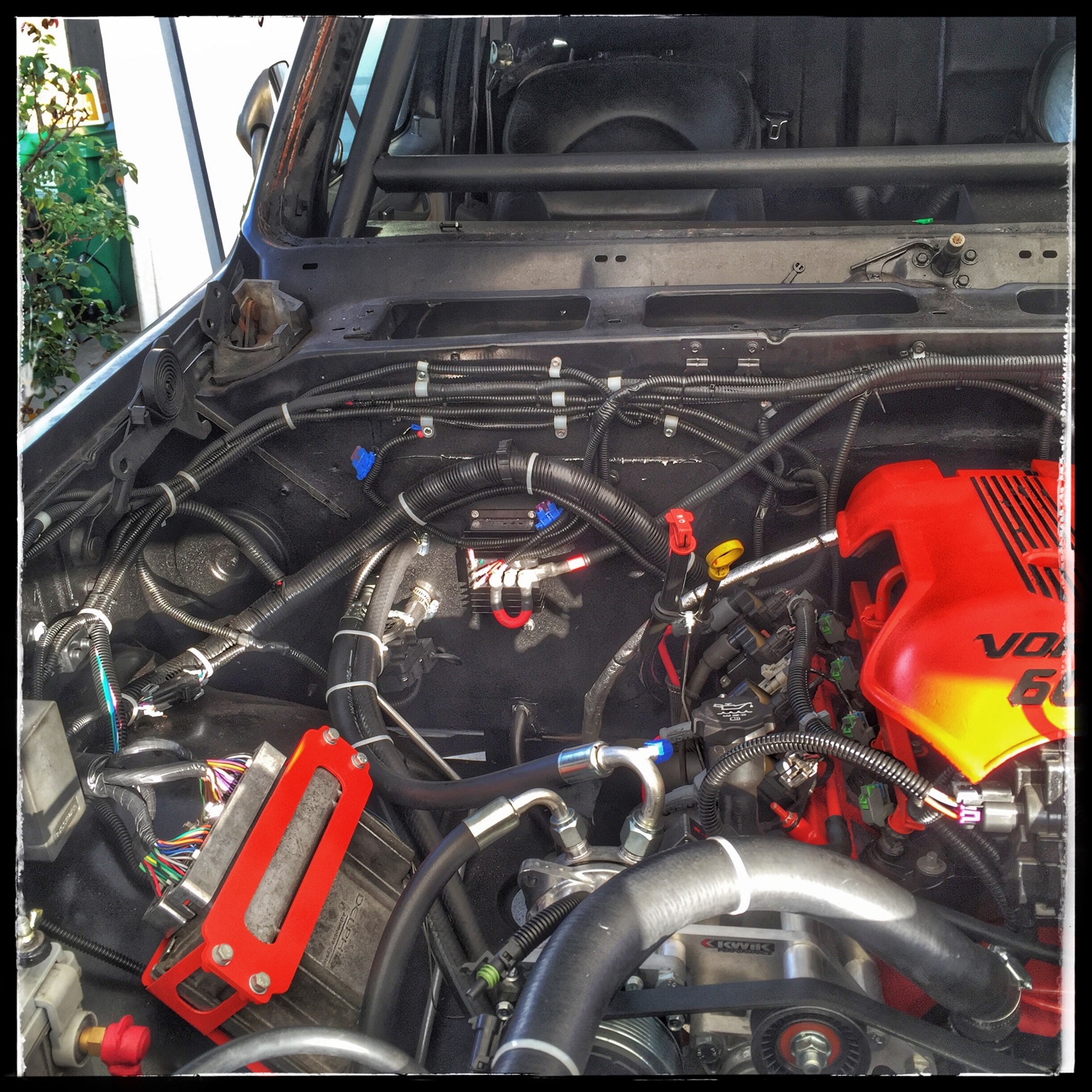
When I dropped in the LS motor I moved the isolator.
Keep in mind, this is not the solution for everyone. It does cost more than an ACR or diode isolator but has many advantages that I liked.
- no voltage drop
- solid state, no moving parts
- small compact
- diagnostic capability
- excellent customer support
In short, I am building my Jimmy to be a go anywhere do anything type vehicle. I want to be able to drive out to Moab from Cali, camp out and drive back with my family of 5 with me. Safely and comfortably.
On the electrical front I wanted total redundancy with my batteries. I always used to stress about killing a battery when I was out boon docking by myself and see no reason to have that stress again. Running dual batteries, that can do the following was all I was looking for:
- be totally independent of each other or
- be connected as one large pool of juice
- enable the secondary to start the truck should the main battery die or discharge
- enable charging and conditioning of the second battery
- do all this easily and smoothly, with limited equipment and ancillaries.
In short, I wanted the security of a backup battery without crazy solenoids, resistors, kill switches, isolators etc etc. I wanted something fool proof as I would be installing and using it.
I found the Hellroaring unit to be ideal. It enables me to do all of the above and operate it through a unit in the cab. I can run the main battery all day long at a campsite etc and then never worry about not being able to start. I can combine the batteries for large amp draws (winch etc). I have one unit to wire into that does all the smart stuff for me.
Best of all, Hellroaring have been awesome to deal with. They have dealt with my incessant phone calls and questions and the instructions that come with the unit are second to none. I am looking forward to getting the system installed and hope this can provide useful to others looking for the same.
This is the unit. Primary and secondary connect to this along with the remote switch. It really couldn't be simpler.
I purchased two AGM batteries for the install. One Interstate and one rebadged Odyssey / Sears.
The most challenging thing so far has been sourcing a tray for the secondary battery location. I ended up cutting a stock junkyard passenger side tray and rewelding the bracket on to fit where it does. I will be finishing up the install hopefully this weekend and hope to have more to post.
I am copying this directly from the hell roaring page as they sum it up quite nicely. The remote offers some diagnostics for the batteries condition. It may not seem intuitive, but I believe there are three or four takeaways from this that you could monitor that give you insight into how your charging and electrical system is really functioning.
This is a significant benefit imo. You will not generally know the condition of your batteries unless you are carefully, repeatedly and consistently testing voltage of both batteries. By measuring the surface charge of the batteries after turning off the engine you can get an idea of the health of your charging system and batteries. If you never peak into a surface charge that is measurable, you could be chronically undercharging the batteries, leaving them sulfated and in less than optimal health.
http://www.hellroaring.com/diagnost.php.
I also finished up my install today. I left the remote in the engine bay as I will be doing a swap here in the next few months and will be redoing much of the wiring at that point.
I did choose to run overkill on the batteries and cabling etc and took the opportunity to make everything as clean and clutter free as I could. To that end I ran rubber boots and shrink wrapped everything that I thought might need it.
The kit comes with pretty much everything you need minus the 2 GA and 4 GA wiring for the battery runs. I went down to West Marine and spent way too much money on wiring. But, my whole survive the apocalypse thing requires marine grade
Nice large inline fuse from the secondary. Run the secondary battery ground to a spot on your frame or engine and the positive runs over to the isolator combiner. This is one key attribute. Only the amperage from the secondary battery will ever run through the isolator. It will not see the amperage from the primary. It only serves to combine or isolate.
I took this opportunity to get covers on as many electric connections as I can. I have repeatedly shorted myself out while working close to the batteries. Seems like a no brainer, but I would like to cover up all battery terminals. Still trying to work out how best to deal with the top mount terminals as they are where I have connected my winch.
The only criticism I read on the Hell Roaring unit was how close the terminals on the unit were. I wasn't particularly worried, but adding some insulation is cheap insurance.
Here is the unit itself. Very small and simple to get up. The green heat shrinked and two smaller reds on the right run to the remote (which is still under the hood). I don't have the ground hooked up. That is the open terminal. I finished the install after this picture and completed the ground.
I need to clean up the primary a little bit. I am thinking of installing a junction box on the firewall to run lights etc off of, but right now everything comes to the primary. Winch, fan relays and everything.
The secondary AGM battery in drivers side location.
I am digging the heat shrink.
When I dropped in the LS motor I moved the isolator.


