CK5
Register an account today to become a member! Once signed in, you'll be able to participate on this site by adding your own topics and posts, as well as connect with other members.

help, clutch lever has too much play. ?!?!?

ashman

What's a pigeonrat??
 Premium
GMOTM Winner
Joined
Mar 1, 2011
Posts
6,339
Reaction score
8,084
Location
salt lake city
I just got my engine all stabbed in and running but the clutch fork has too much play in it. The fork ends up hitting the back of the opening before it can engage the clutch enough.

My first thought was that the fork wasn't on the throwout bearing correctly, or that I had installed the bearing backwards. After repulling the engine :rolleyes: neither was the case. :confused:

I'm at a loss... I installed a new clutch and pressure plate. Is it possible that the new pressure plate is thinner than my old one? :dunno:

If it helps, I have a sbc engine with an advance adapters bellhousing on a NV4500.
 
well, it appears there is a high profile pressure plate and a low profile. evidently I've ended up with the wrong one...
 
If you are using the AA bell housing and a stock clutch fork from 69-72, you might be stuck with their requirement to use a center force pressure plate. I had a hack of a time getting mine to work and I didn't want to use the centerforce so I had a custom pivot ball made to give me the right throw on the fork.

Or if you can switch to the other hi/low version that might work too. :) I didn't know there was a low profile pressure plate.
 
I didn't know there was a low profile pressure plate.
Obviously neither did I. :doah:

Unfortunately I gave the old pressure plate (that worked with this setup) to Oreilly's when I bought this new one. It looked like a standard pressure plate to me. :dunno:

There's got to be a low dollar version that will work, but finding it ought to be oh so fun. :rolleyes:

Oh well, so much for taking the truck to the mountains this weekend. :(
 
Far as I recall,GM used 3 types of pressure plates...3 fingered style, a flat diaphram type and a raised diaphram type...each had its own specific height throwout bearing that had to be used with each one too...the longest bearing for the flat diaphram type,the other 2 types used shorter throwout bearings,I cant remember which one used the shortest one though,probably the raised diaphram type..
 
The pressure plate I have in now is the 3 finger type, just like the last one. both throwout bearings are the same size. So either there are different height 3 finger pressure plates, or I assembled something incorrectly (not a far stretch).
 
There is also 2 different pivot balls for the bell housing , not sure if that would be it?
 
That could well be it too!...


I have never seen the Advanced Adapter bellhousing,but some later GM ones had an adjustible ball pivot for the fork on the aluminum bellhousings,there was an allen or torx head bolt that could be accessed from the tranny side of the bell if I remember right..however there wasn't much range of adjustment,and I never had to fool with one,all the ones I put clutches in worked fine with the adjustment left right where it was from the factory..maybe you need a particular clutch fork with that custom bellhousing...
 
Ah, is that what you are using? I would use the diaphragm clutch over the old 3 finger version. I think AA even said somewhere that the 3 finger plate wasn't compatible. I've never used a 3 finger, but I've never heard anyone say they preferred the 3 finger over over any other one.
 
Here's the post on mine where I ran I to similar problems.

http://coloradok5.com/forums/showthread.php?p=2077622#post2077622
Thanks for posting that. I like your bracket a lot better than theirs, but it'll work for my purposes.

Ah, is that what you are using? I would use the diaphragm clutch over the old 3 finger version. I think AA even said somewhere that the 3 finger plate wasn't compatible. I've never used a 3 finger, but I've never heard anyone say they preferred the 3 finger over over any other one.
When I got the new pressure plate I was trying to simply replace the one I had (that worked) with the same thing so I picked out a 3 finger type again. If the diaphragm plates are better I don't mind switching, just gotta find one with the high profile.

As far as modifying the pivot ball goes, I don't see how that should be necessary. Everything was working just fine before so I should be able to find the right one to replace what I had.

I had a local 4x4 shop do the install originally so if I can't figure it out by Monday I'll just give them a call and see if they know what to use. They are a pretty reputable shop and do TONS of conversions so I'm sure they'll have the answer.

Once I get the answer I'll be sure to post it here for posterity. :D
 
I've got the same AA bell housing. What are you guys using for a rod against the AA clutch lever?
 
I've got the same AA bell housing. What are you guys using for a rod against the AA clutch lever?
Their kit came with a rod to replace the stock one that was on the slave cylinder but all it was was a fine thread rod with one end rounded off to fit into the slave cylinder. It would be easy enough to make with a grinder. The stock wedge piece is then just held in place with a couple of nuts.

I can snag a pic if it helps.
 
Their kit came with a rod to replace the stock one that was on the slave cylinder but all it was was a fine thread rod with one end rounded off to fit into the slave cylinder. It would be easy enough to make with a grinder. The stock wedge piece is then just held in place with a couple of nuts.

I can snag a pic if it helps.

Ya a pic would be great.

I made my own rod and ground a shouldered nut to fit the slot it the arm but its not an ideal solution to me as the slot in the arm is pretty big and the rod can slide in the slot affecting the linkage geometry and play.
 
Ya a pic would be great.
Pushrod1.jpg

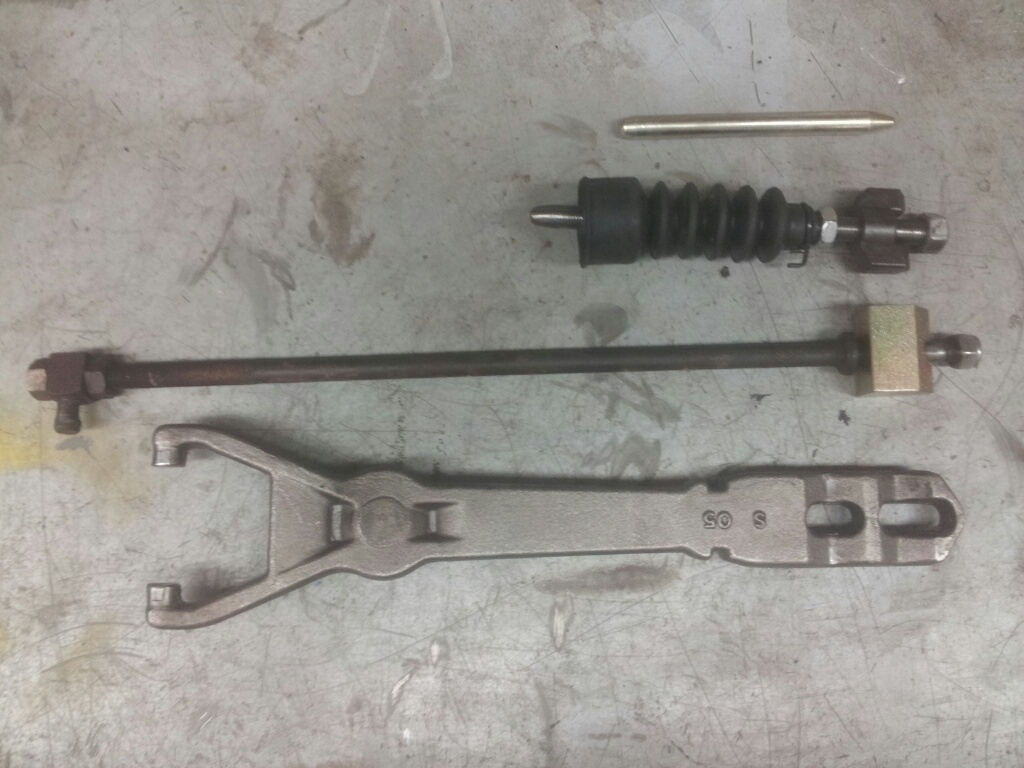
on top is the pushrod that came with the slave cylinder. Below that is the one that came with the AA kit assembled with the rubber from the slave cylinder and stock jam wedge.

I threw the stock mechanical linkage (with the AA wedge on it) and clutch fork in just for some perspective.

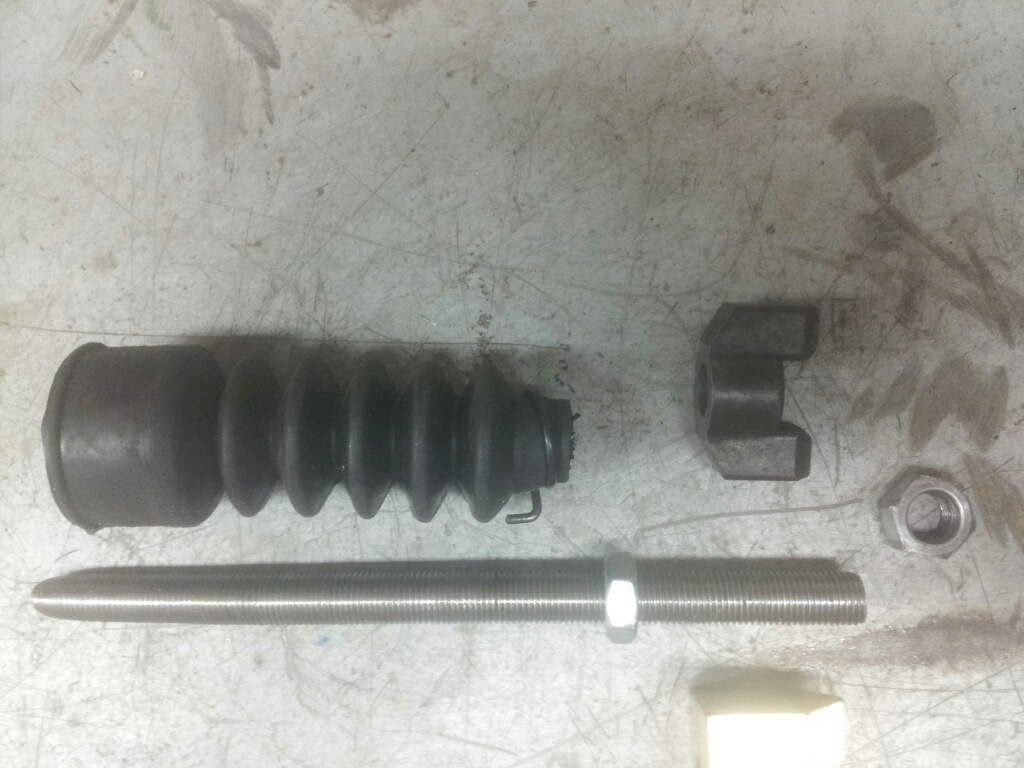
Pushrod3.jpg

disassembled pushrod. As you can see, it's just a 3/8" threaded rod with the slave cylinder end rounded off. It's about 6" long.

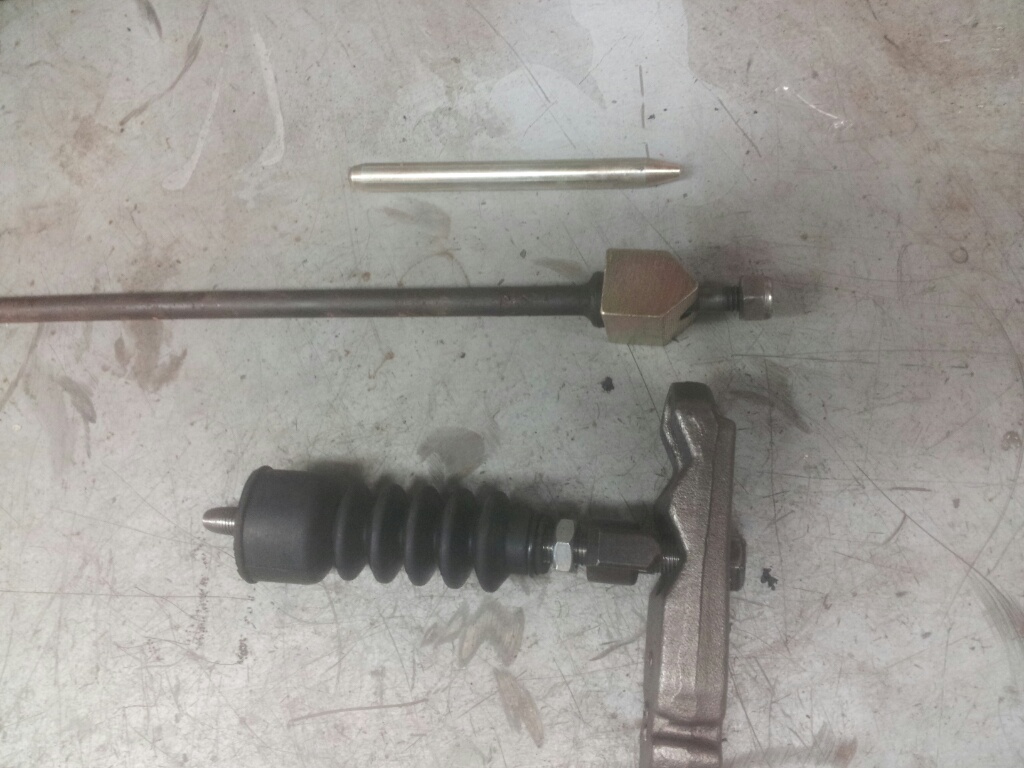
Pushrod2.jpg

assembled on the clutch fork.

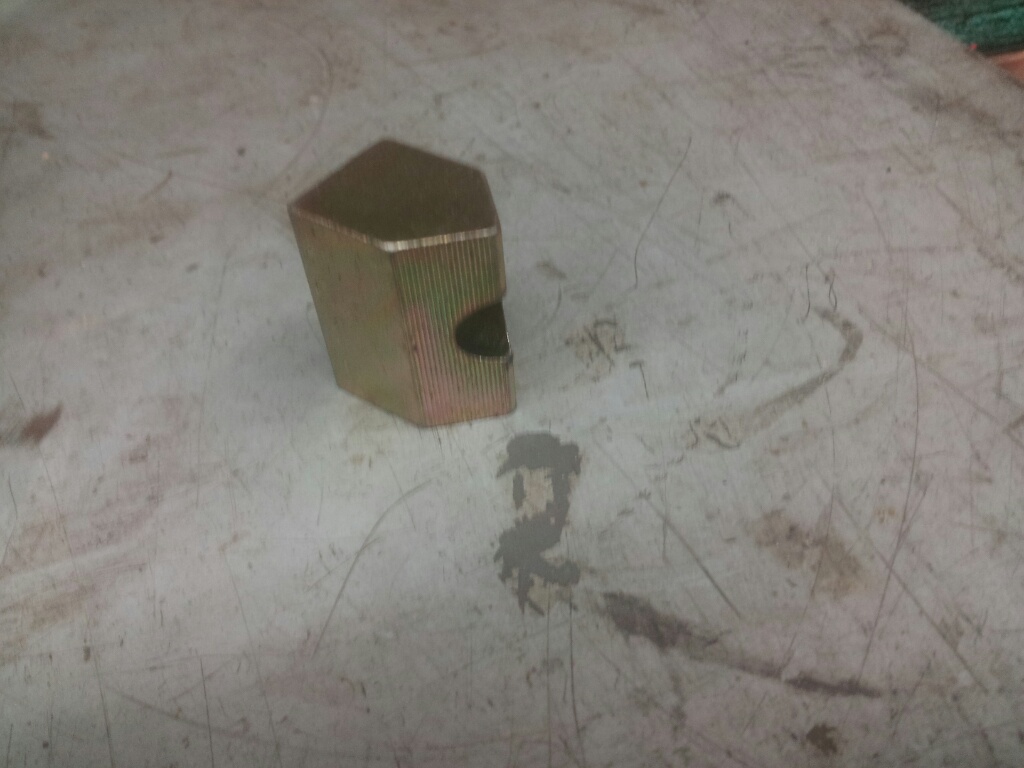
Pushrod4.jpg

the AA wedge. Looks like it would be simple enough to drill a hole through a block then grind it into a wedge but I could always drop this one in an envelope if you really wanted it since I am just planning on using the stock one.

================
back on my problem... I talked to the guy that installed my transmission today and he said that I should be able to use the pressure plate from any 1/2 ton chevy that came with an NV4500 between '89-'92. Unfortunately when I went to O'reilly's and had them look it up it came up with the same clutch (and pressure plate) size from '72-'92 so I'm missing some info somewhere. Gonna do a little more digging tomorrow...
 
If you are using the AA bell housing and a stock clutch fork from 69-72, you might be stuck with their requirement to use a center force pressure plate. I had a hack of a time getting mine to work and I didn't want to use the centerforce so I had a custom pivot ball made to give me the right throw on the fork.

Or if you can switch to the other hi/low version that might work too. :) I didn't know there was a low profile pressure plate.

I went to a local clutch shop and they really knew their sh!t. It turns out there is a low/high version but the low version was only used on chevy stuff before the mid 60's so doesn't really come into play here. When AA says to use a high profile pressure plate it's because the jeep guys do use a low profile plate and that wouldn't work at all for us.

The clutch shop explained to me how a new clutch has MORE play behind it than a worn clutch due to the way it compresses the springs on the pressure plate. That is likely why my old clutch worked ok but the new one has the fork hitting the back of the bellhousing. So basically, I had the right clutch, pressure plate and throwout bearing and they were all installed correctly all along.

Most likely what the real issue is is that my flywheel was turned again and the guy told me that this was the last time it could be, meaning it is significantly thinner than a new one. I don't know how much "significantly" is but it's enough that the small camfer on the edge of my flywheel is gone. That's got to be at least an 1/8" or more. I'm going to see if I can get a measurement off of a new flywheel to see for sure.

The solution at this point seems to be to either move the pivot ball out a bit (washer behind it I guess) or get a new flywheel.

Stay tuned...
/sigh
 
Sounding familiar... :)

Adding the washer might be tough, but try it. There aren't a lot of threads on it.

Although modifying the pivot ball to fit an old flywheel doesn't seem like a great idea. If its the last time it can be turned, you may need to mess with the pivot height the next time you change the clutch.
 
Although modifying the pivot ball to fit an old flywheel doesn't seem like a great idea. If its the last time it can be turned, you may need to mess with the pivot height the next time you change the clutch.
I had the same thought. Another option is to clearance the clutch fork opening a bit. Right now there is about 3/8" before it hits the back of the opening. I need to figure out how much room I need to fully release the clutch and see if that is worth doing.
 
Top Bottom