
CK5
Register an account today to become a member! Once signed in, you'll be able to participate on this site by adding your own topics and posts, as well as connect with other members.

High Centered My Trans X-Member --- again!

Joe In Montana

1/2 ton status
Joined
Sep 9, 2016
Posts
283
Reaction score
109
Location
West Central Montana on the Bitterroot River.
Vehicle - 1986 K5, 383 Stroker, Crane Cam, Edelbrock Lo-Riser and Q-Jet, THM700-R4, snowplow front leaf springs ONLY with factory HD sway bars front (2.75") and rear (2.5"). Like I say - the rear suspension is stock height.

To the problem:

I thought I was helping things by dropping my transmission mount x-member a couple of inches to keep the driveshaft u-joints happier. I built four spacers to drop it 2 inches lower than the frame where it's bolted on.

Well - I high centered it again --- at 10 MPH and twisted it back at a 30 degree angle, putting a lot of stress on the poor rubber part of the transmission mount.

Can you say: "Big Rock"?
.........................I can.
................................now.​

It kinda racked the frame rails a bit too - but I can take care of that with a couple of fish plates -- well enough.

Nothing actually broke - just some serious bending, that's all. Thankfully I had my Ramsey 9K mounted on the front 2" drawbar.

In the field I ran my winch cable over a split log I jammed in front of the winch, then around and under the frame and hooked into the x-member and pulled it straight again. It actually cut the log in half, but it brought the frame back to a decent position which is where it is right now.

There was no room for my snatch block.


Ah, yes - It kinda kinked my exhaust a tiny bit too when it bent the x-member into it. Is a two inch crush a lot of restriction? Hah!

I guess it was a bad idea to drop the x-member that much - (2 inches) - but I still need a little less u-joint angle to keep the joints from whipping around when I start off from a light /stop sign. I can feel them thump at start-up.

And yes - the joints are new - 12K miles new anyway. And well greased.

Maybe I can point the differential up a little by cutting and rewelding the brackets on the housing?

Besides going to a CV d-shaft - what did you guys do to help keep the angles in better relationship?

I do NOT have the rear end jacked up in any way.
 
Vehicle - 1986 K5, 383 Stroker, Crane Cam, Edelbrock Lo-Riser and Q-Jet, THM700-R4, snowplow front leaf springs ONLY with factory HD sway bars front (2.75") and rear (2.5"). Like I say - the rear suspension is stock height.

To the problem:

I thought I was helping things by dropping my transmission mount x-member a couple of inches to keep the driveshaft u-joints happier. I built four spacers to drop it 2 inches lower than the frame where it's bolted on.

Well - I high centered it again --- at 10 MPH and twisted it back at a 30 degree angle, putting a lot of stress on the poor rubber part of the transmission mount.

Can you say: "Big Rock"?
.........................I can.
................................now.​

It kinda racked the frame rails a bit too - but I can take care of that with a couple of fish plates -- well enough.

Nothing actually broke - just some serious bending, that's all. Thankfully I had my Ramsey 9K mounted on the front 2" drawbar.

In the field I ran my winch cable over a split log I jammed in front of the winch, then around and under the frame and hooked into the x-member and pulled it straight again. It actually cut the log in half, but it brought the frame back to a decent position which is where it is right now.

There was no room for my snatch block.


Ah, yes - It kinda kinked my exhaust a tiny bit too when it bent the x-member into it. Is a two inch crush a lot of restriction? Hah!

I guess it was a bad idea to drop the x-member that much - (2 inches) - but I still need a little less u-joint angle to keep the joints from whipping around when I start off from a light /stop sign. I can feel them thump at start-up.

And yes - the joints are new - 12K miles new anyway. And well greased.

Maybe I can point the differential up a little by cutting and rewelding the brackets on the housing?

Besides going to a CV d-shaft - what did you guys do to help keep the angles in better relationship?

I do NOT have the rear end jacked up in any way.

No pictures? Build a stronger crossmember?
 
You have a 2.75" front sway bar?

And there really shouldn't be any reason to lower the t-case with no lift.
 
By droop the case you made the front angles worse. With some 2” square tube it’s pretty easy to make a crossmember.
 
I'm confused...why would you even have any u-joint angle problems with a stock suspension in the first place? If you dropped the x-member 2 inches your prob going negative at the pinions when the suspension compresses and the springs wrap up. esp if the factory springs are worn out and flexy. A taller tire will help with the break over height.
 
The make shim wedges that go between the spring pad and the leaf spring to change the rear pinion angle.
 
upload_2018-4-16_11-35-8.png
I'm confused...why would you even have any u-joint angle problems with a stock suspension in the first place? If you dropped the x-member 2 inches your prob going negative at the pinions when the suspension compresses and the springs wrap up. esp if the factory springs are worn out and flexy. A taller tire will help with the break over height.

Here's the vehicle in question: upload_2018-4-16_11-35-8.png

The rear suspension is sitting bone-stock - the only difference is that I put snowplow springs in the front end. Those are 33x13.50R15s on it here.

Currently I'm running 2001 Chevy/GMC 4WD aluminum 16" rims on it now with 265x75R16s.

How would taller tires cause any break-over difference unless the center of the differential housing moved in reference to the frame? Taller-or-no-tires would not change the position of the housing unless the weight of the vehicle was increased or decreased substantially.

Even with the drop, I still have a distinct angle down to the companion flange on the differential. I only tried to minimize it by lowering the tail of the transfer case.

There isn't any angle problem with the front joints, one is CV and the other is common-open style. The splines are still sufficient for any compression/extension travel - at least in 30K*+ miles there've been no troubles.

* I corrected that mileage in a post further on ...................
 
Last edited:
It sounds like you might be talking about two different things? I'm just here for the free banter lol.

Breakover angle will change with tire size because you are measuring to the lowest point on the rig, centered between the front and rear tires. In our case, the transfer case/x-member is generally the lowest point in the center of the rig. You mention differentials, which are generally the lowest point in regards to clearance, but thats overall ground clearance, not breakover angle. Maybe thinking of clearance vs. breakover? Either way larger diameter tires would help. So does rotating (clocking) the transfer case, but pretty much any amount of clocking requires floor pan modification. :( Trust me, if it were easier, I'd do so myself, it's pretty much a no-brainer.
You said the front is fine in terms of driveshaft angle, which makes sense due to the CV joint, but don't discount travel. The front shaft travels more than I thought it did, might not hurt to make sure it's not compressing more than you think. I'm guessing a plow plus any bumps makes for some decent suspension compression at times. When I initially cut my front driveshaft it was still a bit long for the amount of compression the stock suspension allowed.

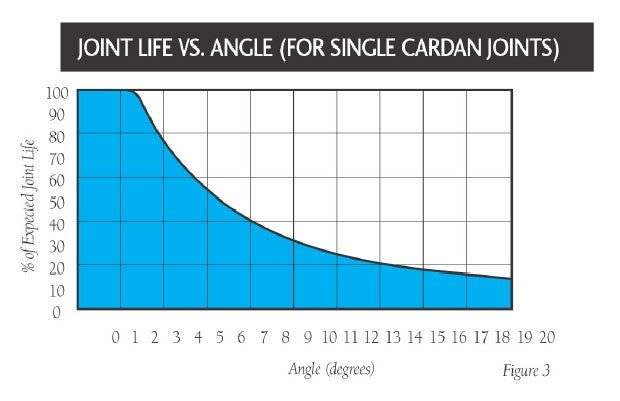
U-joints are not helped by changing the angle on one end or the other. That actually makes it worse even though you are decreasing the angle. They need to be within something like 1-2* of each other at both ends (it's 1*, page 5 on the below linked PDF). You'd have to move the pinion up the same amount you dropped the t-case to achieve that. Spicer(?) used to have a chart that showed how exponential wear accelerates on the joints when the angle is out even a couple of degrees.

Page 8 of the PDF here talks about the angles https://www.waterousco.com/media/wysiwyg/pdfs/content/J3311-1-DSSP.pdf
Page 12 talks about an angle of less than 3* to reduce vibration.

Here is *a* chart talking about angles and life:

joint%20life%20vs%20angle.jpg


Gives a good answer as to why CV's on the rear should be more popular than they seem to be when people lift.

From stock however, if no lift and stock drivetrain length, I'm not sure why you'd need to worry about angles?
 
Last edited:
20180414_185549.jpg

Kinda back where it belongs - this was in the field repair with my winch and a half-log for a guide around and under the winch to the crossmember.

20180414_185625.jpg

One can see the forward/rear driveshaft and u-joint here and it has a down bubble on it.
20180414_185737.jpg

Admittedly - these spacers are small diameter, but I wanted to test this theory before I made a commitment on building an actual frame spacer.
 
<snippity-snip>
Gives a good answer as to why CV's on the rear should be more popular than they seem to be when people lift.

From stock however, if no lift and stock drivetrain length, I'm not sure why you'd need to worry about angles?

I don't run a plow - just installed the springs for a higher entry angle for the 4' snow I used to have to navigate when I lived at 7,000 feet in California.

I had to sometimes push snow with my headlights and needed a little more room to get through our driveway to a dirt road, to another dirt road to an almost-paved secondary road - to a state highway --- just to buy a half gallon of milk.

Here in Montana, I haven't really had to be in 4wd for the 'snow' except to go out and play in it. Wimpy showfall here.

Deflection of the front springs is kinda limited what with the extra rated weight capacity - and I may take them out someday. (Yeah - 'someday")

The only reason I worried about angularity on the rear driveshaft, was the distinct - "flipping-over" I felt at crawling speeds - especially when I towed a heavy trailer.
 
I agree with the others, there is no reason you should need to lower the tcase on a stock suspension. The spacers between the frame and crossmember is another argument completely and I think you've seen at least one of the bad effects.

.....but I still need a little less u-joint angle to keep the joints from whipping around when I start off from a light /stop sign. I can feel them thump at start-up....

I believe you're describing rotational movement of the rear axle which causes the pinion move up & down ("axle wrap"), no amount of lowering the tcase will not stop this. Axle wrap is a byproduct of the leaf spring flex and the climbing action of the ring & pinion gears in the axle. If you want to stop axle wrap, and it's not coming from bad parts (ie; bushings, u-joints, gears), you need to add a traction bar of some sort.

You also keep mentioning the "snow plow leaf springs" you added to the front, in one of the pics it looks like you've installed an "add-a-leaf" in to the stock springs. Adding a positive arch spring in to a negative arch set will eventually cause problems.
 
Yeah - those add-a-leaf springs have been there since - lessee ---> Huntington Beach --- so that's about 1997 or so and over 60K miles ago. I added dual standard duty shocks all four corners and never have had any troubles with the recurve of those front springs.

Any yeah ---> I've heard horror stories about them cracking at the point where they end and the final dimension of the 'king' spring at the hanger....so I added a 3/4 ton king leaf and had it recurved positive by Vehicle Spring Service in Anaheim. They also 'flipped' the lesser springs and pronounced them good at that time too.

With the short K5 wheelbase and taller-than-normal tires, I get some sidewall flex so I use dual-sway controls cranked down TIGHT and maybe I only tow 10K lbs a couple of times a year - mostly now just wood gathering and such for my wood stoves. That's all very local trips and never over 45 MPH.

I shoot the front end thrust alignment once in a while at my son's shop in Missoula, and nothing's varied in all that time. Oh - yeah - I did new balls on the spindles a few years back - but other than that nothing else has moved or sagged to any noticeable amount yet.

I've just never like the u-joint flopping when it goes ballistic trying to catch up with the yoke every 180 degrees.
 
Those spacers are to have a longer bolt for more tension. Not for a spacer.

Can you help me understand that?

I admit that those spacers are not up to GM standards - but at this point - and perhaps for too long now - they've been there and just these two times that I high centered that x-member I know that the footprint of those spacers is somewhat sadly lacking. Point taken and understood.
 
"spacer" goes above the frame
it it only there so a longer bolt can be used, effectively clamping the crossmember better than the shorter belt you would otherwise use without the "spacer". The crossmember should fit against the frame. If you were running a 6" lift or something, you can space the crossmember down with some square tubing, spanning a longer distance than the crossmember itself

I have a 5" lift and the custom crossmember I built actually raises the T-case up into the floor more.
 
I think I see your point.

Those spacers were OE installed on top of the frame and then the heads of the bolts were run up so that the threads were protected by living out of harm's way.

The x-member was under the frame rail, and it was held up by the bolts.

So - the bolts, spacers and nuts are OE as supplied from GM. I just repositioned them to test for the benefit that I might get by dropping the x-member that 1.5" of the height of the spacers --- or so.

No length problems seem likely as these are all the same parts - just re-arraigned.
 
As I understand it, the spacers are for flex. We all know how limber our frames are.

The crossmember must be removable so it cannot be riveted like other crossmembers. A short bolt (no spacer) would be much more rigid and might shear during frame movement whereas the longer bolt in a spacer can flex a little.

This is not to say it should move all over the place, just that the few thousandths of deflection allowed by the spacers is a compromise between rigidity and remove ability.
 
The amount of clamping force a bolt can provide is proportional to the length, due to the elastic properties of the steel.
 
Top Bottom