CK5
Register an account today to become a member! Once signed in, you'll be able to participate on this site by adding your own topics and posts, as well as connect with other members.

Is It Ok To Use Full Synthetic Oil Such After Long Use Of Conversational Oil?

That's part of the issue when I looked into it due to the ~2x cost of synthetic. Other than the 15k mobil, none of them seem to recommend anything more than 6 month interval, nor will they recommend you increase the mile interval.

With a vehicle that sits much of the time, six months and 1500 miles doesnt help.
The castrol I used did specify 1 year 10k mi
 
On an older engine, I would do a flush with Seafoam or something like it, maybe BG 44K. I can't remember what BG has for crankcase flush. Dump some in, run it for the time that it says, then dump the oil.
I doesn't hurt to do this once in a while anyway, but before changing to even a synthetic blend, it can be helpful.
I have seen improvements in trucks at work by running semi-synthetic oil from Schaeffer's. We sampled some of the oil when on conventional and on Schaeffer's. There were improvements in the results. We also had a tired old truck quit smoking in the morning by only switching the oil. It also was running almost 10* cooler on the oil temperature after 2 oil changes using Schaeffer's. Checked it with a FLIR camera since it doesn't have a gauge.
I have since switched the whole fleet to Schaeffer's semi-synthetic 15w40 and have had better samples than the conventional oil. We even had a driver not do ANY write-ups and by the time we caught it in the shop, it had 1049 hrs on the oil. The sample tested good. Our normal service interval ends up serving the oil at about 650 hrs.

I was running Rotella in my big block due to what the machine shop wanted. I changed it to Schaeffer's 5w40 full synthetic diesel oil after 10K miles since it was a fresh engine.
The tiny bit of oil consumption, less then 1/2 of a quart in 3000 miles, went down after going to Schaeffer's. I did see that it takes a little bit longer for the oil temperature to reach peak numbers, and it may be slightly cooler by a few degrees, less than 5*. It doesn't have an oil cooler, just a gauge with the sender in the oil pan.
I have experienced oil stay cleaner longer with better oil, but some may not feel that it's worth it.
So I believe that there are advantages to better oil as I have seen it in other applications as well, gearboxes especially, but everyone has to make their own decisions.
 
Amsoil says 1 year on their stuff. Mileage varies up to 12,000
 
All oils leaves a varnish on parts that act as a cushion. Switching brands can wash this cushion away as additives in each oil type desolves the varnish of another.
That explains new noises after switching.
Additionally, manufactures and researchers realized the catalytic converters burning up due to the zinc additives in conventional oils so they quit putting it in. Consequently, removing the zinc to save the converters resulted in cams and lifter failure.
So now you have to buy zinc additives, ($20.00 a pop), at each oil change or pay a higher price for oil within it.

My advice. Use the conventional oil you've always used, buy the zinc additive or the oil with zinc and move on. New is not always better.
 
Two things I did not see mentioned.
1. Oil picks up other contaminants which is why it turns black. The longer oil change intervals of synthetic means more contamination running around the engine.
2. Synthetic doesn’t break down as easily as conventional. If you overheat there potentially will be less damage with synthetic.
 
fyi almost all oil for years now is semi synthetic mix .

and your older gas engine was not made for 5w based oils . stick to the 10w weight .

i can tell you tho years ago i swapped from 5w-30 to 10w-30 on a tbi 350 engine designed for 5w-30 oil and i noticed a slower crank and inital start up speed . swapped back to the 5w-30 and was back to normal . and the oil cap on that gm long block engine showed 5w-30 oil grade is spec .

also you live way down south . you dont need the 5w for cold starts . us northers guys might notice it in the winter more than you will .
It does get cold here in New orleans, Louisiana actually.

20 degrees with some breeze
 
Still enamored with my mini starter. 20* or 95* ambient, cold or hot engine, that thing doesn't care with 10W30 (zero difference in cranking speed), and saw the same with a 454 in the same temps but 20W50.

I was looking at going thinner on the oil (5W-30) but after all the reading and research, it doesn't seem warranted in my climate for my uses.

Pretty good read on "thin vs thick" oil here. Kind of summarizes what you can find if you spend a lot of time on the topic. You'll see Ford referenced in this as using different viscosities elsewhere in the world, but you can also find where some manufacturers (BMW for one) have reduced the oil change mileage intervals as well if you do some digging elsewhere. Apparently some were a bit too optimistic about oil life.

https://www.machinerylubrication.com/Read/518/motor-oils
 
I used to be anti synthetic.
Then i moved to the top of a mountain in Wyoming...

Rotella 5w 40 synthetic t6 winter.
Rotella 15w40 synthetic t6 summer.
Every 3000 miles.
Delco filter with every change.

You can definitely tell the difference at minus 40 cranking the 6.2 over.
Even better to run the propane block heater over night.

Havent noticed any leaks after switching
From Dino oil.
Zero oil consumption.

Got a 454 Carburated V8 in a 1983 C20 Turbo400.

As of now it has 1040 conventional oil which the next oil change will be switched to 5w40 .

Is it ok to use ful
I used to be anti synthetic.
Then i moved to the top of a mountain in Wyoming...

Rotella 5w 40 synthetic t6 winter.
Rotella 15w40 synthetic t6 summer.
Every 3000 miles.
Delco filter with every change.

You can definitely tell the difference at minus 40 cranking the 6.2 over.
Even better to run the propane block heater over night.

Havent noticed any leaks after switching
From Dino oil.
Zero oil consumption.

l synthetic? Also engine has over 149000 miles
Synthetic will most always be a thinner oil per viscosity, it is a better oil but as an engine builder i would stick with a 15-40 Delo, bearing clearances have increased over time and that engine needs all the help it can get so in this instance i would advise against it
Did you know even the NHRA doesnt allow synthetic oils anymore because it takes forever to clean up, your time to switch oils was 130k ago jmho
 
Still enamored with my mini starter. 20* or 95* ambient, cold or hot engine, that thing doesn't care with 10W30 (zero difference in cranking speed), and saw the same with a 454 in the same temps but 20W50.

I was looking at going thinner on the oil (5W-30) but after all the reading and research, it doesn't seem warranted in my climate for my uses.

Pretty good read on "thin vs thick" oil here. Kind of summarizes what you can find if you spend a lot of time on the topic. You'll see Ford referenced in this as using different viscosities elsewhere in the world, but you can also find where some manufacturers (BMW for one) have reduced the oil change mileage intervals as well if you do some digging elsewhere. Apparently some were a bit too optimistic about oil life.

https://www.machinerylubrication.com/Read/518/motor-oils
Yes, this is a huge rabbit hole you can really fall very far down. I was doing similar Internet searching because the 73 C10 needs an oil change and I have 5qts of 5w20 synthetic on-hand I was thinking about using. I've kinda decided that in the grand scheme of things using it for 1 oil change cycle is likely to result in little to no difference. Normally I would use 5w or 10w30.

Although one thing I saw mentioned several times was how cold starts result in the most engine wear so I'm probably going to stick with the 5w oils as much as I can.
 
Unfortunately yes. And I like rabbit holes.

I tend to think on our older engines, clearances when new were less than they are now on more modern engines. That was one thing I didn't look at, what are the factory bearing clearances on the new engines? Does that align with some of what you read as justification?

As far as I'm concerned, the ability of an oil to remain on parts after shutdown is far more important than viscosity in startup. That's the only time the crank should be touching the bearing, and it seems likely that high quality and/or thicker oils will do much better at that. Oil pressure remains zero after startup for a period of time, worse after an engine sits for awhile. As far as I'm concerned, that's where oil performance is most important...whatever is left on the bearings is doing ALL the work of minimizing bearing wear, being able to move the oil faster (which I feel is of questionable importance in the grand scheme) due to viscosity seems a very minimal benefit.

GM spec'd 5W30 on the later 350's, I think that is as thin as I'd go, and no less than what GM ended up with on the 454 if the bearing clearances weren't changed. And I'd only run 5W-30 in the 350 to be able to run the same oil in my truck and car. Manufacturer recommends 5W-20 as the "primary" oil in my car, but 5W-30 is also "ok" per their recommendations.

I suspect all things being equal, keeping up on oil and filter changes at a proper interval is most important. Ignoring all the modern issues like converter fouling/lack of zinc, etc.
 
One interesting point I read a few people make was that 30 weight oil being used when the 350 in the 73 was built would shear to 20 weight pretty early in it's life. Apparently that's one of the improvements in oil formulation.

I have read a couple of different theories on the new engines using 5w20 vs 5w30. One is the tighter bearing tolerances you have mentioned and the other is for better fuel economy. It is the latter reason that is why some manufacturers have started shortening the length of time between oil changes. Basically they are running the lighter fluid to meet CAFE standards, but it needs to be changed more often.

Another point I read was that we all have it stuck in our heads that higher oil pressure is better. But in reality flow is more important and flow is the inverse of pressure - all other variables being equal. That being in general higher pressure is due to a resistance to flow - going back to the tighter bearing clearances.

The stuff I was reading talked a lot about synthetics being able to handle higher temperatures for a longer period of time. They pointed out that older motors would typically run in the 180F range but newer motors run 210F all the time all year around - which I've noticed is true in our company's 2008 2500HD with 6.0L. This was more in regards to the idea of going to heavier weight oil in the winter versus summer.

I'm rambling with different things here, but this is my last. Another article I read was focused on oil weight vs horse power. They did find that lighter oil equalled more HP but you'd also need to change it more often and in the motor they were testing it was only an 8HP gain. One minor point they made I found interesting, the oil temperatures stayed lower with the heavier weight oils like 40 and 50 weight. I found that to be validation for running 10w40 in the 454 in the crew cab that is towing our camper.
 
Cold starts and getting oil to the top end asap are why i use 5w 40 synthetic in winter.
But it is minus 40 to 0 degrees at 9,000 ft where the truck sleeps.
If it were only occasionally zero but mostly 20 degrees and warmer, i'd just run 15w 40 all the time.
It's a 6.2 diesel j code with no cat, egr, def, dpf.
In fact, the m1009's have a National Security exemption from smog equip right on the core support.

Roller lifters, so lack of zinc isn't a huge concern.
I see no need to add zinc but i do see the need to get oil flowing as quick as possible.
Try pouring 15w 40 at minus 40 degrees.
You can't.
It is similar to room temp honey.
But the 5w 40, while still thick at that temp, does pour.


Now the 5.3 in the Tahoe has 5w 30 in it this winter sleeping right next to the m1009.

Why synthetic?
Because they maintain their multi viscosity abilities longer than dino.
I have not tested that.
I just drink the coolaid.
 
I tend to think old engines with lots of miles and have bearing clearances "loose" need some thicker bodied oil to keep the bearings from metal to metal contact,the thicker grades of oil increase pressure,which will force the crank away from the bearings better than a thin oil with less viscosity..without sufficient pressure,oil cant get pumped up to the valve train as well..

Thicker oil will not drain off as fast on parts too,so less cold start damage will happen,at least in warmer climates..for this reason I liked adding some "Motor-Medic" or STP,or some similar oil thickener ,in summer months..
Marvel Mystery Oil helps thin out high viscosity oils at low temps,but doesn't affect its viscosity after its warmed up--it also has higher film strength than many thick oils too,which adds cold start protection..

In arctic conditions ,I'd run a 5W-30 oil ,but many older engines probably wont like it much after being run on thicker oils for over 100,000 miles,and it could encourage a bearing to spin or not have enough viscosity to protect things at high temperatures..
Thinner oils are fine for newer engines with tighter tolerances,and may even be required,a thick oil in them can do more harm than good...
 
I tend to think old engines with lots of miles and have bearing clearances "loose" need some thicker bodied oil to keep the bearings from metal to metal contact,the thicker grades of oil increase pressure,which will force the crank away from the bearings better than a thin oil with less viscosity..

But this is where the previous point was made....higher pressure does not necessarily mean better lubrication. IF the system was closed, then higher pressure means "better" lubrication. But the pressure tap for the gauge is typically not at the "end" of the fluid path, and the pumps bypass. I don't think thicker oil is questioned as being more effective at lubrication, the question is, does the thicker oil actually do a good job lubricating at the furthest point from the pump, or is that gauge reading simply telling you that your thicker oil is harder to pump and instead of pushing the oil to the furthest points, it's bypassing more because flow is not efficient?

Realistically, and this is something I'd like to see/do, the answer would be to test what the oil pressure is at the opposite end of the engine, both hot and cold, with various viscosities.

Additionally, on the 6.2's, they don't run oil jet piston cooling do they? If they rely on splash oiling, then is it possible that lower oil temps are because the thicker oil doesn't splash cool as well?
 
I think the oil pressure sending unit on most Chevy engines are located at the far end of the oiling system...or darn close to it..
I do notice thick oil tends to take longer to make the gauge rise after a cold start,and the length of time it takes,is equal to the amount of oil starvation the parts furthest away suffer from..

I don't know for sure about a 6.2's oiling system as far as the pistons and wrist pins,I think only 6.5's had that..the high compression ratio of a diesel must put extreme loads on the rod and main bearings I'd think,and a light oil may squeeze out and allow some metal to metal wear to happen..

I've run a lot of worn out high mileage engines in the past--some smoked so bad I used 3 quarts of 20W-50 and topped it off with 2 quarts of oil thickeners like Motor Medic or Lucas,none of them blew up,but they did often make that ominous woodpecker bearing rap right after a cold start until some pressure hit the bearings..and I didn't beat them mercilessly either,especially when cold..

I cant say I ruined any engines by using too thick of an oil,but I had a few start sounding like they would come apart after I put 5W-30 in them,the lifters clattered and you'd hear the bearings knock after starting it ,cold or hot,for several seconds..I put thicker oil back in..

I changed the oil in my 6.2 once with SAE 30 oil,after using 15W-40 diesel oil,it ran noticeably quieter with SAE 30...which is what is listed as "preferred" on the sun visor's viscosity chart,over 32 F..

I didn't run it that long with SAE 30 because it was starting to get cold,and the Wolf's Head oil I used,despite saying it was "good for all gasoline and turbo,and diesel engines",it didn't have a diesel "C" rating ,I decided to dump it early at 2500 miles rather than wound the thing worse than I already had by using drain oil in it for awhile ,whe it was leaking a lot of oil..
 
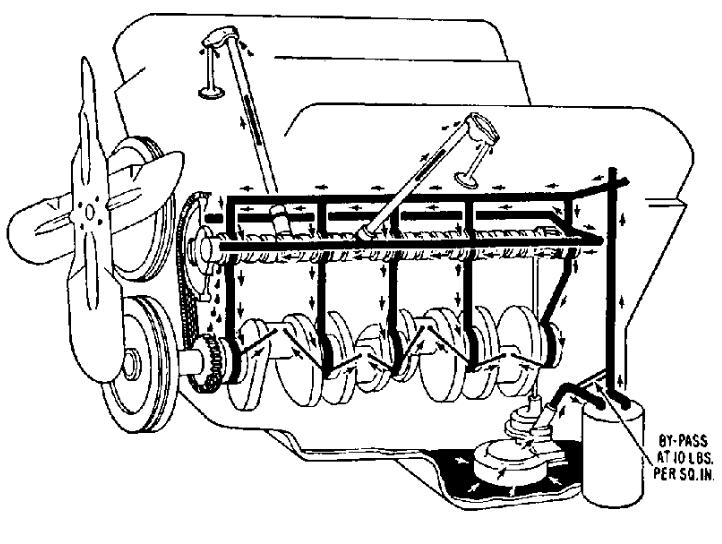
oilpasse3.jpg


Many small blocks (theory: only 4 bolt mains) have the oil gallery plug behind the water pump/alternator on the passenger side. That would be the place to measure. I don't think I can use that location on mine, too much in the way.

FWIW I only found one post mentioning it, but stated they had seen 7-15PSI less off the front of the block. Would be a good way to monitor bearing wear.
 
Last edited:
Many small blocks (theory: only 4 bolt mains) have the oil gallery plug behind the water pump/alternator on the passenger side. That would be the place to measure. I don't think I can use that location on mine, too much in the way.

FWIW I only found one post mentioning it, but stated they had seen 7-15PSI less off the front of the block. Would be a good way to monitor bearing wear.
That is where my oil sender is on the 454 which is a 4 bolt main block. I suspected this might be a good spot for the reasons you mention.
 
Top Bottom