CK5
Register an account today to become a member! Once signed in, you'll be able to participate on this site by adding your own topics and posts, as well as connect with other members.

Is this a problem?

76k5blazerr

Git-er-dun
 Premium
Joined
Nov 13, 2013
Posts
1,587
Reaction score
744
Location
North Carolina
So today I pulled my front tires off the 72 c10 to see how much life the front brake pads have left in them. Pads look new. Then when putting the tires back on I tried to spin the tires by hand (truck still in the air) and the tires are really hard to spin by hand. Feels like the brake calipers are too tight or something? Is this normal? Or is it even the brake pads holding it back? Do I have a problem?
 
Could be bad brakes hoses.

Drive it, and see how hot the calipers get.

Martin
 
My 84 c-10 did the same thing. Before I bought the truck , it sat for like 8 years. Turned out the piston was froze in the caliper from corrosion/ sitting too long. Bought some NAPA calipers, problem solved.
 
My 84 c-10 did the same thing. Before I bought the truck , it sat for like 8 years. Turned out the piston was froze in the caliper from corrosion/ sitting too long. Bought some NAPA calipers, problem solved.
Well that's a possibility but I'm not sure because the brakes on this truck work great.
 
Should drag a little, not much.
Brake hoses swelling closed allow pressure to push fluid thru but can hold pressure on the calipers by not letting fluid return. Sticking calipers also, but seems odd both sides are the same.
 
I've had more brake hoses swell shut than stuck calipers--and more than once I put on new calipers first,and found out the hoses were causing the brakes not to release..sometimes they will let fluid pass to the calipers,but not bleed back into the master after you let off the pedal,like a check valve..

Have you taken off the calipers and cleaned up the pins and slides and lubed them ?...you can test for seizing caliper pistons by prying on them with a large screwdriver or small pry bar and see how much effort it takes to push the piston in when you pry on them..the inspection hole in the casting of the caliper is where you'd insert the pry bar,against the inside of the rotors cooling slots...they should go back in fairly easy...

It also could be the wheel bearings --too tight,or they are starting to seize up from water intrusion,or lack of fresh grease..seeing your pads haven't burnt off it rapidly,it could well be something else rather than the calipers or hoses...all disc brakes have "some" drag to them,they have too,or else you'd have to pump the brakes a few times to get a good pedal,if the pads aren't right up against the rotors like they should be..
 
I'm sure in some deep dark recess of GM's specifications library there is a spec for the maximum amount of torque it should take to turn a hub against dry clean brakes, but I have never seen it.
Its mostly a matter of feel from having felt lots of them.

I have seen times of various vehicles where I was suspicious of the amount of torque it took. From what I have found, the best check is, if your emergency brakes work well, take it out and drive it a few miles where there is no traffic.
Let the brakes cool off first, then drive it using only the emergency brake to stop.
After a few miles in the 40mph range, the rotors should be cool to faintly warm, and the hubs should barely be warm if any at all.

Touch everything carefully! If a brake is hanging, that rotor could be very hot.

As for both sides the same, I would suspect the center hose, the master cylinder, or the master cylinder linkage. Is the brake pedal coming all the way back?
And have you changed the master cylinder lately?

The wrong MC might be a cause.
 
Just dealt with something along these lines. Back in the day purchased some of the "cheap" lifetime warranty brake pads. Due to improper bleeding, I wore one side down to almost nothing since it was doing all the work.

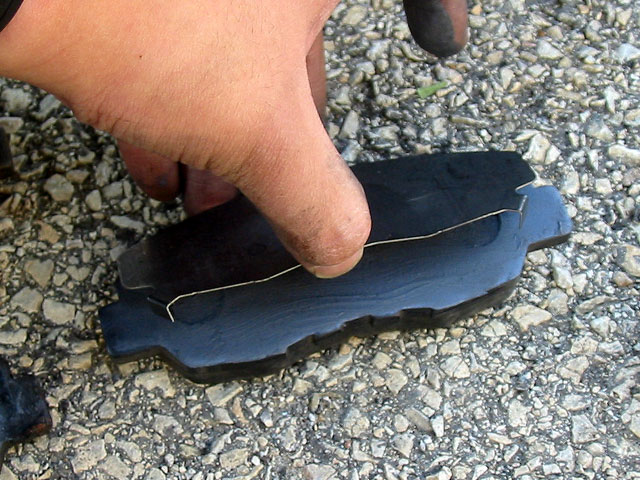
Got new pads, installed them, bled properly, tested, all seemed good. Can't remember what drove me to remove the calipers again, but I had to. Pulled the calipers and noticed the anti squeak (?) pads had come apart. They look something like this:
anti_squeal_outer_1.jpg


But two of those pieces (steel) per pad. They aren't bonded, they are just a "press" fit, and are not spring steel. So they fall off once you take the caliper off the rotor.

ANYWAY, I noticed after putting the pads back together and forcing them onto the rotor (caliper piston was fully compressed) that there was noticeable drag when attempting to rotate the tires. Noticeable as in you couldn't spin the tire. You could rotate it, but it took quite a bit of effort. Took everything back apart, took one of those pads off each side, reassembled, and while there is still drag, it is slight and the wheel can gently move.

My highway mileage went down 3MPG (one reason I check each time I fill up), that seems to have coincided with the brake pad change, so I'm hoping that the amount of drag was significant. I'm going to watch mileage next time I drive it.
 

Latest Posts

Top Bottom