CK5
Register an account today to become a member! Once signed in, you'll be able to participate on this site by adding your own topics and posts, as well as connect with other members.

Let's talk aftermarket fuel lines

stan1688

Weld-it-yourself bumpers
 Premium
GMOTM Winner
Joined
Sep 13, 2006
Posts
1,061
Reaction score
709
Location
Independence, KS
I'm getting ready to do a cab swap on my crew cab, and in the process I was going to move the tank. I'd like to re-do the fuel lines while I'm at it. I'm running a stock TBI 454.

The way I see it, I have 3 options (aside from stock-type fuel lines):

1: Braided lines with AN fittings
Pros: Durable, look cool
Cons: Most expensive option, can be hard to cut (from what I've read)

2. Nylon lines with push-on quick-connect fittings
Pros: somewhat cheap, quick-connect fittings are cool, easy to fix if damaged
Cons: can get melted? aren't rated as high for pressure (wouldn't be a problem for me)

3. Fuel safe rubber hose with push-on fittings
Pros: cheap, simple, easy to fix if damaged
Cons: easily damaged? handle the pressure?


Anything anyone else would add or take away?

What are you running?


Also, what fitting sizes and line sizes are on the fuel system as a whole (for future reference for me or anyone else)?


This is what I've found so far. Correct me if I'm wrong.

Supply line: 3/8"
Supply line fitting at throttle body: 3/8"
Supply line fitting at fuel filter: 3/8"
Supply line fitting at tank: push-on rubber hose with clamp
Return line: 5/16"
Return line fitting at throttle body: 5/16"
Return line fitting at tank: push-on rubber hose with clamp

I don't have much experience with the fuel system on our trucks so any info is appreciated.
 
Last edited:
nylon is used by gm for years as oem line at 60-65 psi in some aplications .

an fine but like said pita to work with and $$$$$

if me I would go nylon with a good kit that has the crimp/install tool and assortment of ends in it . most kits come with 3/8 and 5/16 line .

also hard line there is plain and armor shield green coated line that lasts a little longer .

and if doing hard lines and lots of fittings look into the mastercool flairing kit.
 
How is nylon to secure so it doesn't rub? It's pretty rigid stuff so will clamp ok, correct? Do you need/do they make a nylon line compatiblen adapter for the TBI end?

I'd have to agree, for cost it's probably the easiest route.

Fittings are all the same size (3/8 and 5/16) however in your case, the fittings at the tank should all be rubber/clamp style (like carb) not the saginaw fittings like at the TBI.
 
I have used push lock fuel hose a couple times now. Used Russell brand on the Sonoma with a tbi 454 and used areoquip aqp on the ibex with a lq4.
 
I think your best bet is a factory style mix of steel lines and rubber hose. It's cheap, durable, easy to repair, it can handle your 14PSI needs, easy to install, and where ever you are; you're prolly close to some place that has the stuff to make an emergency repair. I think a factory type set up is everything you're looking for.
 
I think your best bet is a factory style mix of steel lines and rubber hose. It's cheap, durable, easy to repair, it can handle your 14PSI needs, easy to install, and where ever you are; you're prolly close to some place that has the stuff to make an emergency repair. I think a factory type set up is everything you're looking for.

I agree. There's no reason for anything fancy with TBI unless you're going for looks.
 
I don't have a set of pickup lines laying around to look at, I suppose one could use a barb coupler to extend the rubber at the tank end?

Of course, the exposed rubber on these lines isn't ethanol resistant, however it is attached to the hard portion. I'm really hoping some of us don't find out the hard way that the braided sections will eventually split from the ethanol too...
 
Keeping steel in the mix where possible definitely makes sense. I put AN fittings at the tank with Summit twist-lok or whatever it's called. I do have a few places with plain old hose clamps onto the factory steel sections, but no trouble so far at TBI pressure. My biggest worry is the new rubber sections dealing with fuel blends, and any chafing where I deviated from factory and don't have as good of clamps (50 cable ties... :doah:). Some guy recommended this stuff and it looks pretty good. I'm considering it for the tank to steel and steel to TBI runs.

http://www.siliconeintakes.com/prod...=1200&osCsid=ea8422ecf48dec3e3a6b51a38ec3c97f
 
Thanks for all the info, everyone. Keep it coming. I'm liking the idea of keeping the steel lines where I can to help keep cost down. Although, I'm hoping I can avoid having to buy a flare tool, which is why I had never considered keeping the steel lines before.

Mastiff, what did you use to convert the fittings at the tank since they're just push-on rubber from the factory? I just discovered Summit's twist-tite stuff yesterday, but just noticed it said not reccomended for fuel lines. The stuff in the link you posted looks pretty good, though, and not overly expensive.
 
I bought a sending unit from a 1990 or 1991 IIRC and it had saginaw male fittings (16mmx1.5 and 14mmx1.5), so I converted that to AN-6 with an adapter. I then got AN-6 push-lok fittings. You could do the AN-6 conversion and then use something other than push-lok, AN-6 is pretty universal.

If you search on that summit fuel line, you'll see a lot of confused an pissed off people since they added that fuel warning at some point along the way. It's been working for me... I assume they added it as a CYA since they don't know how it will react to all the different fuel blends. I've had parts store fuel line rot away in one year on my Scout, which sits a lot. This stuff has held up for that.

Having said all that, I'd do it differently if I were doing it again. That's why I was looking at that PTFE stuff. It seems pretty durable both chemically and physically. I added braided sleeving to the summit hose at the potential chafe points.

2012-02-12_20-39-12_921.jpg
 
When I converted to TPI I ran stainless braided from the tank to the fuel rail, then back to the tank for the return line. I also left enough line so I can drop the tank without disconnecting the fuel lines. I'm running an intank pump and got some conversion fittings for the sending units to go from the o-ring fittings to the AN fittings.

It may have been more expensive , but I went that route because of ease of installation. Also, the TPI system runs around 50 psi, so it's a bit higher than TBI.
 
Thanks for all the info, everyone. Keep it coming. I'm liking the idea of keeping the steel lines where I can to help keep cost down. Although, I'm hoping I can avoid having to buy a flare tool, which is why I had never considered keeping the steel lines before.

Mastiff, what did you use to convert the fittings at the tank since they're just push-on rubber from the factory? I just discovered Summit's twist-tite stuff yesterday, but just noticed it said not reccomended for fuel lines. The stuff in the link you posted looks pretty good, though, and not overly expensive.

You don't need a flaring tool to run factory type lines. even if you did buy a flaring tool' still cheaper than any other option.
 
do you have any pictures of your setup and lines?

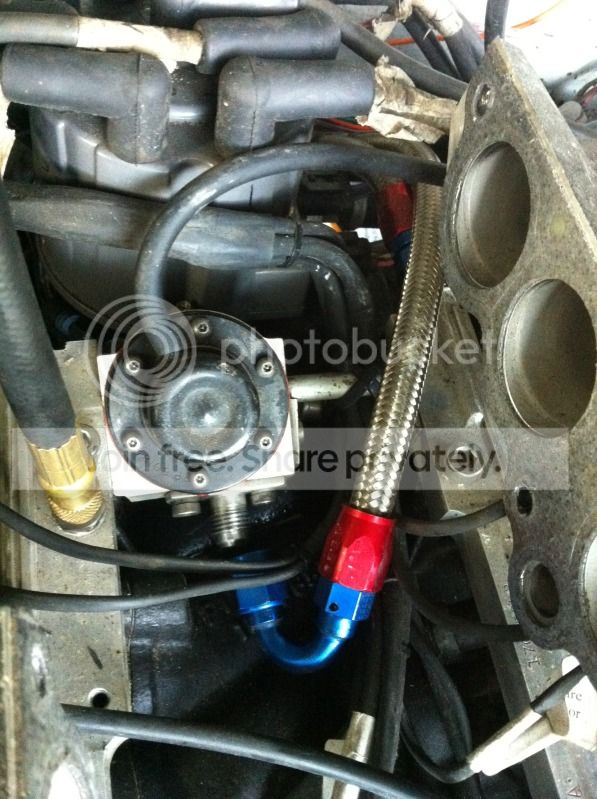
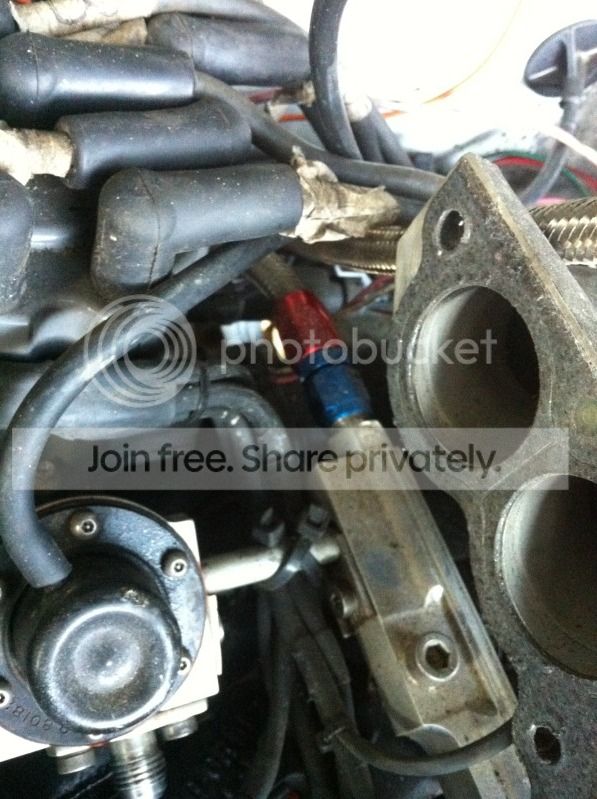
Me? I only have picture of my fuel rail. TPI fuel rails normally have the fuel lines come in through the front. I modified the fuel rails so the fuel lines come in through the back, for a cleaner look. I just ran the fuel line on the inside of the frame rails, and they're held in place with some of those grommet deals that are bolted to the frame.

The fuel rail.

1350167936.jpg


1350166824.jpg


Here's the intake itself.

image.jpg
 
yea i was interested in seeing how you've got them run through the frame. i'm doing the same thing, stainless front to rear, but my truck is still missing a lot of operational pieces (exhaust, wires, shifters)
 
yea i was interested in seeing how you've got them run through the frame. i'm doing the same thing, stainless front to rear, but my truck is still missing a lot of operational pieces (exhaust, wires, shifters)

I don't have any pictures of it, I didn't do anything special. Just ran them on the inside of the passanger side of the frame rail and ran the lines up the back of the trans bell housing. I used clips like these to hold them in place along the frame rail.

image.jpg
 
You don't need a flaring tool to run factory type lines. even if you did buy a flaring tool' still cheaper than any other option.

how are you adding the o-ring flair to the line and if need be for rubber hose section a bulge in the hard line to keep the hose from sliding off ?
 
Top Bottom