CK5
Register an account today to become a member! Once signed in, you'll be able to participate on this site by adding your own topics and posts, as well as connect with other members.

Loss of steering assist on braking

Blue85

Yooper
 Premium
GMOTM Winner
Joined
Jul 26, 2000
Posts
16,785
Reaction score
9,827
Location
Keweenaw
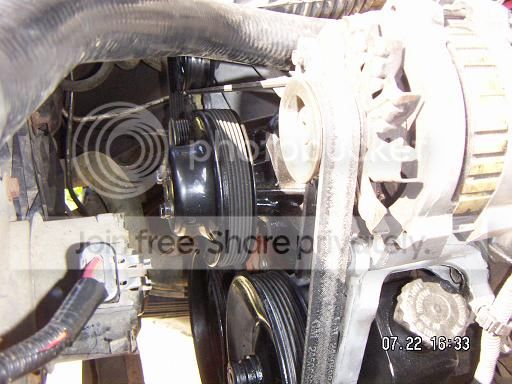
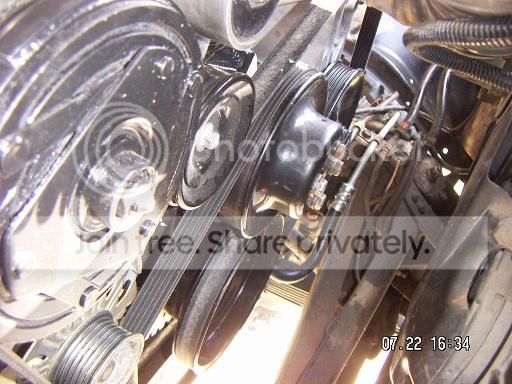
Following conversion from V-belts to serpentine, I have this problem with the power steering. Sometimes when I brake, the assist goes away. Revving the engine seems to cure it. No, I don't have hydroboost. This is the same steering pump and steering gear I used before, only the lines are new. The pump just got swapped into a TPI reservoir. (I did also try another rebuilt pump and it was the same). At standstill it seems a little weaker than before - I can't spin the wheel quite as fast without runningn out of assist. The pulley sizes are virtually the same (crank and PS) between the V-belt and serpentine. Here are my suspects:

-Air in the system - may work itself out over time. Maybe the deceleration moves the air around?
-$9 Autozone pressure hose may have a smaller ID than the original, reducing flow at idle.
-Belt is slipping, I just can't hear it. The belt wrap is not so great, but a worn-out loose belt and a brand new one both work the same.
-Decel actually pulls on the pressure valve?

I have the belt routed like this - except what's marked as "8" is a second alternator, not a smog pump. PS pump is "5":
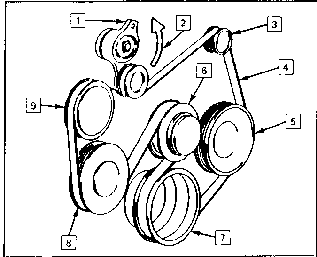
1989belt.gif


The old TPI belt routing was as follows:
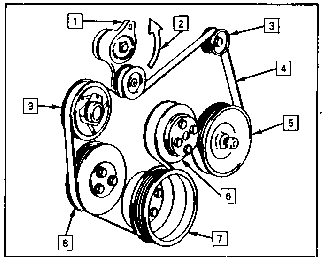
1988belt.gif


As you can see, it favors the steering, but it won't work for an alternator instead of the smog pump.
 
Last edited:
Exactly why braking would cause it, I don't see. But the wrap does look a little weak. Especially compared to the factory setup.
Those belts don't seem to squeal as much when they slip as V belts, so it may be slipping without your hearing anything.

If it is the wrap, you should be able to overload it just by turning the wheel suddenly and putting a sudden load on the pump.
If you can get it to do it sitting still, you can watch the pump. It will actually stop for a second when it slips.

Other than that, unless a hose is getting pinched, or the engine is moving forward and something is binding the PS pulley, I don't have a clue.
 
How much driving have you done since the conversion?

I rebuilt my PS pump (waste of time) and didn't bleed it "by the book", which ended up taking awhile to purge the air out of the system. With rapid wheel movement, or first thing on cold startup, all assist would be gone.

I'd agree on the belt slipping/diagnosis from Fordum. You've got less resistance to steering while moving than while sitting still, rapidly cranking the wheel at idle should stress the pump pretty good.

Did pulley diameter change? I've been playing around with reducing the pump pressure and haven't really noticed any appreciable change in steering effort. Stock I never ran out of pressure, no matter what I did. But if your setup was marginal before the belt swap, and the pulley diameter increased, maybe pressure dropped too much? If you were running out of assist before, I think you had a problem in the first place. If anything, these trucks had way too much assist, the cars (especially those with TPI, which were all sporty) probably had less boost to assist in feeling the road.

GM was serious about pressure on the pumps, I've got a shim that's .01" thick, and on this pump I'm running a pack of three shims that total .06" (thicker=less pressure), which was an increase of .01 from the previous iteration, and about double what the stock '87 truck pump had for shims. I have yet to run out of assist.
 
Both of the pictures are TPI wraps. I think the bottom one is 1988 and the top one is 89-90. No, I haven't done the other wrap, as it requires a different belt length. I have the alternator in #8 position setup to charge the main battery directly and when I first started running this setup, it would squeal when the Windstar fans kicked in. I cured that by getting more help from the second alternator (#3 position). I don't think I can make the 2nd alt work with the 2nd belt routing. If this is really an issue of belt slip, I was thinking to add an idler just left of the #4.

When I went with this routing, PS belt slip was my #1 concern, so I'm not sure why I don't believe it now. It just seems like I could feel or hear belt slip. When I rev the engine the assist comes back smoothly, no signs of anything grabbing or surging. Turning the wheel doesn't affect the idle.

As I stated above, the pulley sizes are very close to the V-pulleys. I have driven about 100 miles so far and had quite a bit of idle time as well charging the A/C and tweaking stuff.

Here's what I'll try:
-Watch the pulley while someone else steers (I've done this while turning the steering shaft underhood and no signs of slip)
-Flush the system out - some of the fluid in there is the old stuff just run through a coffee filter - and bleed it better before starting
-Bump up the idle speed - it's down near 500 sometimes warm and in gear.
-Pull the new pressure hose and compare the tubing i.d. to the factory hose (I had to cut the ends off that hose to get the fittings out with a socket).
-If no other progress, drill the pump fitting out a bit.
 
I like the idea of an idler to the left of #4 pully to give the belt some more surface area on it. But the only odd thing is that i have seen serp belts that were slipping, and they were decently loud. :dunno:
 
When I went with this routing, PS belt slip was my #1 concern, so I'm not sure why I don't believe it now. It just seems like I could feel or hear belt slip. When I rev the engine the assist comes back smoothly, no signs of anything grabbing or surging. Turning the wheel doesn't affect the idle.

I think along the same lines...if it was slipping, you'd likely hear something. Even with the ribbed belts if my alternator is not tight enough, it squeals when a heavy electrical load is applied.

As I stated above, the pulley sizes are very close to the V-pulleys. I have driven about 100 miles so far and had quite a bit of idle time as well charging the A/C and tweaking stuff..

Missed that. I think 100 miles is plenty to have it purge itself. Having just swapped in a new pump and bleeding it "correctly", I didn't have any of the same problems as I did without bleeding it.

-If no other progress, drill the pump fitting out a bit.

It's not that complex if there are stock spacers in the valve, and as far as I've seen so far, they all have them. Take the pressure side line off the pump, remove the fitting, take out the valve, and remove as many of the shims as you want. The least pressure you can run the better (for cooling purposes) but too much is better than too little. I used a giant piece of shrink tubing to cushion the valve, clamped in vise grips, and undid the nut holding the shims/spring/check ball in place. This is why I added a PS filter in-line, so I can drain it without making a mess, and re-use the fluid. :)

Test for too little pressure is to drive the vehicle on a wide open area like a large parking lot, and start turning the vehicle as abruptly as you can. If you lose assist, you don't have enough pressure. Of course, this assumes that everything else is in working order, which you are checking.
 
Test for too little pressure is to drive the vehicle on a wide open area like a large parking lot, and start turning the vehicle as abruptly as you can. If you lose assist, you don't have enough pressure. Of course, this assumes that everything else is in working order, which you are checking.
This is too little pressure or too little flow? The way I understand the valve, it bleeds pressure through the bypass hole when it gets too high. Removing shims increases the pressure at which you use the bypass. So if assist is good at higher rpm, then the pressure limit is OK. The problem seems to be flow at lower rpm, where the valve should be inactive. Not true?
 
I'd be more than willing to compare the valve I took out of mine that was working correctly to what you have, if you don't mind dumping your system. But I assume if you've ruled out the other problems, this is all you will be left with.

It can very well be a flow issue as well (or instead of), and I know full well that if it's a parts store replacement, you more than likely did not get what GM installed. GM had a large variation in both flow and pressure based on application (up to almost 50% flow difference) although I can't find any flow/pressure numbers on the car stuff. The S10 stuff was less than the full size, I would bet cars followed the same trend.

BUT my first pump came out of a Monte Carlo as I recall, so I would have expected similar issues were it just flow.
 
This is the same pump, same valve, same fitting I was running on the V-belts. Just different brackets, reservoir, pulleys, hoses and belt.

I did also adjust the sector shaft about a 1/2-turn. That's easy enough to back off to check.
 
For some reason I was under the impression that before the V-belt to serpentine conversion, you DID run out of assist, but it was much less frequent, and under different conditions, is that correct?

If so, I can see it being a combination of what you've done: more resistance in the box plus a slightly different sized pulley simply exacerbated an already existing "problem".

I would be more than happy to send you the valve I was using, if you rule out everything else. Only reason I didn't swap this into the parts store pump I bought is that the parts store pump had a physically longer valve that may or may not have interchanged, and I was in a bit of a hurry to get it replaced.

My impression and experience is that unless there is a problem, you should NEVER run out of assist.
 
OK, must have read that elsewhere.

I'd have to concur then that if it was working absolutely fine before, something else is the problem.
 
I confirmed that the belt is not slipping - even at full lock. Then I found a damaged O-ring and thought the little sliver was blocking the input to the box - but replacing it made no difference. I also confirmed that the pressure line is just as big inside as the original. So I pulled the pump again and found the valve stuck. I've heard this can happen, but never encountered it before. The fluid had some junk in it. I cleaned the bore and the valve and blew all the passages out. Then I drilled the fitting with a #23 (.154").

Now it seems to work. I will just have to drive it and see if the problem comes back. It really feels a lot better now than it has since the swap.
 
Interesting, as the valve on the pump I just bought was completely stuck as well (was in there to change the pressure). Worked on it for a bit with a magnet, then finally when I *wasn't* messing with it, the thing shot out, spewing whatever assembly lubricant they had used in the rebuild.

At least you more than likely solved the issue!
 
Interesting post. I have a similar situation on the blazer. Once in a while, the Blazer steering will buck a little when I slow down for a corner. Seems only to happen when the brakes are pushed but that could be coincidence. Haven't drove it enough to really nail down all the symptoms.
 
Could the motor be momentarily diving to below idle rpm's upon braking, causing assist to fail?

Sent from my BlackBerry 9810 using Tapatalk
 
I think so. I think it was really marginal and braking with a hot engine was the worst-case, so it showed up there first. It was getting worse, though, to where it rarely had assist at idle. I don't know how much effect drilling the fitting had (I only went up about 2 drill sizes) or if all of my improvement was from flushing and cleaning.
 
Top Bottom