CK5
Register an account today to become a member! Once signed in, you'll be able to participate on this site by adding your own topics and posts, as well as connect with other members.

LS exhaust manifold torque value

ashman

What's a pigeonrat??
 Premium
GMOTM Winner
Joined
Mar 1, 2011
Posts
6,336
Reaction score
8,069
Location
salt lake city
Everything I'm finding online says final torque for the exhaust manifold bolts should be 18ft-lbs. That seems really light to me. Is that correct? :confused::dunno:
 
I can look tomorrow at work in the service manuals or later tonight If I can remember.
 
Seems i forgot my password it is written down at work for the gm service information.
 
Mine are certainly socked down tighter than that, but I have aluminum gaskets.

Honestly theyre a good n tight. As in use your judgement an go as tight as it feels comfortable. Theyre going to loosen up on heat cycle anyway and need to be re-tightened...
 
Interesting. According to that the spec is 15ft-lbs with thread lock on it. Maybe this is in response to the fact that so many of these bolts break off when trying to remove them. :dunno:

Mine are certainly socked down tighter than that, but I have aluminum gaskets.

Honestly theyre a good n tight. As in use your judgement an go as tight as it feels comfortable. Theyre going to loosen up on heat cycle anyway and need to be re-tightened...
I just replaced all of the bolts with grade 10.5 so they should be good and strong but honestly I usually am looking up torque numbers to make sure I don't over-tighten. I used to crank things down way too tight and break bolts all of the time. I didn't realize just how over the top I was being until I bought a torque wrench and started looking up the numbers.

In this case the numbers just seemed way light to me. I guess they just don't need to be super tight. :dunno: I'll go a little bit tighter than 18 though because I'd rather not use thread lock on them.
 
increasing a bolt strength just moves the fail point.... the threads will still only hold a certain pull, etc... torque #'s are usually less than most peoples "feel" for what it should be.. amazing how many things on modern mills are in in/lb's...


ALL fasteners have a proper torque, whether notated or not.... factors that change the range are diameter, materials of fasteners and components, thread type, length, etc...

not that the german torque method doesn't work a majority of the time.. but it can certainly bite you in the arse...


one of my pet peeves is watching all these reality show idjits, who are portrayed as professional, zipping parts on ALL the time with impacts... conical lugs on a steelie? fine... alum rims? not so much... than I've seen major no-no's too, zipping flywheels on, etc.. where torque #'s can be critical...
 
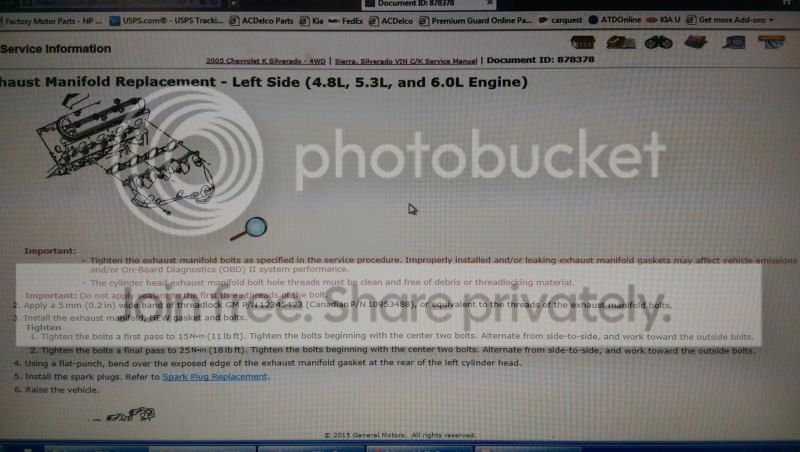
On a 2005 the gm service manual says 11lb ft then a final pass of 18lb ft.

IMAG0426_zpsfjcwp8fe.jpg
 
Thanks again babaganoosh. I guess I'll keep it nice and light and see if it leaks. I can always go tighter later.
 
ALL fasteners have a proper torque, whether notated or not.... factors that change the range are diameter, materials of fasteners and components, thread type, length, etc...

Would changing to a stainless fastener be likely to prevent the "stiction" that always seems to be a problem on exhaust?

I'm sure OEM's don't use stainless unless they absolutely have to, to save money, but if that would likely fix the issue, would make sense for retrofits.
 
sometimes yes.. we run ss on many different marine exhaust components, but not all.. all the ss app's I see are ss studs, with steel nuts... not generally ss bolts...

but it does open up other potential issues too.. dissimilar metals, galling, etc..
 
Top Bottom