

A lot of valid points have been brought up. I'm a Caterpillar mechanic and I'll tell you right from the get-go that the fuel system in a PSD is way more sensitive to the engine oil you use than it is to the fuel. PSD's don't have a fuel injection pump like '02 and older dodges or pre-Duramax GMs. I'd like to see someone get enough life out of a PSD unit injector for the ULSD to have made a difference. If you're concerned about fuel quality, use one of the many quality fuel additives previously mentioned in this thread and be choosy about where you buy your fuel. Also, don't be one of those "I change my fuel filter every 25,000 mile" kind of guys. Fuel filters are cheap. Change yours every oil change.
CK5

You are using an out of date browser. It may not display this or other websites correctly.
You should upgrade or use an alternative browser.
You should upgrade or use an alternative browser.
LSD-The fuel not the drug.
- Thread starter 1-tonmudder
- Start date

1-tonmudder
1/2 ton status
Sorry guy's I have been in and out of town all week and forgot about this.I am refering to ultra low instead of just low sulpher,I should have been more specific from the get go.
I tried just adding some 30W oil to the fuel when I filled up.I put it in one tank and not the other.The engine seems to be quieter and run better on the "doctored" tank of fuel.That conclusion might have just been all in my mind,but that is the way it seemed.
Mine is a 7.3 litre and I do know it is very important to have/use good oil in the engine since oil pressure is so critical.I use Rotella,a quart of Lucas additive,and a factory Ford filter every 5k miles.
It has 334K on it and I'm sure there are others around with that many miles or more on them,but I havent seen them.It will start on the coldest day without either even if I forget to plug it up so I feel it is in pretty good shape and want to keep it that way.
If/when the engine pukes I'll have to fix it since I can't justify buying $30-$50K replacement and using it like I do this one.
I tried just adding some 30W oil to the fuel when I filled up.I put it in one tank and not the other.The engine seems to be quieter and run better on the "doctored" tank of fuel.That conclusion might have just been all in my mind,but that is the way it seemed.
Mine is a 7.3 litre and I do know it is very important to have/use good oil in the engine since oil pressure is so critical.I use Rotella,a quart of Lucas additive,and a factory Ford filter every 5k miles.
It has 334K on it and I'm sure there are others around with that many miles or more on them,but I havent seen them.It will start on the coldest day without either even if I forget to plug it up so I feel it is in pretty good shape and want to keep it that way.
If/when the engine pukes I'll have to fix it since I can't justify buying $30-$50K replacement and using it like I do this one.
Last edited:

just a thought to test your theory as to how adding the engine oil might affect how well your engine runs:1-tonmudder said:Sorry guy's I have been in and out of town all week and forgot about this.I am refering to ultra low instead of just low sulpher,I should have been more specfic from the get go.
I tried just adding some 30W oil to the fuel when I filled up.I put it in one tank and not the other.The engine seems to be quieter and run better on the "doctored" tank of fuel.That conclusion might have just been all in my mind,but that is the way it seemed.
Mine is a 7.3 litre and I do know it is very important to have/use good oil in the engine since oil pressure is so critical.I use Rotella,a quart of Lucas additive,and a factory Ford filter every 5k miles.
It has 334K on it and I'm sure there are others around with that many miles or more on them,but I havent seen them.It will start on the coldest day without either even if I forget to plug it up so I feel it is in pretty good shape and want to keep that way.
If/when the engine pukes I'll have to fix it since I can't justify buying $30-$50K replacement and using it like I do this one.
have someone else pour the oil into one of your fuel tanks on your next fill up. this way you don't know which tank has the oil and then see if you can notice a difference between the tanks and figure out which tank the oil was put into.
1-tonmudder
1/2 ton status
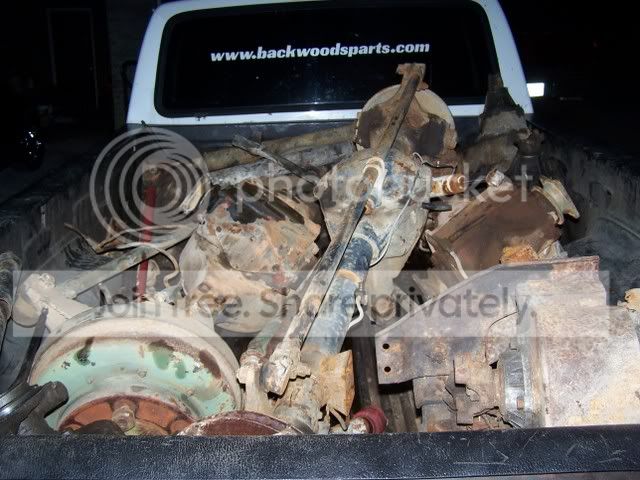
Yeah it's a 96 Sw F350 2wd 4dr.I bought the truck for $3k with 278K on it and almost right away had to put a camshaft sensor on it.Last winter the dualmass flywheel gave it up and I bought a Luk replacemnet.With the exception of those parts and 3 Autozone alt's it has been a good truck. It gets loaded like this prety often.

4by4bygod
1/2 ton status
this is long, but bear with me..
Here's a thread on the NRC's issues with ULSD
http://coloradok5.com/forums/showthread.php?t=202729
Here's a bulletin from the canadian petroleum institute.. you may need to cut and paste into your browser, as it's a PDF.
www.cppi.ca/pdf/ULSD_Q&A_e.pdf
It talks about the need for a lubricity additive with ULSD, how the fuel suppliers ( not the refineries ) would be adding anything ( if at all), the kind of mileage hit you can expect, and implementation timelines..
This document does talk about a lubricity standard being in effect, however, according to the petroleum industry, there had never been a lubricity standard ASTM spec because the SLBOCLE & HFRR tests were considered to be "inaccurate, and of poor precision" for measuring lubricity..
you have to ask yourself, if the tests are the same as they were before, and the fuel has only gotten worse, why would the results now be considered valid when they weren't before? because somebody said they were?
For further reading - This was written before the 2005 "standard".. you guys tell me what changed:
http://www.chevron.com/products/prodserv/fuels/bulletin/diesel/L2_5_3_fs.htm
http://www.chevron.com/products/prodserv/fuels/bulletin/diesel/L2_5_2_fs.htm
here are some excerpts:
"Two laboratory lubricity tests have recently been standardized by ASTM: the Scuffing Load Ball-On-Cylinder Lubricity Evaluator method (SLBOCLE) and the High-Frequency Reciprocating Rig[/i] method (HFRR). These tests are relatively quick, inexpensive, and easy to perform."
"There was general agreement that lubricity is important and that an enhanced value, in some cases, would provide a functional benefit. However, a lubricity requirement for premium diesel was put on hold because the available test methods have poor precision and do not accurately predict performance for all fuel/additive combinations."
"ASTM has not yet included a lubricity specification in D 975 because:
The correlations among results of the two test methods and performance in fuel injection equipment needs further clarification.
In their current form, both tests methods do not properly rank all fuel/additive combinations..
The precision of both test methods is poor."
So, if anyone can point to an improvement in testing, I'm all ears..
And let's not forget that lubricity is not allowed to be a named "feature" of premium fuel,( why not, if it's inherent ) and people still lose injectors, suffer compression loss,and having their filters clog with yeast, fungus and bacteria..
furthermore, they still can't figure out how to make ULSD work in cold weather without using high sulfur kerosene as an antigel.. I posted up some pics of a clogged filter in the diesel forum, discussing this very issue..
http://coloradok5.com/forums/showthread.php?t=199194
As far as the the engine manufacturers or auto industry saying that there are no issues, I take that with a grain of salt.. their job is to sell more cars, trucks, and replacement engines..if they really felt that fuel wasn't an issue, their warranty information wouldn't say that they aren't responsible for damage caused by fuels of inadequate specification.. check out your caterpillar guide to fuels & oils, it's a very interesting read..
bottom line is that fuel specs vary, there's disagreement as far as what specification to measure and how to measure it, and what to do once it's measured, and the refineries and engine manufacturers all point fingers at each other when bad things happen.. and the poor guy with the the truck is at the mercy of everyone else.. that's where I come in..
Here is some info on the issues with ULSD & the lubricity question..DEMON44 said:Would you care to share proof?
Thats something I'd need to see.
Here's a thread on the NRC's issues with ULSD
http://coloradok5.com/forums/showthread.php?t=202729
Here's a bulletin from the canadian petroleum institute.. you may need to cut and paste into your browser, as it's a PDF.
www.cppi.ca/pdf/ULSD_Q&A_e.pdf
It talks about the need for a lubricity additive with ULSD, how the fuel suppliers ( not the refineries ) would be adding anything ( if at all), the kind of mileage hit you can expect, and implementation timelines..
This document does talk about a lubricity standard being in effect, however, according to the petroleum industry, there had never been a lubricity standard ASTM spec because the SLBOCLE & HFRR tests were considered to be "inaccurate, and of poor precision" for measuring lubricity..
you have to ask yourself, if the tests are the same as they were before, and the fuel has only gotten worse, why would the results now be considered valid when they weren't before? because somebody said they were?
For further reading - This was written before the 2005 "standard".. you guys tell me what changed:
http://www.chevron.com/products/prodserv/fuels/bulletin/diesel/L2_5_3_fs.htm
http://www.chevron.com/products/prodserv/fuels/bulletin/diesel/L2_5_2_fs.htm
here are some excerpts:
"Two laboratory lubricity tests have recently been standardized by ASTM: the Scuffing Load Ball-On-Cylinder Lubricity Evaluator method (SLBOCLE) and the High-Frequency Reciprocating Rig[/i] method (HFRR). These tests are relatively quick, inexpensive, and easy to perform."
"There was general agreement that lubricity is important and that an enhanced value, in some cases, would provide a functional benefit. However, a lubricity requirement for premium diesel was put on hold because the available test methods have poor precision and do not accurately predict performance for all fuel/additive combinations."
"ASTM has not yet included a lubricity specification in D 975 because:
The correlations among results of the two test methods and performance in fuel injection equipment needs further clarification.
In their current form, both tests methods do not properly rank all fuel/additive combinations..
The precision of both test methods is poor."
So, if anyone can point to an improvement in testing, I'm all ears..
And let's not forget that lubricity is not allowed to be a named "feature" of premium fuel,( why not, if it's inherent ) and people still lose injectors, suffer compression loss,and having their filters clog with yeast, fungus and bacteria..
furthermore, they still can't figure out how to make ULSD work in cold weather without using high sulfur kerosene as an antigel.. I posted up some pics of a clogged filter in the diesel forum, discussing this very issue..
http://coloradok5.com/forums/showthread.php?t=199194
As far as the the engine manufacturers or auto industry saying that there are no issues, I take that with a grain of salt.. their job is to sell more cars, trucks, and replacement engines..if they really felt that fuel wasn't an issue, their warranty information wouldn't say that they aren't responsible for damage caused by fuels of inadequate specification.. check out your caterpillar guide to fuels & oils, it's a very interesting read..
bottom line is that fuel specs vary, there's disagreement as far as what specification to measure and how to measure it, and what to do once it's measured, and the refineries and engine manufacturers all point fingers at each other when bad things happen.. and the poor guy with the the truck is at the mercy of everyone else.. that's where I come in..
Last edited:
4by4bygod
1/2 ton status
DEMON44 said:4by4god........we've got anywhere from 2 to 9 of these 3512 Generators running on our test pads on any given day. We burn hundreds of gallons of diesel fuel daily. not once has a fuel additive been added, they do not fail. There is no indication of imminent failure either. This is just on our site, never mind the hundreds of gens on our rigs in the field. running flat out all day everyday. Now you talk a good game, and I'm sure you know what you're talking about. But you have to prove it to me. that untreated diesel fuel is hurting our engines.
Demon.. according to dieselnet:
http://www.dieselnet.com/standards/ca/fuel.php
You are presently running 500ppm sulfur fuel in off road applications in Canada.. 15ppm ULSD will be mandated for off road in 2010.. is this wrong?
If you're running 500ppm, you wouldn't see problems associated with a lack of lubricity. Do you know what your refineries are churning out now?
Actually, the oil & gas industry is one of our biggest sectors..
If you haven't already, check out the EnCana information in my vendor thread.. we've proven ourselves with them in texas, ( in CAT 399's, in the gulf of mexico ) where, thanks to the TCEQ, the ULSD & other emissions laws are happening sooner rather than later.. EnCana got involved with us initially for the emissions benefit ( lowering pm & nox at the same time, which nobody else can do ), and since they know we eliminate the lubricity question entirely, they are comfy in the fact we've solved every possible issue, form every concievable angle.
In fact, the EnCana bigwigs have called us "the solution the oil and gas industry has been waiting for".. now if there were no issues,or potential issues, why were they looking for a solution?
anyway, that's just some food for thought.. I appreciate the discussion..

Can Can
Pusher Man
I don't know enough about this topic to add anything. However, the fact that EnCana is publicly supporting the product leads me to believe it's a good thing.
EnCana doesn't fock around.......
EnCana doesn't fock around.......
4by4bygod
1/2 ton status
DEMON44 said:How do you refute information like this........quoted from the Canadian Petrolium Products Institue link?
I don't dispute that there are lubricity standards ( quoted from the canadian petro link ) in effect. The reason I linked the chevron info in my previous post was to show you that the petro industry itself doubts the accuracy of the testing methods cited..
If I may take the discussion a bit further afield, the HFRR / SBOCLE tests only put pressure on the fuel & additive combos, and the idea is to measure the wear scar left behind.. this doesn't take into account the high temps associated with injector pressures and combustion temps.. see, when you push a petro additive through your fuel system, you get carbon build up, increased emissions, etc, etc.. they are good anti gels, but that's really it..
I would prefer the CAT1K test, or the RP503, ( a mirror of the CAT1K that the railroads use to fail additives) where you would run the fuel & additive combo for 250 hours WOT then pull everything apart and see what you had, but that's just me.. Trouble is, Southwest Research charges a gazillion bucks to do that test, and that would eat into the marketing budgets of companies like Lucas or Stanadyne..
Seems the process of adding lubricity factors before retail sale has been proven to work in Europe since the early 90s. Why can it not work here?
see, now this is where it gets interesting.. fuel can be treated at the supplier level, but it can be hit or miss..for example, we work with a BP distributor that supplies the BP ULSD fuel to an underground mine who uses our stuff.. when we met the owner of the fuel place, we watched as he was dosing a tanker with a truck stop type diesel fuel supplement.. he told us that since the refiners can't add anything, he will dose fuel if the customer asks for and pays for the service..so, the suppliers can add stuff, but it shouldn't be assumed that it's always done, or always done with a superior product.
We've had similar discussions with another supplier we work with..
http://www.suncoastresources.com/
There are ACES links on both the title page and the oils & lubricants page.. again, they only add stuff for the customers that ask and pay for the service, and the products specified can vary in cost and effectivness.
it also helps if the fuel supplier plays right..we've had to really sit on the BP guy to make sure that our stuff gets in the fuel for the mine, and since he serves one of my school districts too, I have to make sure that he always gives them ULSD, and not some out of spec fuel he bought off the rack someplace because it was the cheapest.. I already had one fuel supplier tossed out of this district, and I've caught this guy doing that once already.. it's like herding cats, but nobody f**ks with my customers..
Anyway, sorry for the andecdotal ramble there, but I just wanted to illustrate what goes on out there.. everyone who uses fuel needs to be vigilant these days..
I believe there are far more diesel powered road vehicles in Europe than there are in North America. I believe they have advanced deisel technology in their engines as well. useing advanced micropeizo injectors in commonrail injection.
Europe really does have it going on, as far as non - truck diesel use.. I think once perception changes over here, they'll be more prevalent.. as far as advanced technology, they've really concentrated on the emissons side of things..
First of all I just want to clarify that I am by no means trying to put anybody, or their products, down nor am I saying that certain additives may or may not offer any advantages.
I also work for an indepentent company that performs these types of tests, and being independent whether or not one of our clients sells X many vehicles or X gallons of fuel, oil, or additive has absolutely no bearing on myself or our company.
I also deal with the entire spectrum of companies, from the multi-billion dollar industries down so some guy mixing up fuel treatments in his garage, so I have seen them all. The biggest thing is that the small guys simply do not have the funding to perform a lot of the very scientific and controlled testing, so all of their claims are based on the "Joe in his farm truck said he's getting XX better fuel economy now and this used truck lasted longer than his last used truck"....granted this statement is to get my point across, but it's not too far off of some of the claims I've heard.
We have put several hundred thousands of miles on individual engines running ULSD straight from a refinery with no additional additives, and perform regular oil analysis and component inspections, and have yet to find any negative effects of ULSD. We also do other types of fuel economy and performance testing with all types of additives, and again I have yet to see any that made a substantial difference.
I also work for an indepentent company that performs these types of tests, and being independent whether or not one of our clients sells X many vehicles or X gallons of fuel, oil, or additive has absolutely no bearing on myself or our company.
I also deal with the entire spectrum of companies, from the multi-billion dollar industries down so some guy mixing up fuel treatments in his garage, so I have seen them all. The biggest thing is that the small guys simply do not have the funding to perform a lot of the very scientific and controlled testing, so all of their claims are based on the "Joe in his farm truck said he's getting XX better fuel economy now and this used truck lasted longer than his last used truck"....granted this statement is to get my point across, but it's not too far off of some of the claims I've heard.
We have put several hundred thousands of miles on individual engines running ULSD straight from a refinery with no additional additives, and perform regular oil analysis and component inspections, and have yet to find any negative effects of ULSD. We also do other types of fuel economy and performance testing with all types of additives, and again I have yet to see any that made a substantial difference.

Thunder
3/4 ton status
I feel the need to clear up something in this thread in reguard to sulfur being stated as a lubricant in diesel fuel.
Sulfur never was a lubricant in diesel fuel. As sulfur is removed by additional refining, constituents of the fuel that provide lubricating qualities (primarily aromatics) are removed in the process. The lower sulfur doesn't affect lubricity at all, but the additional refining required to achieve the lower sulfur content will remove more lubricating qualities from the fuel that must be restored by fuel additives to meet the ASTM lubricity requirements.
Sulfur never was a lubricant in diesel fuel. As sulfur is removed by additional refining, constituents of the fuel that provide lubricating qualities (primarily aromatics) are removed in the process. The lower sulfur doesn't affect lubricity at all, but the additional refining required to achieve the lower sulfur content will remove more lubricating qualities from the fuel that must be restored by fuel additives to meet the ASTM lubricity requirements.
Very good info! didn't know that!Thunder said:I feel the need to clear up something in this thread in reguard to sulfur being stated as a lubricant in diesel fuel.
Sulfur never was a lubricant in diesel fuel. As sulfur is removed by additional refining, constituents of the fuel that provide lubricating qualities (primarily aromatics) are removed in the process. The lower sulfur doesn't affect lubricity at all, but the additional refining required to achieve the lower sulfur content will remove more lubricating qualities from the fuel that must be restored by fuel additives to meet the ASTM lubricity requirements.
4by4bygod
1/2 ton status
Thunder said:I feel the need to clear up something in this thread in reguard to sulfur being stated as a lubricant in diesel fuel.
Sulfur never was a lubricant in diesel fuel. As sulfur is removed by additional refining, constituents of the fuel that provide lubricating qualities (primarily aromatics) are removed in the process. The lower sulfur doesn't affect lubricity at all, but the additional refining required to achieve the lower sulfur content will remove more lubricating qualities from the fuel that must be restored by fuel additives to meet the ASTM lubricity requirements.
100% correct... I forget to make the distinction sometimes, in the heat of discussion..
Also, I didn't mean to take this thread in the direction of an infomercial, but I thought I should at least give some background so the things I say have some context.. We've all seen what we've seen from our own perspectives, and i appreciate the chance to share mine..
Thunder
3/4 ton status
I just thought I would throw that out for people who needed to know.
The primary problem with ULSD is the loss of Aromatics as I stated. Aromatics are high boiling point oils.
Aromatics keep seals in good condition and lube the pump and injectors. They are hard to break down under high temp/shear factors.
Synthetic oils had this problem when they first came out. Because they were synthetic. They contained no aromatics to keep the seals and gaskets soft. So Syn oils got a bad reputation for use in older engines. Because many older engines leaked oil after switching to syn oil. It is not because the molecules in syn oil are smaller. it is because there was nothing in Syn oils to protect the seals.
Additives have been added to most all quality syn oils now to keep the seals/gaskets from drying and hardening.
I am sure the refinery industry adds similar additives to Good Quality ULSD. To help this problem.
But IMHO it sure doesn't hurt to use a good fuel additive with an older engine not designed for ULSD. A good additive should help to get better fuel mileage too. Because ULSD has less BTU content. Therefor will make less power in older engines designed for older diesel formulations.
The primary problem with ULSD is the loss of Aromatics as I stated. Aromatics are high boiling point oils.
Aromatics keep seals in good condition and lube the pump and injectors. They are hard to break down under high temp/shear factors.
Synthetic oils had this problem when they first came out. Because they were synthetic. They contained no aromatics to keep the seals and gaskets soft. So Syn oils got a bad reputation for use in older engines. Because many older engines leaked oil after switching to syn oil. It is not because the molecules in syn oil are smaller. it is because there was nothing in Syn oils to protect the seals.
Additives have been added to most all quality syn oils now to keep the seals/gaskets from drying and hardening.
I am sure the refinery industry adds similar additives to Good Quality ULSD. To help this problem.
But IMHO it sure doesn't hurt to use a good fuel additive with an older engine not designed for ULSD. A good additive should help to get better fuel mileage too. Because ULSD has less BTU content. Therefor will make less power in older engines designed for older diesel formulations.


