CK5
Register an account today to become a member! Once signed in, you'll be able to participate on this site by adding your own topics and posts, as well as connect with other members.

Math Check? u-joint angles?

ragedracer

1/2 ton status
Joined
Aug 17, 2008
Posts
161
Reaction score
1
Location
Phoenix, AZ
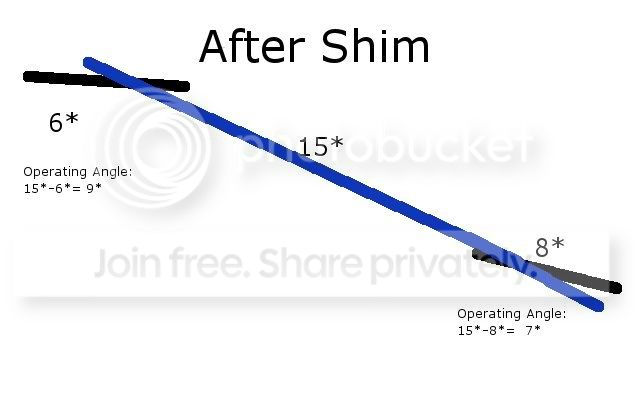
Allright, I'm new at this, and I suck at math, so I wondered if some of you knowledgeable folks can take a look at this and see if it makes sense.. The first drawing is how the axle currently sits. 2nd drawing is my estimation with an 8* shim. What I can't figure out is what the 8* shim will do to the operating angle of the upper u-joint. I know its going to increase it, but by how much? Does anyone have the math skills to figure that out?

Thanks!
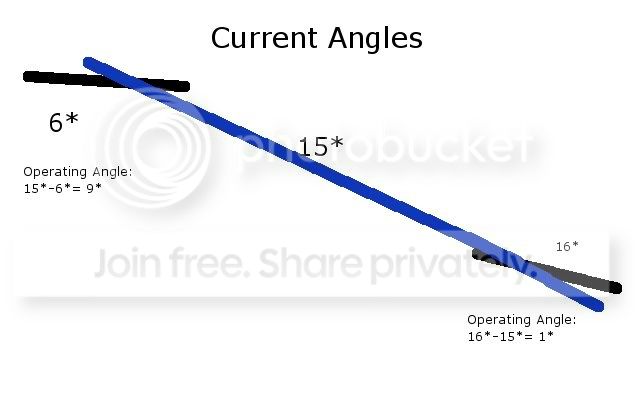
current.jpg


after.jpg
 
Nobody can figure what will happen to the operating angles without all the measurements (d-shaft length, pinion length, etc). If your t-case output is 6*, then your pinion would optimal at about 5* to allow for pinion to rise under torque. From the looks of it, you may not be able to accomplish that without binding the u-joints. Is this on a K5 or SB or what? You may be better off with a SYE and CV rear shaft (that's what I did on my Jeep). Then you could leave the pinion pretty high without any problems. The bonus would be added ground clearance under the pinion.
 
K5. And its an NP208, so the SYE is no fun. I could get a double CV shaft though. It's kinda looking like I'm headed that way. Even the 9* angle on the TC side is pretty out there, and it will just get worse when I shim the pinion. I guess it's time to start saving some $ for one. No matter how much I shim the pinion angle, I'm only going to make the other angle worse and worse. But, without a shim, the 1* angle at rest is pretty perfect for a double CV.
 
you only have a 2 degree difference in angles.that should run just fine the way it is.up to 3 degrees will work but its getting close to having wobble issues at that point.
Right now he seems to have a 10* difference, and he's considering an 8* shim to correct it. Then he would only have a 2* difference. I'm still trying to figure out how the angles came out so bad on this Blazer.:doah: It seems like most guys have nowhere near that kind of an angle discrepency after a shackle flip. I had to shim down about 6* on my K20 to get the vibes out.
 
I can't figure it out either. The angles got excessive fast. I really think I'm going to end up with a CV shaft.
 
I think a 9 or 10 degree shim would be better. Same price either way so may get it right. 10* will put you at 5* pinion and 9* case then account for the 1 or 2 degree wrap under a load and should be good. I think this would be optimum to account for wrap and the possible degree of angle you add at the tcase output. 8* seems right on paper, but it's hard to estimate how much it will change the driveshaft slope.

What are you running for rear suspension?

I ended up with almost this exact problem with an Echobit flip and 7" shackles. I bought 10* shims and took care of it for the most part...soft springs are harder to keep vibe free because of greater pinion wrap under hard acceleration. Mine was vibe free at cruise throttle.

I think you will be ok if you get them within 2 degrees of eachother as long as you keep both operating angles 10* or less.

Or you could cut and reweld the perches. Then you can measure as you rotate the axle and get it perfect :)
 
K5. And its an NP208, so the SYE is no fun.

I hear this from time to time and haven't figured out why people think it's such a PITA...
I've heard of guys using the back half of a dodge 208 but even easier than that would be the "kit" (it's really just one part) from here...

http://www.driveshaftsuperstore.com/drive_shaft_SYE.htm

About half way down they sell a piece of splined shaft with a drive-flange attached so "all" you have to do is drill and tap a hole in the end of the stock shaft, slip this part on and bolt it down... instant NP208 SYE.
 
I can't figure it out either. The angles got excessive fast. I really think I'm going to end up with a CV shaft.

A 4" shackle flip will move the axle forward about 1" and that in turn changes the driveshaft angle and then to add to the mess the pinion also rotates upward when a shackle flip is installed. You should move the axle back at least 1" then start checking pinion angle again.
 
A 4" shackle flip will move the axle forward about 1" and that in turn changes the driveshaft angle and then to add to the mess the pinion also rotates upward when a shackle flip is installed. You should move the axle back at least 1" then start checking pinion angle again.
Then he'd definitely be spending some dough on a new d-shaft, because his old one will be too short. I wasn't buying the 1" shift, so I just mocked it up, and now I really don't buy it. It'd be shifted forward a max of 1/2" (actually about 1/4" using a flat spring profile), which is really not gonna affect much in the d-shaft angles.
My biggest concern is whether his u-joints will bind after he goes to all the trouble of shimming his pinion down to the proper angles. Raged, I really think you should reconsider the SYE route. Once it's done, I think you'll be much more satisfied with the results.
 
Then he'd definitely be spending some dough on a new d-shaft, because his old one will be too short. I wasn't buying the 1" shift, so I just mocked it up, and now I really don't buy it. It'd be shifted forward a max of 1/2" (actually about 1/4" using a flat spring profile), which is really not gonna affect much in the d-shaft angles.
My biggest concern is whether his u-joints will bind after he goes to all the trouble of shimming his pinion down to the proper angles. Raged, I really think you should reconsider the SYE route. Once it's done, I think you'll be much more satisfied with the results.

I know that every situation is different but my shackle flip moved my axle forward 1" (closer to the t-case) and that will make the driveshaft collapse further and in his case with a 208 means that the slip yoke is going further into the t-case and if not careful can bottom out and destroy a t-case.
 
Hmmm, it doesn't look overcompressed to me.:rolleyes: This pic is of his drivelines from his other thread, and it looks like it pulled out a little more than it's old wear marks.
http://coloradok5.com/forums/showthread.php?t=252832

That pic is also of the vehicle sitting on flat ground and not flexed. When he is flexed that slip yoke could easily bottom out in the t-case and ruin a persons day. Like i said, every situation is different but every shackle flip i've seen moves the axle forward close to 1". It is impossible for it not to since the axle is moving in an arch because of the pivot point at the front spring eye when you rotate the rear end of the spring downward.
 
That pic is also of the vehicle sitting on flat ground and not flexed. When he is flexed that slip yoke could easily bottom out in the t-case and ruin a persons day. Like i said, every situation is different but every shackle flip i've seen moves the axle forward close to 1". It is impossible for it not to since the axle is moving in an arch because of the pivot point at the front spring eye when you rotate the rear end of the spring downward.
Hmmm, now let's see, his d-shaft is farther out than stock, and the axle moves BACK as it comes up, since the spring flattens out, so that would mean.....yep, no problem.:waytogo: Add in the fact that shimming his axle is going to pull the sl;ip yoke out even farther, and he may even have it too far out of the tailhousing. I see far more problems with tailhousings breaking due to a combination of steep d-shaft angles (without SYE) and jumping the truck, putting an abrupt force in an upward direction against the housing. And that's funny to see, if it's not your truck.:haha:
 
Hmmm, now let's see, his d-shaft is farther out than stock, and the axle moves BACK as it comes up, since the spring flattens out, so that would mean.....yep, no problem.:waytogo: Add in the fact that shimming his axle is going to pull the sl;ip yoke out even farther, and he may even have it too far out of the tailhousing. I see far more problems with tailhousings breaking due to a combination of steep d-shaft angles (without SYE) and jumping the truck, putting an abrupt force in an upward direction against the housing. And that's funny to see, if it's not your truck.:haha:

I'd have to agree... His d-shaft is probably too short already... mine was after the 6"
 
I see far more problems with tailhousings breaking due to a combination of steep d-shaft angles (without SYE) and jumping the truck, putting an abrupt force in an upward direction against the housing. And that's funny to see, if it's not your truck.:haha:

Been there done that. I grenaded a 208 when I used a little to much throttle on a waterfall. The main cluprit for the breakage though was when the truck came off the ground the rear suspension unloaded fully and bound the ujoints in the shaft. The combination of the bound ujoints exploding, spinning tires hitting earth again, upward force on the driveshaft totally destroyed the driveshaft and tcase. It ripped the tailhousing off the tcase and destroyed the slipyoke & ujoint at the slipyoke. The force from the broken parts locking up the drivetrain even put a noticable bend in the mainshaft of the transfer case.

Since this happened I added a center limit strap to make sure the ujoints won't bind and have tried to stray a litttle more responsible on the throttle. I had just swapped from a carb to FI though and was not used to the throttle response and it got me in trouble. :D
 
Hmmm, now let's see, his d-shaft is farther out than stock, and the axle moves BACK as it comes up, since the spring flattens out, so that would mean.....yep, no problem.:waytogo: Add in the fact that shimming his axle is going to pull the sl;ip yoke out even farther, and he may even have it too far out of the tailhousing. I see far more problems with tailhousings breaking due to a combination of steep d-shaft angles (without SYE) and jumping the truck, putting an abrupt force in an upward direction against the housing. And that's funny to see, if it's not your truck.:haha:


You're correct on this. Also, when I lowered the TC, the slip went right back to where it was before the lift, or pretty close.

I'm getting 10 different answers, which is kinda what I expected, and why I posted. I want to know what everyone thinks.

As one guy said, once I do an SYE, that means custom shafts. Have to buy 2 so I can I have spare. With the stock setup, I can carry a spare for next to nothing.

Its a tradeoff. I'd rather have 5 spares for just the price of the SYE.
 

Latest Posts

Top Bottom