CK5
Register an account today to become a member! Once signed in, you'll be able to participate on this site by adding your own topics and posts, as well as connect with other members.

MIG welding a panel or patch difficulty level

Chief Brody

"Amity Island Welcomes You"
 Premium
GMOTM Winner
Joined
May 18, 2010
Posts
9,606
Reaction score
1,980
Location
Alabama
How hard is it to weld a patch or whole panel without blowing through the metal???

I have been discouraged locally by people telling me to just pay somebody to do it because I will blow through it and ruin it...
 
practice on some 18ga. to get yourself accustomed to it, try tack welds, then short stitches, those are key from what I understand...
 
Not terribly hard once you get the method down. I have a Millermatic 135 (biggest I could get that was 110 volt at the time) and my method is some .023" wire, 75/25 gas and turn the heat up like I'm welding 1/8" steel. sounds crazy, but the idea is to have instant heat when you pull the trigger. With it set that way a half second pull on the trigger puts in a tack weld that penetrates completely before the surrounding steel has a chance to get warm.

I will fit a patch section with say a dozen tacks. Next round I use a sharp flat screwdriver to slightly adjust fitment between panels as I tack it heavier. Once I'm satisfied the panels aren't going to shift any I make another lap getting it tacked every couple of inches, then another lap getting it to every inch, then every half inch.

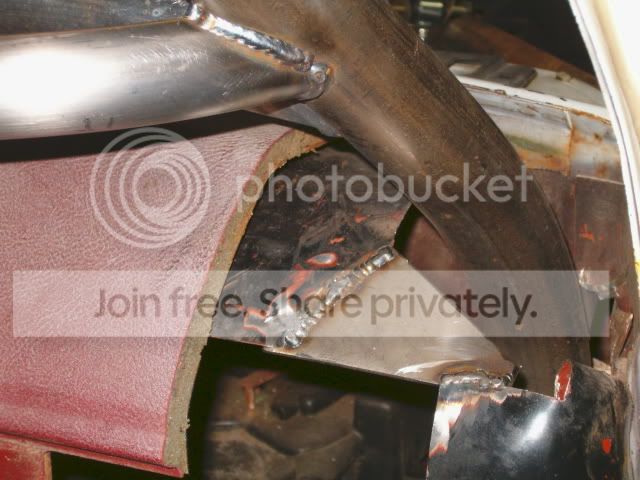
Here is a progress shot.

031.jpg


Same panel repair a little further along...

003.jpg


Rene
 
How hard is it to weld a patch or whole panel without blowing through the metal???

I have been discouraged locally by people telling me to just pay somebody to do it because I will blow through it and ruin it...

I've done it with both self-shielded wire and with gas. The gas makes a much cleaner result and tends to burn through less. I would practice on some scrap like was suggested to get a feel for the power and feed settings that work well.

Sheetmetal requires a pretty consistent gap between the new and old metal. If the gap is too tight, the weld builds on top of the joint and requires too much grinding to flatten out. The extra grinding can also heat up the panel and cause warping. If the gap is too large, it gets tough to let the weld span both sides of the gap.

If you aren't scared away yet, the best way to get good welds without warping the panel is to apply very small tack welds in the gap of the panels in alternating locations so that the panel doesn't heat up too much. Check out some of Greg72's build thread as he has a ton of good pictures of it on the trans tunnel.

Edit: Rene was the other master I attempted to glean info from before I did mine. The higher heat setting he recommends works pretty well from my small amount of experience.
 
if you can reach the back side, a block of brass( I know not everybody has one) held up against the back side helps too. it wont stick to the brass and keeps the metal puddle from going out the back side. I've made a small one by hammering a brass fitting flat before.
 
Aluminum chunks also work as good "dis-similar backing". Copper is really best though.

Rene
 
its really easier than people make it sound, i mean ive welded in two sets of floor pans 4 rocker pannels and 4 cab corners with flux core 90 amp wire feed welder from harbor frieght. its alittle harder with a crappy welder but it will do it.

just take your time and practice practice practice
 
TrustyK5's method is how i did my floor, cab corners, rockers, bed patch and tailgate patch. Take your time cause the metal will warp if it gets hot enough.
 
If I can do it.. you can do it! Im using 030 but I'd like to try .023

really its the rusty thin stuff, once you get it ground down, its way too thin to weld to. Use a bigger cut, get a good fit up, and you should be ok.

I don't have that much experience with welding, Im just a shade tree mechanic. But my mig isn't all that powerful (even though it is a 230v) I keep it pretty darn low. Don't stick it right in the gap. Get it on the thicker new metal to start the pool and just dab it over real fast over the gap. Move and do it again. Keep the heat in the area low., and make sure you have a good ground.
 
I would use a next higher heat setting than what the metal thickness calls for, then just take a quick shot of the trigger, and not try to run a bead, that will set a tack in place...then move an inch or two away, and do it again, and again, and again. Once you have a bunch of tacks in place go back to the first tack and put another one beside it, then an inch away to the 2nd tack, do the same, then the 3rd tack, over and over, until you have run a bead looking bunch of tacks.....the sheetmetal will cool while you keep moving down the line, and keep it from warping with a quick tack.

Ironmaiden373.jpg
 
On a related note, whate guage sheetmetal should be used for body panel patches? I have some rust holes in the top of the bed rail I want to patch up.
 
14-16 for a high exposure point like floor or bed, but probably 18 or even 20 would work for most sheetmetal patches.
 
On a related note, whate guage sheetmetal should be used for body panel patches? I have some rust holes in the top of the bed rail I want to patch up.

16 for most floor areas, and also the ends/pillars. 18-20 for the rest of the box.
 

Latest Posts

Top Bottom