CK5
Register an account today to become a member! Once signed in, you'll be able to participate on this site by adding your own topics and posts, as well as connect with other members.

need set up advice on putting a lift in my shop

jbowman502

Newbie
Joined
Jan 26, 2011
Posts
1
Reaction score
0
Location
Crestwood, KY
hello everyone, thanks in advance for your time. i am at the point in the buildup of my 84 Jimmy where it's time to stop procrastinating about putting a lift in my garage. my cab and frame are sitting on jackstands and i don't feel comfortable installing my lift kit, D60's, engine, or anything else. plus i built the shop with tall ceilings just for a lift so it's time to do it. i've done enough research to know that i can find a nice used 2 post lift with 15K pound capacity for around 2grand on craigslist or ebay. my question has to do with my concrete. i only have a 4" concrete floor that was laid by a company that was contracted by the builder of my house. woulda coulda shoulda, i know....not sure what i was thinking. i would imagine that the concrete is not the highest of quality or the most dense. should i jackhammer up my floor, dig out and fill in deeper concrete footer pads for the base of each lift post or should i weld on wider base plates for each lift post, or am i okay with 4" of concrete? i just can't see how an 18" square base plate bolted to 4" of cheap concrete would keep a full size truck from tipping over and killing someone! thanks again!
 
Find the lift you want and lookup the manual online it will tell tou exactly what you need for a footer. I wouldnt trust that 4" either.
 
Yes! Do reinforce the floor by pouring deeper concrete!

First get a concrete saw and cut a square pattern first. Don't just start breaking it up with a jackhammer. Looks like ****, so get a diamond blade and cut a nice, neat square and then break it up with a sledge hammer. Save your money from the jackhammer rental. A sledge will break it up easily once its cut.

Next after the pieces of concrete are out, dig down with a spade squarely and straight down to the depth of your choice. The deeper the better. No such thing as overkill.

After that, get some rebar and pound them into the hole, deeper into the ground below the footing base. Say you dig a 3' hole, pound rebar about 1' below that, so get some 4' rebar and pound them into the hole until the top of the rebar is about 2" below the shop floor surface. Cut some smaller pieces to tie to the long bars protruding out of the ground. I would put 4 pieces in each hole, at each corner and then tie smaller pieces to each bar in the square shape.

When you get ready for concrete and go to order it, tell them you want 4000 lbs. rated as its the strongest you can get. Rent a vibrator to pack the concrete in all the nooks and crannies when you pour it. It will help in removing air bubbles and pockets but don't vibrate too much as the rocks and stuff in the concrete will settle to the bottom if you do it too long.

Try to make a template for the studs on a piece of cardboard to locate the studs for you to put in after you're done pouring the concrete. This will prevent you from having to drill the hard concrete once its cured. Having your studs put in after you pour will see the lift go up quicker.

I'm sure I've missed some other important tips, so let others chime in.
 
A 15K lb lift will require probably a 6" thick slab at minimum. There is really no reason to buy a lift bigger than 9K lb though and those will work with a 4" slab. I just installed a 9K lb. lift at the shop i'm at and when I drilled the mounting holes the slab was only 4" thick and we've had a Ford crewcab on it with no problems.
 
A 15K lb lift will require probably a 6" thick slab at minimum. There is really no reason to buy a lift bigger than 9K lb though and those will work with a 4" slab. I just installed a 9K lb. lift at the shop i'm at and when I drilled the mounting holes the slab was only 4" thick and we've had a Ford crewcab on it with no problems.

Man, I sure would want a footing under those pads. I just couldn't see trusting some three inch red heads or lag shields into a 4" slab for that.

I would do as Wes mentioned with the saw cut and and rebar cage. Then you could use some 5/8"( or larger) J bolts or stab bolts for easy mounting once the concrete has cured.
 
I was just looking at Rotary Lift's website and most all of the "light duty" lifts recommend 4" concrete and then the larger lifts 5".
 
I've been researching this for close to a year now, depending on the capacity of the lift the minimum thickness of the slab changes. I've seen 6"-18" requirements from several different manufacturers. Maybe a 4" reinforced slab would work, but personally, there is no way I would ever risk being under my truck with that kind of weight concentrated through two posts onto 4" of concrete, IMHO thats asking for trouble. It's called punching shear, and its not as fun as it sounds...

The companies that I have looked at have also stressed that the pad be level, so if you do it yourself get seriously anal about it, for that matter if someone pours and levels for you get seriously anal on them.

I've been looking at the Mohawk lifts and from the stories I've read their policy is they won't even assemble it for warranty purposes until they've checked out the slab, and even then, if they don't like it, they'll require you to tear it up and either have them do it or take your chances again. I think I really like the Company for that reason, probably will go with them in the end.
 
I was just looking at Rotary Lift's website and most all of the "light duty" lifts recommend 4" concrete and then the larger lifts 5".

Does it mention a grade of concrete ?
The grade, not to mention the style of reinforcement will make a huge difference in strength. For example , improperly set wire or even rebar (laid on the bottom of the pour) are as weak as concrete with no reinforcement.
The dealer I used to work at had at least 3 lifts , all 9k's , begin to crack the 6" slab over time, one even began to lean when a heavy vehicle was one it. The problem was low strength slab, and undersized wire laying directly on the sub base (dirt). Granted these lifts were used a lot, and not always properly loaded, plus they were all asymmetrical load styles, which to me seems to put more strain on the mounting area.


Overall I agree with most of what Wes said, the only thing I would do in addition, is depending on what is under the slab, I would consider undermining some of the surrounding floor, maybe a foot under tapering down to your actual excavation, and also using a hammer drill, drilling 2 holes per side of your box and installing 12" pieces of rebar , 6" into the existing slab to act as dowels to tie the new and old together.
Only do the undermining mentioned if you are going to use a vibrator , other wise you will never flow the concrete under the slab properly and end up with air pockets.

Just my .02$ , I am not a finisher, I am a demo guy, so I can tell you all about how, why and what causes concrete to fail. Not to mention, how much easier it is to break out weak, un or under reinforced slabs and walls.
 
If it were me, just for piece of mind, or so I don't have to hear my wife, worry out loud, I think I would find out what the manufacturer recommends then double it. Between my wife and Murphy a bad luck day is a good day! Figured I'd say it since no one else has as of yet.
 
I stand corrected...:waytogo: My guess is, they have done a lot more engineering on the stability of the lift than what my construction experience has taught me.
 
great info on this site for shops and lift in shops. free site and great guys.

also high traffic flow site to.

www.garagejournal.com

and please !!! read up and do it right first. big step to use a lift . 10+ years of it for me. and rotory all 7 lift in the shop i was at no problems.
 
A two post lift with 18" pads WILL NOT "punch" through the concrete. Unless the sub-grade below it is hollow, even then prob not. Worst case scenario is you will start getting cracks developing around the plates.

I am a concrete contractor and have poured several shop floor with lifts. Specs on the floor vary widely with different lifts. However the spec sheets they provide are general, and don't take into consideration what your soil and climate are. So the instructions may be good for one area and overkill for another.

There are MANY factors that should be considered when making the choice on reinforcing or not. Feel free to PM me or I can give you my number and I can talk you through it.
 
I wanted a lift in my garage since day one...but finances ran dry before I got to that point,I still have the rear door opening covered with plywood since I built it in '92,never did get a "real" electrical service put in it either...dont forget you'll probably need 220V to run the lift motor--that alone costs as much as a used lift will in many cases..

After being around many lifts in commercial garages,I would not want a 2 post lift,I dislike them a lot--they not only have more potential for tearing out of the floor,but they often are just plain scary when certain vehicles are on them,and the pads that lift the vehicle can slip easily if your torquing on a bolt hard or prying something into position..

My friend had an 11K lift that had two drive on ramps,it had two 12' lengths of channel iron under it that contained the hydraulic pistons--it was used mostly for wheel alignments,but was excellent for just about any other job--it had a air jack that slid on a carriage between the two ramps ,so you can lift either end of the vehicle up for tire changes,brake jobs,etc,and the open center made for easy access to mufflers and tranny's,and the jack could be used to lift the tranny into position..

I liked that lift a lot,and like an idiot,I balked at taking it when the bussiness was sold off,and the new owner wanted all NEW lifts and eqiupment put in!--another guy grabbed it before I had a chance to make up my mind..I think its still sitting in the weeds right where he left it,at a house he lost to forclosure..bet its scrapped by now..:(...

There was a "mid rise" lift in one bay at that shop too--what a POS,I wouldn't take it as a gift--was best for crushing exhaust systems and bending driveshafts ,you cant get under it since it lifts only 3' high,and there's NO access to the underside of the vehicle..its only good for brake & tire repairs...he also had a "FIAP" two post 6K lift I could have had free too,but he'd had numerous problems with it ,it used an acme thread screw as the lifting device,and twice the bronze "nuts" that bore the brunt of the lift force stripped out,despite faithfull greasing,and it had a motorcycle drive chain under a plate that spanned the 2 posts that would de-rail at the worst possible moment or snap--also had a timing belt drive setup to the motor that had issues too..I passed on it..still regret letting that 4 post lift slip by,I could have installed it on my 4" thick floor with no issues at all,in fact the shop it was in only had 3" of concrete in most of the floor,and they never had any sign of concrete damage,and they put one ton dually utility trucks on it all the time...
 
I have a 10k lift. Will lift my 05 3500 crew cab duramax 4wd truck. Footings are 3' x 5' by 2' deep with #4 bar built and tied as a cage with the J bolts hooked into it. No issues at all.

Saw a truck like mine pull the bolt out of a floor at a dealership. Truck nosed forward as the lift pulled out. Owner got a new front end out of it.
 
I bought mine used for 500.00:D My floor is about 4" and no problems so far. I've lifted my k5 with the cummins, my f150 and my durango with a 7k lift. Someday I will get a 9 or 10k lift but for now mine works great.

HPIM1762.jpg
 
My friend had an 11K lift that had two drive on ramps,it had two 12' lengths of channel iron under it that contained the hydraulic pistons--it was used mostly for wheel alignments,but was excellent for just about any other job--it had a air jack that slid on a carriage between the two ramps ,so you can lift either end of the vehicle up for tire changes,brake jobs,etc,and the open center made for easy access to mufflers and tranny's,and the jack could be used to lift the tranny into position..

I've used both a 4 post lift like that and a 2 post before, and the 4 post would would be my first choice by a wide margin - but I'd take one of each if I could. :whistle:

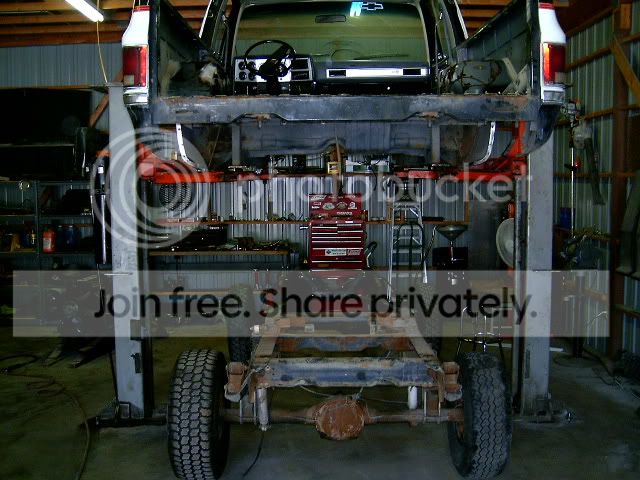
There are some things - like lifting the body off like in sixb's pic - that you can't do on a 4 post.
 
4 post lift dont work good for lifted trucks and huge tires. the jacks on them dont go that high. and installing lift kits and axle swaps and somtimes driveline parts sucks on 4 post lift.

i would take a 12k-15k 2 post anyday.
 
Having experience with both, I say 2 post.

The 4 post hoists are nice for all the work space/shelving you have right on them though.

Ideally I would have one of each.
 
Top Bottom