I disagree with most of the posts so far in this thread, here's why:
Any restriction in the sytem is a loss of efficiency. Most of the efficiency is lost in the design of internal combustion engines but:
Any time you hear a carburetor or throttle body said to flow XXX CFM, that doesn't mean that is the maximum amount of air it can flow. That means that XXX CFM is the amount of air it can flow with a certain pressure drop:
i.e. a 4 barrel carb that flows "750 CFM" can flow 750 CFM of air air through it with a 1.5" Hg pressure differential (2 barrel carbs are generally rated for 3" Hg, which means they flow much less air than their CFM # might indicate compared to 4 barrel carbs).
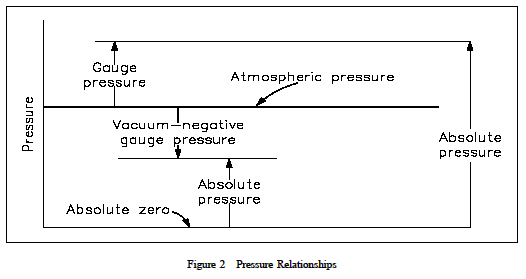
For reference. atmospheric pressure is 29.92" of Hg.
So, since everything is based off of sea level:
A 750 CFM 4 barrel carb will have ~30" Hg pressure on the top side of it and ~28.5" Hg pressure on the bottom side while flowing 750 cubic feet per minute of air through it.
A 750 CFM 2 barrel carb would only flow ~27" Hg @ 750 CFM.
If your intake (stock, restrictive) takes away another 1" of Hg you are losing a few percent of power to the wheels.
I made up the 1" number but most aftermarket companies advertise significantly more than a 4% increase in airflow.
The deal is that everything (air filter, throttle body/carburetor, intake manifold, cylinder head, exhaust manifold/header, exhaust) has an effect on the efficiency of the motor. If the intake flows better, the motor has less vacuum to overcome and becomes more efficient.
Seriously, that's it.
There are plenty of arguments against aftermarket filters (oil messing with sensors, filtering ability, etc.) but most aftermarket filters are much less restrictive than the OEM stuff.



It'll be a first for this forum as far as I know...


 )
)